JOHN HENRY NEWMAN

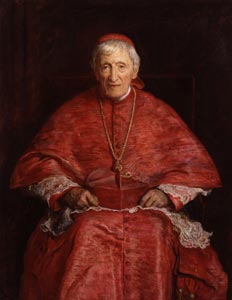
On Sunday 19 September, during the celebration he is due to officiate in the archdiocese of Birmingham, Benedict XVI will proceed to the rite of beatification of the Venerable Cardinal John Henry Newman (1801-1890). Anglican pastor and theologian, Newman was converted to Catholicism and ordained priest in 1848. He then entered the Oratory of St. Philip Neri, and continued to live there to the day of his death. Newman in fact founded the first Oratory in England, at Maryvale; it was later transferred to Birmingham. In an interview with Father Edoardo Aldo Cerrato, Procurator General of the Oratorian Confederation since 1994, SIR questioned him about Newman’s choice of the order founded by St. Philip Neri.What were the reasons that led the newly converted Newman to join the Oratory?
"The institution founded by St. Philip began to exert its fascination on him when Cardinal Nicholas Wiseman persuaded him to receive ordination as priest and suggested to him the Oratory as the form of life best suited to him and to his companions. Sustained by the conviction that he had to live in a community characterized by an acute sense of the culture of and an innate taste for humanism’, Newman arrived in Rome in October 1846 to prepare himself for ordination and already in January 1847 had entered into contact with the Oratory. We have discovered he wrote to Cardinal Luigi Fransoni on 14 February a path intermediate between the religious life and a completely secular life; and this is perfectly adapted to what we feel is our need’. Pope Pius XI’s approval of Newman’s plan for an Oratorian foundation in England came on 21 February. Newman’s writings on the Oratory show the importance that the Oratorian vocation had for him and the profundity with which he lived it. This indebtedness is also shown by the choices he made in his daily life: his request to Leo XIII to be able to remain in his Community in Birmingham even after his nomination as Cardinal, and his wish to be buried in the cemetery of the Fathers at Rednal, in a grave just like any of the others". Did the "kindness" and freedom of spirit of St. Philip Neri inspire this choice?
"Philip Neri was grasped by Newman in his originality as man of ancient times’, in whose person and teachings the primitive form of Christianity, and charity as a way of perfection, were revived: Twelve priests who work together: that’s what I desire. An Oratory is a family and a home’. What fascinated Newman in the founder was the element of kindness’ which seems to me to express Neri’s inner world. It’s a characteristic that was a temperamental gift in the saint but, at the same time, a synthesis of the high values acquired in a strong and yet gentle rapport with the living presence of Christ: a singular freedom of spirit, love for an authentically community life regulated by laws of discretion, respect for each person’s gifts, and a wise simplicity that turned Philip’s joy into a pensive joy’, as Goethe wrote in the journal of his Travels in Italy". What spiritual and cultural "depth" did Newman’s relation with the Oratory have: how did he experience his own vocation as priest and scholar within it?
"The Oratory, said the French theologian Louis Bouyer, was born from the fusion, in St. Philip, between an exceptionally inward spirit and an exceptionally open mind: it is this vocation to which Newman felt himself called and to which he responded with generous dedication and creative fidelity. Remarking on the decisive influence of St. Philip Neri on Newman’s spirituality, Cardinal Jean Honoré went so far as to speak of a third conversion’: Newman, who confessed to love, already in his Anglican period, and who aspired to be ignored, now, in the troubled years of his life as a Catholic, asked of Philip to learn to despise being despised’. The mortification of the rational’ so insistently proposed by Neri is not any rejection of the cultivation of the intelligence, which can be extended to all fields of knowledge, nor of human affections, given how indispensable friendship between the members of the Community is, or even of temporal goods: it is the renunciation of pride".The "absent" Father of Vatican Council II: that’s how he is defined by Paul VI, while John Paul II spoke of the "genius of Newman". What significance can his beatification have? What does his message still have to say to us today?
"I will try to sum it up in a single concept: Fides et ratio’, faith and reason. Newman’s experience is the experience of faith tested and endorsed in the light of reason: the Christian is called to be free but not independent, all the more so in an historical and cultural phase like the present one in which, as Cardinal Bagnasco observed in his presentation of Newman’s Oratorian Writings’, we are witnessing a reversal of categories’ as a result of which personal independence seems more important than truth. This has been taken so far that for culture to have any link with truth, with what is good, with the moral criterion, seems now to be a negative fact’".Fact File
The Confederation of the Oratory of St. Philip Neri has since 1942 brought together the Oratorian Congregations recognized by the Apostolic See over the centuries, beginning with that founded by the Saint himself in Rome and recognized by Gregory XIII in 1575. At the present time there are 82 such Congregations; they are present in various countries of Europe (Italy, France, Spain, Poland, Lithuania, England, Germany, Switzerland, Austria, Holland), in the Americas and in Africa. They comprise over 500 members, to which novices and aspirants should be added. Some thirty Communities in the process of being formed exist in various nations, and plans for the foundation of others have also been hatched. Apart from the secular Oratory, the pastoral activities to which the Communities dedicate themselves include parish ministry, the running of colleges for students, youth apostolate and spiritual assistance in some universities (especially in the USA), the ministry of confessions and spiritual direction.
(08 September 2010)
