EUROPEAN CHURCHES
The CCEE meeting in Edinburgh underlines faith’s role to overcome the crisis

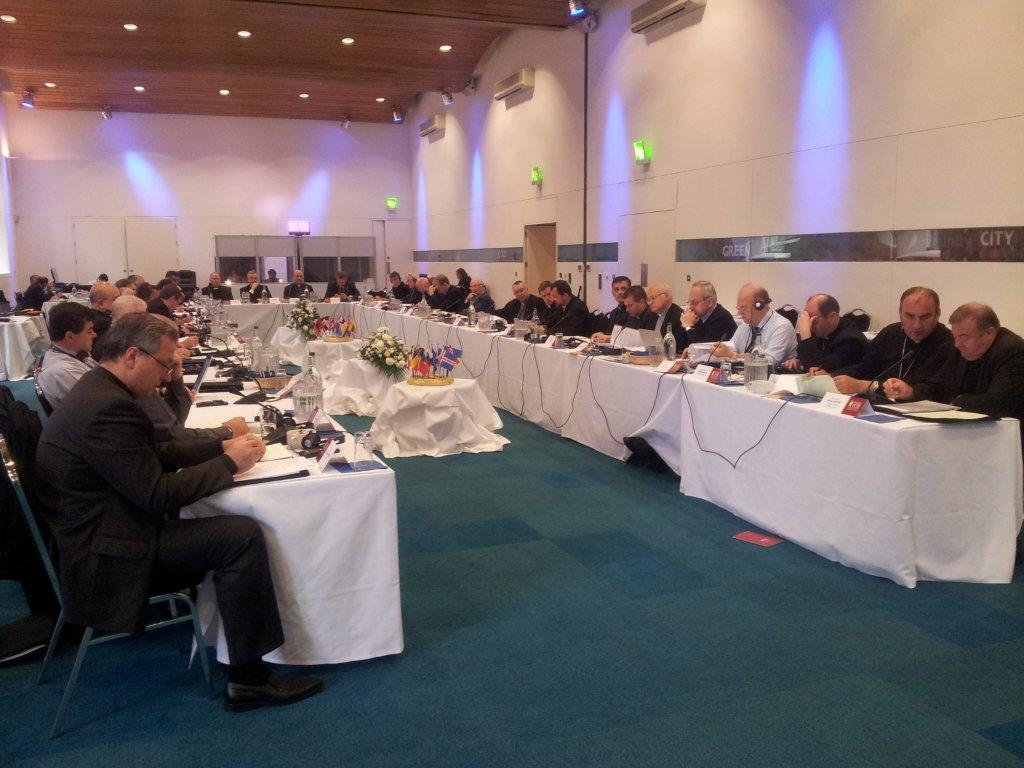
"The future of Europe is also going through a renewed testimony of faith in politics. Human reason enlightened by faith will know how to find the appropriate responses to the current political and economic challenges". The phrase is contained in the final statement of the General Secretaries of 38 European Bishops’ Conferences (CCEE) who convened in Edinburgh (June 29-July 2) for the 40th annual meeting focused on the new evangelization, the role of Christians in public life and on Europe’s need for God. "The new evangelisation is a call to inner renewal of the life of faith for all Catholics. Precisely because of this it has a public dimension, too, which impacts on all the spheres of European society".Intellectual rebirth. "It is possible to see how the trend emerging in many European countries in the areas of politics, culture, legislation and public opinion, tends to confine God to the private sphere. Often one sees subtle forms of limiting the religious freedom of the Churches, if not actually forms of interference by States in the life of the Church. This removal of God from daily life is a loss for the whole of society, especially visible at a time of economic crisis like ours; a time which is marked furthermore by a great thirst for God". In their statement the General Secretaries underline that the Church is called by society itself to be a public voice which recalls that without God human life, both in its personal and communal dimensions, "it cannot be fully realised". One solution, which emerged in the course of the meeting, and which is also an appeal addressed to all the faithful, is that of growing in the "virtue of excellence", especially "intellectual excellence". Bishops and priests, religious and laity, "must grow in their capacity to witness publicly to the faith in today’s world" in tune with the Holy Father’s appeal in proclaiming the Year of Faith, thus beginning the path for a new evanglisation. "To public life affirm the CCEE General Secretaries in the release – the Church brings not just some moral rules necessary for a healthy living in harmony in a pluralist society, but more profoundly brings a rationality for understanding life and also the foundations of ethics and morals. The Church is not suggesting technical solutions to current problems, but is convinced that reason enlightened by faith is able to find the necessary means to restore hope to European society. Salvation does not come from politics, but from God alone, and those who allow themselves to be enlightened by God will bear His light to the world".Solidarity to the US Church. The bishops in Edinburgh jointly conveyed their solidarity to the Bishops’ Conference in the United States "at a time when on the other side of the Atlantic a series of legislative interventions are endangering religious freedom". "When religious freedom is reduced simply to freedom of worship or conscience, and denies the possibility of a public presence of the Christian faith, it is the whole of society which feels the effect. It is a major cause for concern when a State imposes on the Churches practices which are against the very conscience of its faithful". Hence the European Bishops’ Conferences hope that "reasonableness may be the victor in the on-going debate between State and Church in the United States".Financing: a distorted image. During the meeting the bishops addressed a range of themes that included the various financial systems of the Bishops’ Conferences in Europe and ecumenism. The findings of a survey conducted by Dr Erwin Tanner, General Secretary of the Swiss Bishops’ Conference, show that "only minimally do the States support the Bishops’ Conferences. The majority of income comes directly from the faithful. The media often paint a distorted, falsified and often very partial picture of this, putting the Church almost as a privileged institution when the various forms of financing, taken into consideration, clearly reveal economic responses, often not even adequate, to the services requested by society itself, such as, for example, Catholic schools, hospitals or old peoples’ homes, etc". As regards the ecumenical situation, it emerged that "ecumenical dialogue is more fruitful at a local level than an international level; the churches prefer to work together on concrete projects rather than on structures; and finally, bilateral dialogue between the churches is more fruitful than multi-lateral dialogue. In short, the Christian Churches in Euroope feel with greater urgency the move from simple co-operation to the search for real unity". Some time was dedicated to the new English translation of the Missal and Lectionary. At the invitation of the Polish Bishops’ Conference the 2013 meeting will take place in Warsaw from 27-30 June.
