EU
Christofias outlined the priorities of the six-month presidency

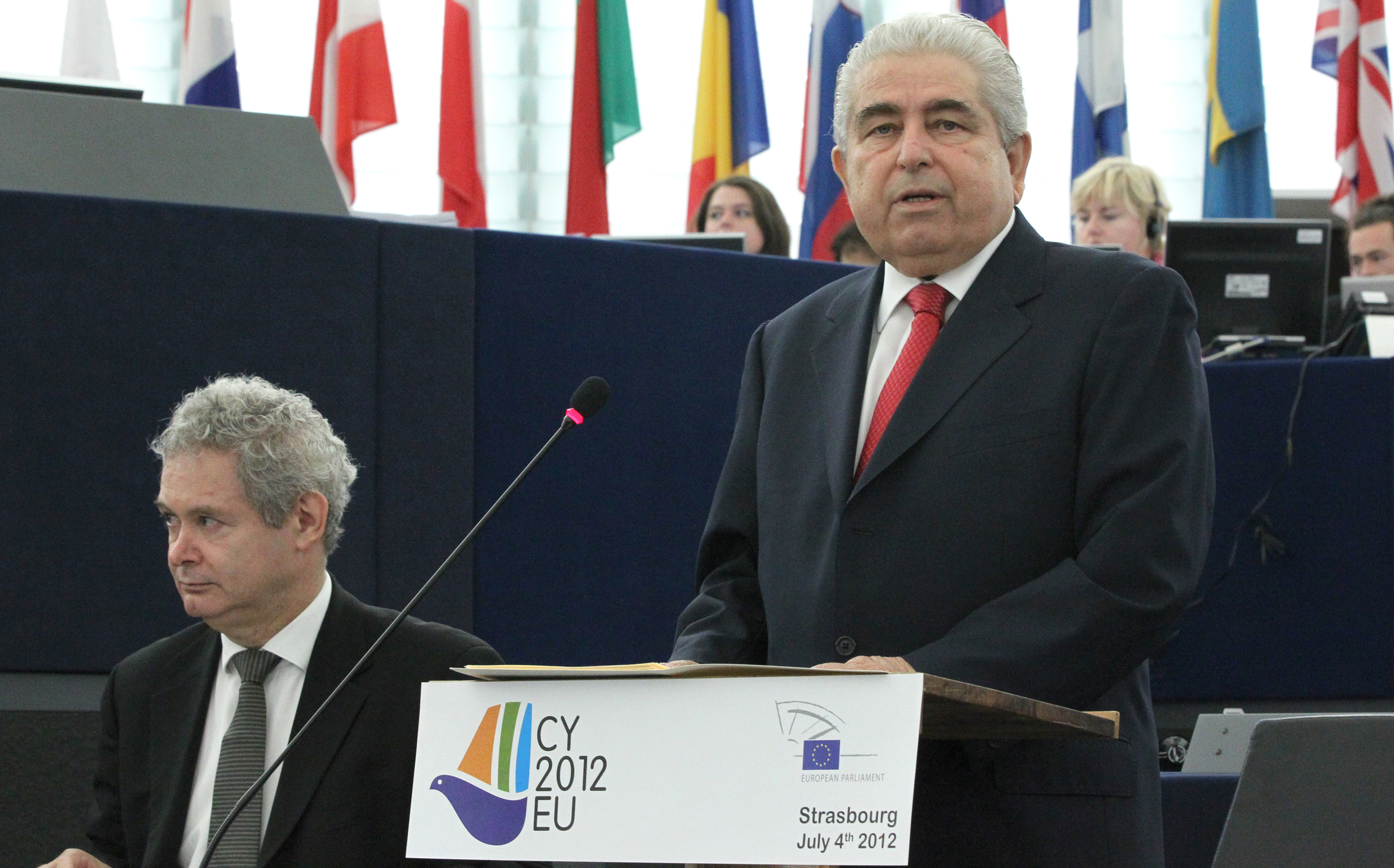
A Europe that is "more efficient and viable"; with more efficient economy, based on growth; a Union that "means more to its citizens" with Solidarity and Social Cohesion; a community of values that is present on the international scenario with the other global players and that is aimed at stepping up relations with its neighbours, starting with the Mediterranean and the Middle East. The President of the Republic of Cyprus Demetris Christofias presented the priorities of the six-month presidency of the Council of the European Union.More solidarity. Before the European Parliament, gathered in plenary sitting on July 4 Christofias delved into economic themes and addressed the political challenges that lie ahead: "We will do our best to work towards a better Europe, closer to citizens, based on social cohesion", on labour, on "solidarity and on security". "The richness produced must be distributed with fairer criteria", reiterated the Greek president. On the background emerged also the problematic relations with Turkey, (candidate to EU adhesion) and the division of the island, half of which is part of the EU and the other part, occupied by 30 thousand Turkish soldiers, is outside the "common home". MEPs’ speeches – that triggered a lively debate in the Strasbourg hall underlined this "unnatural division" with "the last European wall that still divides the capital" Nicosia. Some priorities. Among the most relevant tasks for the presidency that picked the baton from Denmark and passed it at the end of the year to Ireland figure the negotiations for the Multiannual Financial Framework 2014-2020; in this area Cyprus could put a specific emphasis on substantial funds directed to agriculture and rural development and support a strengthening of the fishery. Stability of national budgets and economic growth will still be on the agenda in the coming months. In presenting his program, Christofias brought a sharp reminder of the Europe 2020 strategy for an economy capable of innovating and creating new jobs, oriented, not least, to social inclusion. “The president is committed to continue the efforts to combat child poverty". In his speech in the hemicycle welcomed with a long applause by MEPs- Demetris Christofias stressed the urgency for action regarding the system of asylum and international protection for refugees. Communism and markets. The president continued his communication outside the Parliament with the same moderate tones. Beyond officialdom, the Cypriot leader opened to personal remarks, concerns and hopes. "I hold no grudges against the Turks. And I have often invited the Prime Minister Erdogan to address together, politically, the situation of our island. One thing is certain: I will continue my commitment to overcome the division between north and south, because the island of Cyprus is the home of all Cypriots". Christofias, a Communist, was plied with questions by MEPs and journalists. He calmly replied: "I believe in the freedom of the market, but market impunity is something else, and we’re experiencing its consequences on our economies". "And again: my communism will not be detrimental to the European Union. The Communist who is in me will fight – in the framework of EU rules and institutions and according to Community acquis -, to lead Europe to a greater unity, social-conscious solidarity and justice". "We want to put human beings at the center of our politics, the center of Europe". Thorny issues. Other specific questions on the situation of Cyprus did not perturb the president. Regarding the internal economic situation, Christofias said: “In my country, the crisis has been felt, but we tried to give different answers, so much so that the minimum pension has grown, and on average, wages have remained the same. The public deficit is under control, while the debt is lower than the EU average. The problem of the debt situation of the banks is not the responsibility of the government, if anything, a better control of the central bank was needed, which I had called for, but which did not occur. So we had to ask for help “to Europe. On the considerable loan contracted with Moscow by Nicosia, Christofias said: “We are not tying our hands by asking for Russia’s help. Simply, we are negotiating a loan at more favourable rates than those provided via the European mechanism, and without conditions. We thereby build on the historical ties with Russia, which among other things derive from the common reference to the Christian Orthodox Church". It’s hard, in this case, to fully understand the explanation…
