SURVEY OF IDEAS
Cyprus: a reflection of ”Études” on the situation in the country

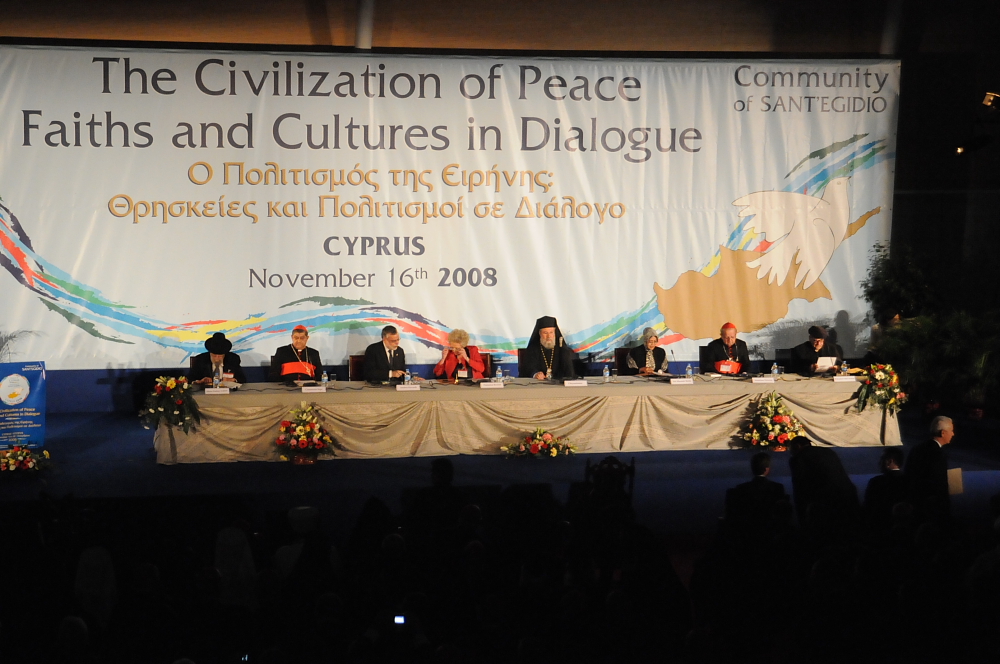
"Although it isn’t effective in conflict management and resolution, artistic creation can still provide a platform for reflection, a shaded understanding of complex political situations. And who knows: one day we could be experiencing a miracle". This is the thesis of Androulia Michaël, maïtre de conférence in Contemporary Art at the Université de Picardie Jules Verne, cofounder of the Chypre culture association (info@chypreculture.org). In the July-August issue of "Études" (www.revue-etudes.com), contemporary cultural review of the Jesuits of France, Professor Michaël drew a portrait of the current situation of Cyprus, which after 38 years of Turkish military occupation, still suffers the division of 36.2% of its territory to the North. On May 1 2004 the Cypriot Republic entered the European Union. On January 1st 2008 it adopted the euro currency. As of July 1st 2012 Cyprus holds the six-month presidency of the EU Council. Militarised area. "The occupied part – explains the author of the article – has remained inaccessible until 2003, when there was a partial opening on presentation of valid passports, as if it were another country. This opening, which could be viewed as normal by those unfamiliar with the situation, fails to highlight the fact that the political problem remains unsolved. On the other side of the country the names of Greek villages are in Turkish, there are huge military areas, and the ghost town of Famagusta, emptied of its people and pillaged after the 1974 bombing has remained uninhabited". "We live in an occupied area where taking pictures – and sometimes even watching! – is forbidden- said Michaël – . "It is under the control of the army that has transformed this part of Cyprus into one of the most militarized areas in the world". Recalling "the omnipresence of flags of both sides", Michaël described the gigantic Turkish banner (425 meters wide and 250 meters high) which dominates mount Pentadaktylos with the slogan of Kemal Atatürk: "What a fortune it is to be Turkish!". "A divided" identity. According to the scholar, "the political and social situation of Cyprus emerges inevitably in the works of artists that provide the opportunity of a shaded and subtle glance, distant from blatancies and clichés". Indeed, artists create "platforms for reflection and multi-disciplinary projects that escape the patterns imposed by politicians". Accordingly, the question of identity is "crucial". Even though it was "invaded many times" in the course of history, "the island has preserved the Greek language and culture, which prevails in 80% of the overall population". However, Professor Michaël underlines, "all Cypriots, regardless of their ethnical origin, can coexist in the respect of mutual differences, sharing the same land". So the problem is not the one that is "often raised by politicians", which reduces the question to an "inter-ethnical problem". Indeed, for a solution "it would be sufficient to ‘create’ a new ‘Cypriot ethnic identity" that could draw "the two communities closer". Failing to understand "contemporary challenges" means "returning to ideas of uniformity instead of accepting and integrating ethic differences within a State whereby diversity is respected". The two communities, the Greek and the Turkish community "can in fact coexist – he insists – and be citizens of the same State".Identity. After having retraced the recent developments of Cypriot art, Michaël remarked that the current "artistic scenario is marked by incredible dynamism; it’s the first time that young artists’ works are showcased in major international museums like the MOMA and Tate Modern (respectively, the Museum of Modern Art of New York, and the section of the Tate Gallery in London – ed.’s note)". "Although it is not effective in conflict management and resolution", the artistic gesture "could be relevant in a complex social and political context" whereby the artist "traces a different cartography, creating an alternative place outside the area, whereby a new thought can thrive and develop". For the scholar, Cyprus "didn’t benefit from the interest of Western artistic scenario, as it happened in the Balkans and in the Middle East". Only recently, notably since its entry in the EU, have we started to witness the birth of a "movement – often spontaneous" meant to relinquish the "cultural paradigm" which the island is a victim of. "For thousands of years Cyprus has been an integrating part of European culture. The entry of Cyprus within European political space – Michaël pointed out – has helped the people of Cyprus not to feel ‘inferior’ and reaffirm their identity". In this horizon Cyprus’ EU presidency "is a momentous time in the history of the island". In the perspective of "a stronger union of all Mediterranean countries – the article concludes – Cyprus could act as mediator and as a privileged bridge, uniting Europe and the Eastern world", while countries would be encouraged "to value what unites them and not what divides them".
