
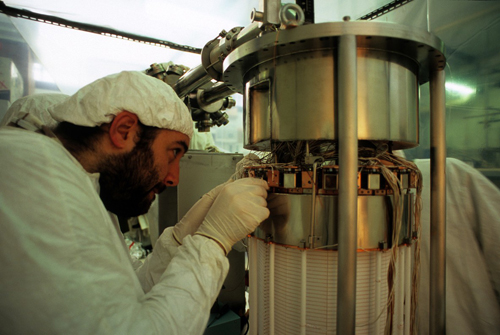
Commission: research and innovation without borders"We cannot continue with a situation where research funding is not always allocated competitively, where positions are not always filled on merit, where researchers can rarely take their grants or have access to research programmes across borders, and where large parts of Europe are not even in the game". These words by Commissioner for Research, Innovation and Science Máire Geoghegan-Quinn are bound to spark a debate in Europe. The statement was released on July 17, commenting on an initiative by the Executive, aimed at removing the obstacles to the single market of research. The Commissioners’ College defines objectives and concrete actions "which Member States should encourage to implement the European Space for Research", namely, "a single market to improve circulation, competition, and cross-border cooperation between researchers, institutions and enterprises". "This will strengthen Member States’ research bases, increase their competitiveness and allow them to work together more effectively to tackle major societal challenges, such as climate change, food and energy security and public health", writes the Executive. To help achieve the European Research Area, the Commission has also signed memorandums of understanding with organisations representing key research organisations and research funding bodies. The European Research Area is planned to be a reality by 2014. The proposal by Geoghegan-Quinn focuses on five key areas: "increased effectiveness of national research systems", "improved trans-national cooperation and competition"; "a more open labour market for researchers"; gender equality and mainstreaming in organisations carrying out and selecting research projects; "optimal circulation and transfer of scientific information". Romania and Bulgaria, warning from the European Union "Romania needs to ensure respect for the rule of law and judicial independence to win back the trust of its partners in the EU". José Manuel Barroso seized the occasion of the six-month report of the Cooperation and Verification Mechanism (CVM) to release worrying comments on the internal situation of the Country. The recent institutional confrontation between the government and the president of the Republic, which led to the suspension of the powers of president Traian Basescu (that will be the object of a national referendum on July 29) doesn’t leave the Commission indifferent. The report under the Cooperation and Verification Mechanism (established on the same day of Bucharest’s EU adhesion January 1st 2007) highlights the commitments made by Romania in the areas of judicial reform and the fight against corruption, necessary for progress towards Community requirements. Barroso added: "the necessary checks and balances in a democratic system must be guaranteed". He said: "While progress has been made on judicial reform and the fight against corruption in the last five years, this progress has been called into question by events in the last month". The president of the Commission said: "Prime Minister Ponta has responded to these concerns and agreed to quickly address them. The Commission will monitor the situation to make sure that these commitments are honoured. Premier Victor Ponta has promised to dissipate these worries soon" and the EU Executive "will monitor the situation to make sure that these commitments are honoured". Also in the report on Bulgaria – made known on July 18 -the various remarks on Sofia also acknowledge its "progress", but a lot still needs to be done in the areas of justice and the fight on corruption. Italy, a portal for the transparency of EU funds "A radical change of pace to communicate with citizens in a transparent and loyal manner": Fabrizio Barca, Italian Minister for territorial cohesion illustrated the purposes of the portal "Opencohesion", that puts online national data on the implementation of cohesion policies of the European Union through community funding. According to Rome’s government, this is the first national portal "on the implementation of investments planned for the 2007-2013 period by regions and central State administration through territorial cohesion resources". The portal contains "data monitored until December 31 2011, corresponding to 467thousand financed projects, 33.4 billion euros of national and European resources, with 35 thousand people involved". The use of resources is analysed for each region, province and municipality of Italy. "Thanks to the portal www.opencoesione.gov.it the funding box is opened:" European Social Fund, European Fund for Regional Development and Development and Cohesion Fund. "The portal prevents the participation requisite from being viewed as mere rhetoric – the Minister said – and it can help us create a 2014-2020 programming that truly responds to citizens’ needs".
