CARD. CARLO MARIA MARTINI
His service to CCEE in the memories of Msgr. Aldo Giordano

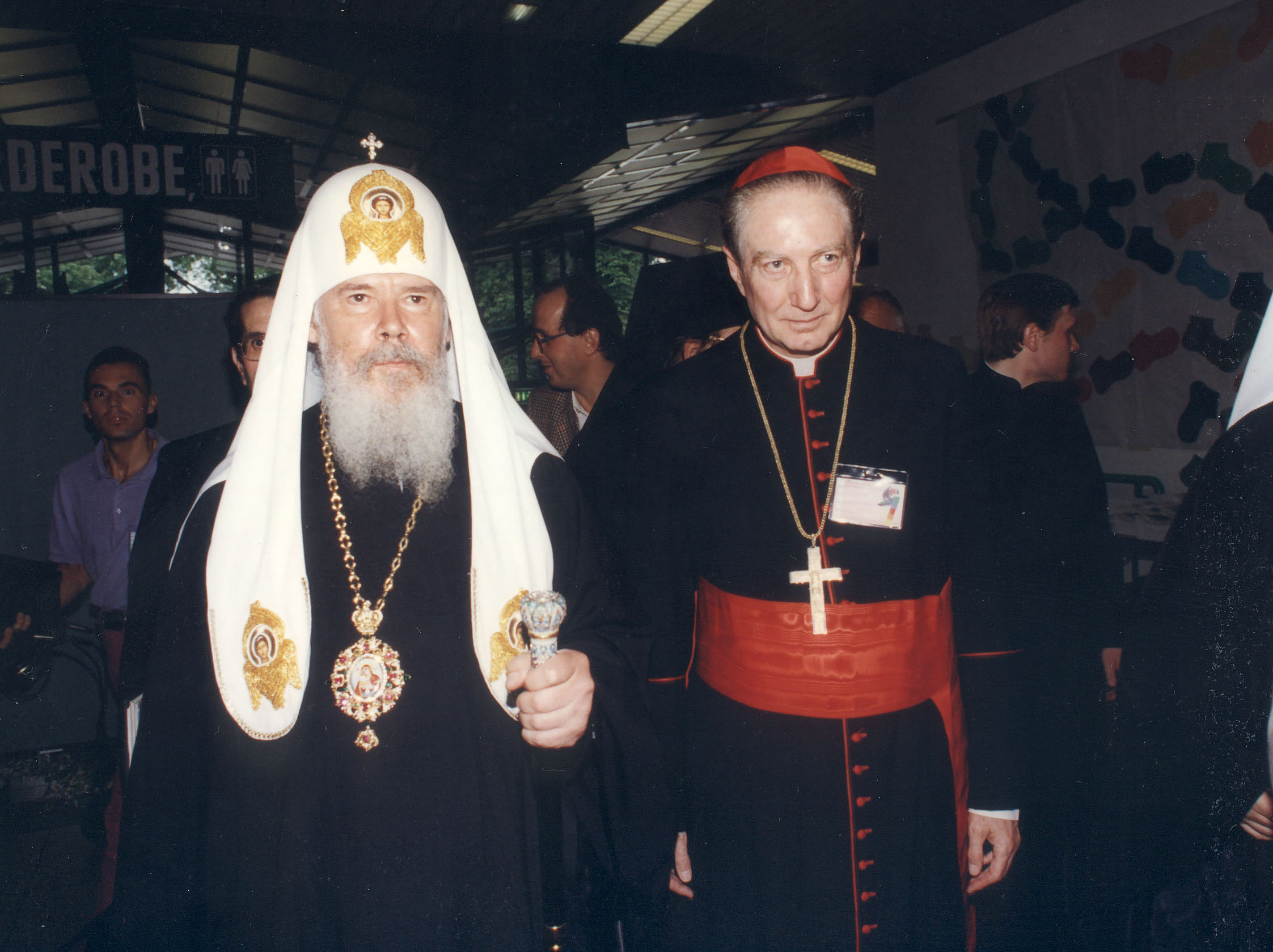
"I have always been impressed by Cardinal Martini’s capacity to re-interpret the events that took place in Europe, along with peoples and individuals’ concerns with the Word of God. It was his most important charisma. With the Scripture he brought light. Europe now has a new intercessor that guards it from the heavens". Msgr. Aldo Giordano, Permanent Observer of the Holy See at the Council of Europe shared his memories of Cardinal Carlo Maria Martini. We asked Msgr. Giordano to draw for us the "European and ecumenical" dimension of the archbishop, president of the Council of the Bishops’ Conferences of Europe (CCEE) from 1986 to 1993. Which European bishops’ events saw Cardinal Martini as protagonist? "When Cardinal Martini served as CCEE President he always had a very busy agenda. Those were the years of Europe’s momentous transformations resulting from the fall of the Berlin Wall in 1989. From April 30 to May 2 1990 the Cardinal presided the first meeting of the bishops of central and Eastern Europe, in Vienna, whose theme was ‘Christ freed us so we could continue being free.’ It was a historical moment. It was a question of deepening mutual understanding, overcoming diffidence and finding new paths for communion and cooperation between those Churches and communities previously forced to lead separate lives. The Balkan tragedy broke out and Cardinal Martini actively sought the roads leading to reconciliation and peace, especially at ecumenical level. The CCEE president had at heart the pastoral themes that deeply involved people’s existence. In 1989 he chaired a symposium of European bishops on a very topical theme: ‘Contemporary approaches towards birth and death.’ He chaired countless European meetings on a wide range of pastoral themes, i.e. catechesis, media, vocations, migrations, interreligious dialogue, role of the laity inside the church… he has always sought cooperation with the bishops’ conferences of other continents, persuaded as he was of the importance of the Church’s "Catholicism". Which ideas did Cardinal Martini bring to the shaping of the New Europe? "I will answer by quoting from Cardinal Martini’s statements on the shaping of the ‘new Europe’, expressed on January 28 2002, in a conference on Europe held at the Bocconi University in Milan. ‘The goal that should be reached in this vast and articulated process is a Europe that will return to breathe with its ‘two lungs’: the lung Eastern culture, tradition and spirituality and the lung of Western culture, traditions and spirituality… we should edify for today and for the future a Europe capable of presenting, interpreting and acting as a ‘family of nations.’, open to the rest of the world and involved in the ongoing globalization process’. The Cardinal also spoke of a ‘Europe of the spirit’ whereby are rediscovered and proposed those values that contributed to its shaping in the course of historical developments: human dignity, the sacred aspect of life, the central role of the family; the importance of education; the freedom of thought, word and profession of one’s own beliefs or religion; the legal protection of individuals and groups; everyone’s cooperation for the common good; work understood as personal and social good; State authority in abidance to law and reason and ‘limited’ by the rights of individuals and peoples. He thus reiterated the need to ‘return, with faithful creativity, to the Christian roots that positively marked European history.’ He said that ‘Undertaking a new, serious proclamation of the Gospel and of the values inscribed within it is the card that should be played, with faith’".Card.Martini has had deeply at heart the ecumenical paths in Europe. Which events do you remember in particular? "With metropolitan Alexi II – who was to become the Patriarch of the Orthodox Church of Moscow and All Russia – Cardinal Martini presided over the first European Ecumenical Assembly, held from May 15-21 1989 in Basel with the theme ‘Peace in Justice’, organized by the Council of European Bishops’ Conferences (CCEE) and by the Conference of European Churches (KEK), the body representing over 120 Churches and communities born of the Reformation, along with Orthodox churches. The Assembly in Basel, attended by 700 official delegates from world countries and Christian traditions was a prophetic sign along the path of the Church and of Europe. After centuries, it was the first time that Churches from European countries convened to delve into their mutual vocation before global contemporary scenarios. Two more European ecumenical assemblies were held: in Graz (Austria), in 1997, and in Sibiu (Romania) in 2007. Patriarch Alexi II and Cardinal Martini were both present in Graz, a token also of their personal friendship. For the progress of ecumenism Cardinal Martini believed in personal relations and in the recovery of the common grounds of the Holy Scripture for unity".
