MESSAGE FROM LEBANON
Msgr. Franceschini (Turkia) on the visit of Benedict XVI

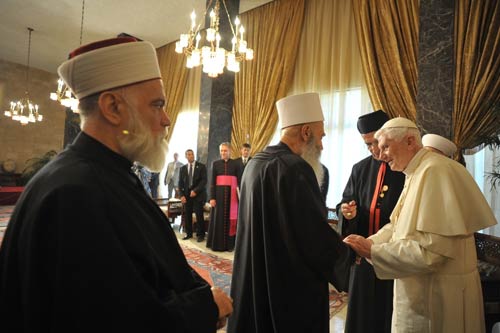
Three intense days of meetings, celebrations, utmost respect, attention and reception for the "passing guest". The visit of Benedict XVI to Lebanon, for the signature and the presentation of the Apostolic Exhortation "Ecclesia in the Middle East", that closed on September 16, left in the Pontiff the "regret" of departure. In his greeting to the national civil and religious authorities Benedict XVI conveyed his appreciation for the warm welcome, adding that the "warmth" shown by Lebanon "can be compared to one of those renowned oriental spices which enriches the taste of food: your warmth and your affection, which make me wish to return". Now begins what can be best described as the most difficult phase, that of "the study and appropriation" of the text "on behalf of the protagonists of the Church, pastors, consecrated persons and lay persons, so that – the Pope said – everyone may find renewed joy in carrying out their mission". This "roadmap for the future" of Christians in the region carries a message of peace that involves the dialogue with the Muslims. Muslims and Christians jointly greeted the Pope in Lebanon, who before his departure said he would go to Lebanon as a messenger of peace, to confirm Christians’ support to interreligious dialogue. The tensions triggered over the past days by the blasphemous film on prophet Mohammed, the violence in Syria, haven’t hindered the mission of Benedict XVI. Daniele Rocchi, for SIR Europe interviewed Msgr. Ruggero Franceschini, archbishop of Smirne, president of the Turkish bishops’ conference, on the Pope’s visit to Lebanon.What has been the most urgent message launched by the Pope during this visit? "In this particular moment the Islamic world needs to understand that Christianity shouldn’t be mistaken with the Western world and that the Church isn’t an enemy of the community of Islamic believers. The Pope’s visit, his addresses, his gestures, were explicit signs in this direction".The Pope went to Lebanon at a tragic time for the region and launched a heartfelt appeal to peace, reiterating Christians’ commitment to this regard… "The Pope entrusted to the Christian Community the task of actively working for the creation of a society whereby peace and respect of other people’s conscience are fundamental goals. The mission of the Christian community in this area is difficult, albeit urgent. When the religious sensitivity of entire peoples is hurt, a disciple of Jesus can only but approve this blasphemous behaviour. In Western society religion is ever more frequently perceived as trivial and supplemental, something ludic. The events caused by the blasphemous film should call upon the West to undertake a serious conscience examination on the way in which is relates to religion. On the other hand, legitimate indignation for the violation of religious sensitivity should shun violent or homicidal behaviours, which are a sin to God, similar to explicit blasphemy".After the consigning of the Exhortation, a period of application and study awaits the Churches. What does the successful impact of the document depend on? "The Apostolic Exhortation, without being abstract, establishes concrete -albeit challenging- goals, which demand the formation of new consciences, new mindsets in the pastors and the faithful. It is a question of being in a true attitude of conversion and listening. Such a path requires a great amount of patience and faith. This doesn’t mean starting from scratch, since many signs of hope can already be seen".Among the objectives indicated by the Exhortation, dialogue with Islam seems to have a special significance…"In our context, such dialogue consists in tearing down the walls of prejudice and closure, which are the result of centuries of hostility. This is carried out in ordinary working days, with humbleness and determination. Also as relates to the reception of migrants, in an area marked by a large number of refugees from countries at war, the Church met the challenge of welcome and support. In this framework, whereby direct evangelization isn’t possible, showing Gospel truth conveyed by being testimonies of Charity is much more effective than words. Thus the Apostolic Exhortation provides concrete guidelines and a precious encouragement".In what way does the Exhortation involve the Turkish Catholic Church? "In our experience, the objectives of intra-ecclesial communion and those of ecumenism are witnessing positive developments. Here the Christian community is so small that often differences give way to sincere and concrete solidarity between Christian communities. The diversity of the liturgical tradition are considered a resource and a richness. The relations with the hierarchies of the other Christian confessions, exception made for the new Protestant sects, are based on profound communion and sharing".
