CCEE
The challenge launched by the bishops, protagonists of the Assembly in Saint Gallen

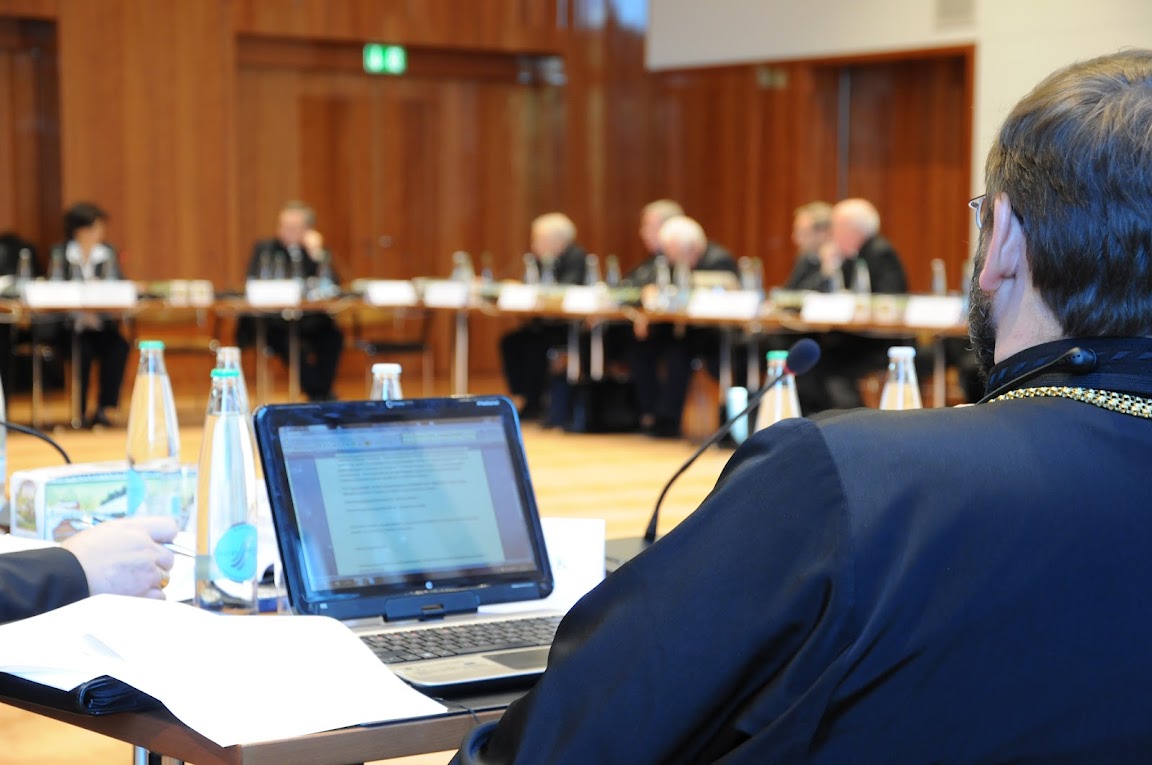
Accepting the challenge of secularization, even transforming it in an opportunity for a renewed, limpid and efficient Christian witness in Europe and across the world. The bishops gathered in St. Gallen for the CCEE Assembly (Council of European Bishops’ Conferences, September 27-30) returned to their respective home countries, after days of intense debates on the situation in the old continent, marked by economic recession and by a deep crisis that has taken on different facets, impacting social fabric, culture, collective and individual behaviours, along with those values that are a historical part of European DNA, such as freedom, tolerance and solidarity.Renewed hope. "Europe is not exempt from the risk of vanity and from the fact of being prisoner of the fascination of newness and infinite progress". We live the "adolescence of the heart that doesn’t allow us to take visionary decisions", said card. Marc Ouellet, prefect of the Congregation for the Bishops, who took part in the CCEE sessions. "Europe – he added – is overwhelmed by a crisis in hope"; "without spiritual motivations it also misses its full realization" on the political and social planes. The Church, in this framework, proclaims that "the only novelty that is not dissipated as fog in the sun is hope"; "not an ephemeral kind of hope but Jesus Christ". Thus the Church is obliged to "ask herself which image of Christ she is transmitting". This open dialogue between the Church and contemporary society triggers deep questions: "We have no magic keys providing the solution to all current problems, which are economic, cultural, ethical and moral", remarked cardinal André Vingt-Trois, archbishop of Paris. "Rather, we should ask ourselves how the new evangelization can support the development of the human person in this renewed", complex, and ever-changing European framework. The prelate underlined: "As the Holy Father said: we must go from a sociological form of Christianity to a Christianity of choices".A conscious faith. On the same line of thought, Card. Jacobus Eijk, Archbishop of Utrecht, remarked: "Today, more than ever before, faith requires a personal choice, a convinced adhesion to Gospel teaching", while the third millennium is characterized by "increasing individualism", which believers are not exempt from, "marked by the tendency to put the individual at the centre", neglecting others and overshadowing the transcendent dimension. Eijk – along with card. Ouellet – underlined the importance of the "challenge of education", which the archbishop of Malines-Bruxelles Msgr. André Leonard, describes as follows: "We should focus on the formation of evangelizers, recovering the importance of well-trained catechists and pastoral workers" within our communities. "We cannot confine the challenge of the new evangelization to intellectuals only". Drawing close to people… Difficulties and obstacles, along with the tasks awaiting the Christian community in Europe, are all put on the table. From the East came the voices of bishops that speak of historically ancient Churches which are also young Churches, flourishing anew after the fall of Communism. Msgr. Mieczyslaw Mokrzycki, archbishop of Lviv, pointed out that after the fall of the Iron Curtain freedom "brought many good things, but it also brought difficulties" linked to "social uncertainty". Many people – Mokrzycki said – have lost their jobs; there are problems such as alcoholism, a high divorce and abortion rates, and a "generalized moral decline". The Year of the Faith, proclaimed by pope Benedict, raises hopes and encourages a renewed commitment by the Ukanian Bishops’ Conference and by all Bishops’ Conferences of Europe. "We wish to draw near our people, help them and instil hope".Roots and destiny. The CCEE plenary carried out a reflection on the progress and obstacles along the path of European integration, the legislative and juridical action of institutions in Brussels and Strasbourg, the widespread phenomena of Christians’ discrimination that affect the continent. Card. Angelo Bagnasco, president of the Italian Bishops’ Conference, CCEE vice-president, delved into the path followed by Europe. Bagnasco identified three challenge in this direction: "Firstly, Europe should recover its soul, i.e., those human and spiritual values that supported the action of the founding fathers", Schuman, De Gasperi and Adenauer. "A Europe that may be a community of destiny, founded on its Christian roots". The second challenge regards a profound cultural elaboration on the principles of freedom, on the one side, and of non-discrimination on the other. The third aspect is political unification, so that it may proceed, in the cardinal’s words – in the direction of a substantial yet light unity, capable of finding a balance" between the Community dimension and "national identities".
