ROBERT SCHUMAN
A year devoted to a lay person who turned politics into a ”road towards sanctity”

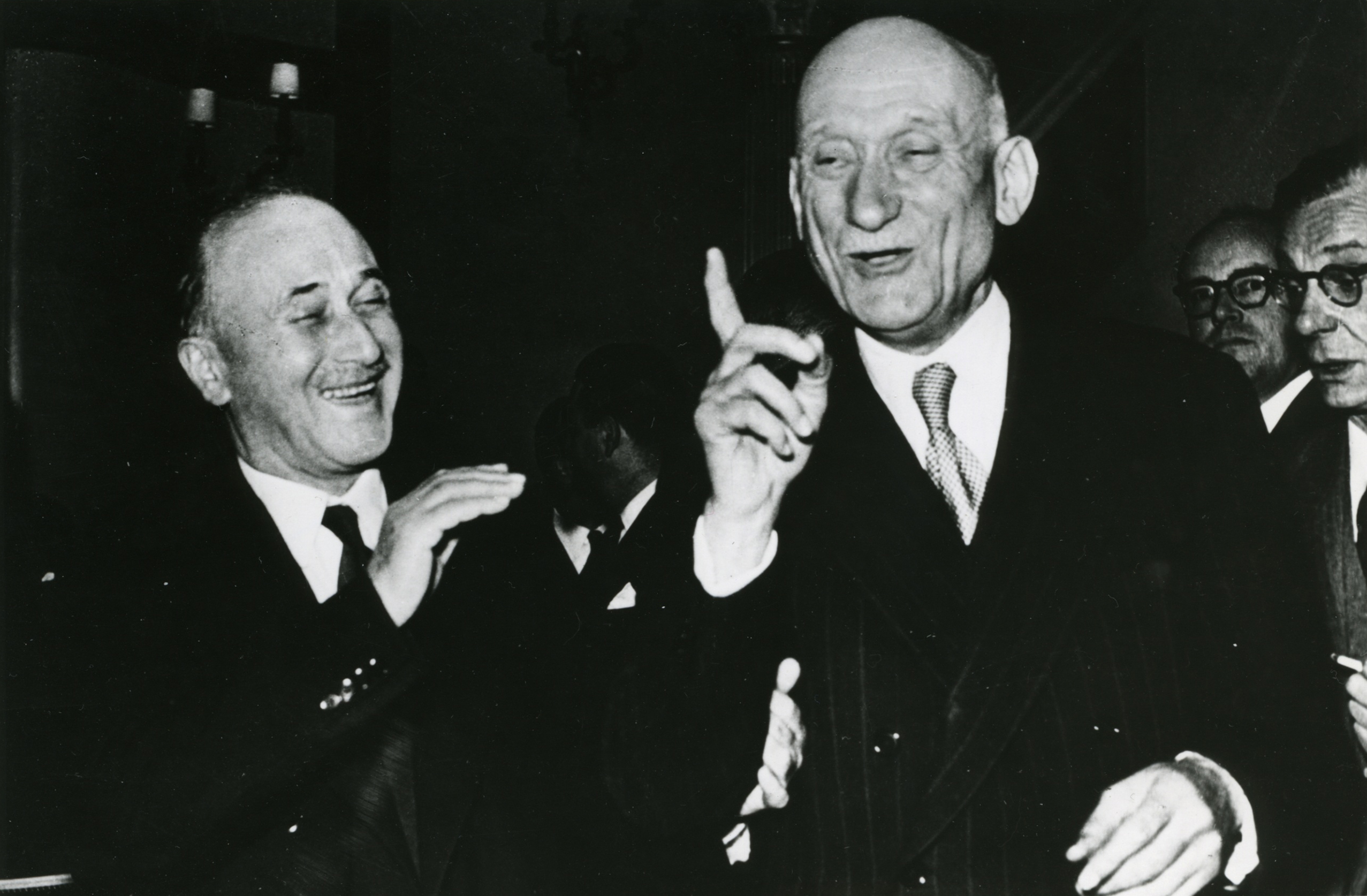
A year under the banner of lay holiness that matures and is shaped with service in the social and political environments: the Saint-Benoît Patron de l’Europe Institute has inaugurated on September 29 the "Robert Schuman Year". The Institute was established to promote the beatification cause of the "father" of Community integration, whose fiftieth "dies natalis" will be celebrated on September 4 2013.Ideals of solidarity and peace. A set of initiatives, celebrations, workshops and moments for reflection will take place with the purpose "of spreading awareness on the figure of this fervent Christian", who stands with Konrad Adenauer (German) and Alcide De Gasperi (Italian), as one of the greatest political personalities which – in the overall complex historical framework of post-war years – drew inspiration from the ideals of peace, solidarity and development so as to "give a soul" to national and international politics. Celebrations in this special year were given the kick-off on September 4, for the 49th anniversary of the death of Schuman, with a Mass celebrated in the chapel of the Soeurs Servants du Coeur de Jésus, in Scy-Chazelles, a city near Metz, where stands the home of the French politician that preserves his memories and archives. On September 29 was celebrated another Eucharist officiated by Msgr. Pierre Raffin, bishop of Metz, in the parish church of the village, to the presence of a large group of German pilgrims belonging to an association n which Schuman had supported as a young man. According to the program, a three-day study and prayer session is scheduled to take place from September 6-8 2013. Evangelical culture and values. Robert Schuman (Luxembourg, 1886 – Scy-Chazelles, Mosella, 1963) exemplifies a traditional but lively Catholic faith, nourished in the family, capable of guiding personal and professional choices, under the banner of the common good and reconciliation (between individuals and between nations). Schuman – whose beatification process is followed by postulator Fr Bernard Ardura, renowned also as president of the Pontifical Committee of historical sciences – embodies with extreme modernity a culture inspired by evangelical values, capable of going beyond particularistic or territorial interests, so as to open up to a greater good: the construction of a polis in which human dignity and the common good rank first. The 1950 "Declaration". Having been raised and having lived in Luxembourg, France and Germany, Schuman, a lawyer, did all the steps of the political ladder, reaching the level of ministerial assignments on the aftermath of the second world conflict. In his capacities as French Foreign minister, with the help of trusted Jean Monnet, on May 9 1950 he released in Paris the famous "Declaration" bound to represent the grounds for the creation of the European Coal and Steel Community (ECSC, 1951), a milestone of the European unification process that continues today, not without problems and delays within EU27. Political will. Inter alia, 2013 will mark the 50th anniversary of the publication of the volume "Pour l’Europe", the only volume signed by Schuman, of which it contains a sort of "political will" on the European building with strong Christian foundations. It states: "Democracy owes its existence to Christianity. It was born the day that man was called to realise in this temporary life, the dignity of each human person, in his individual liberty in the respect of the rights of each one and through the practice of brotherly love to all. Never before Christ had such ideas been formulated". It continues: Democracy is above all not something made quickly; Europe has taken more than a thousand years of Christianity to fashion it".From history to topical events. But the proposal of the "Robert Schuman Year" takes on a contemporary connotation especially since, as explained by the Institut Saint-Benoît, the figure of the precursor of unity beyond national borders, shows that politics can be a way leading to sanctity for Christian laity, following the teaching of the Second Vatican Council, of which next October recurs the 50th anniversary. Non only: "Schuman’s life shows that political action is compatible with faithfulness to moral values, compliant with an authentic Christian life. In this sense the "father of Europe", who passed away when the works of the Council began a second phase, after the death of John XXII and under the new guide of Paul VI, can be included in the long list of Christians who were able to anticipate some of the successive acquisitions of the ecumenical assembly.
