EUROPE AND SYNOD
European bishops’ speeches in the Synod hall (3)

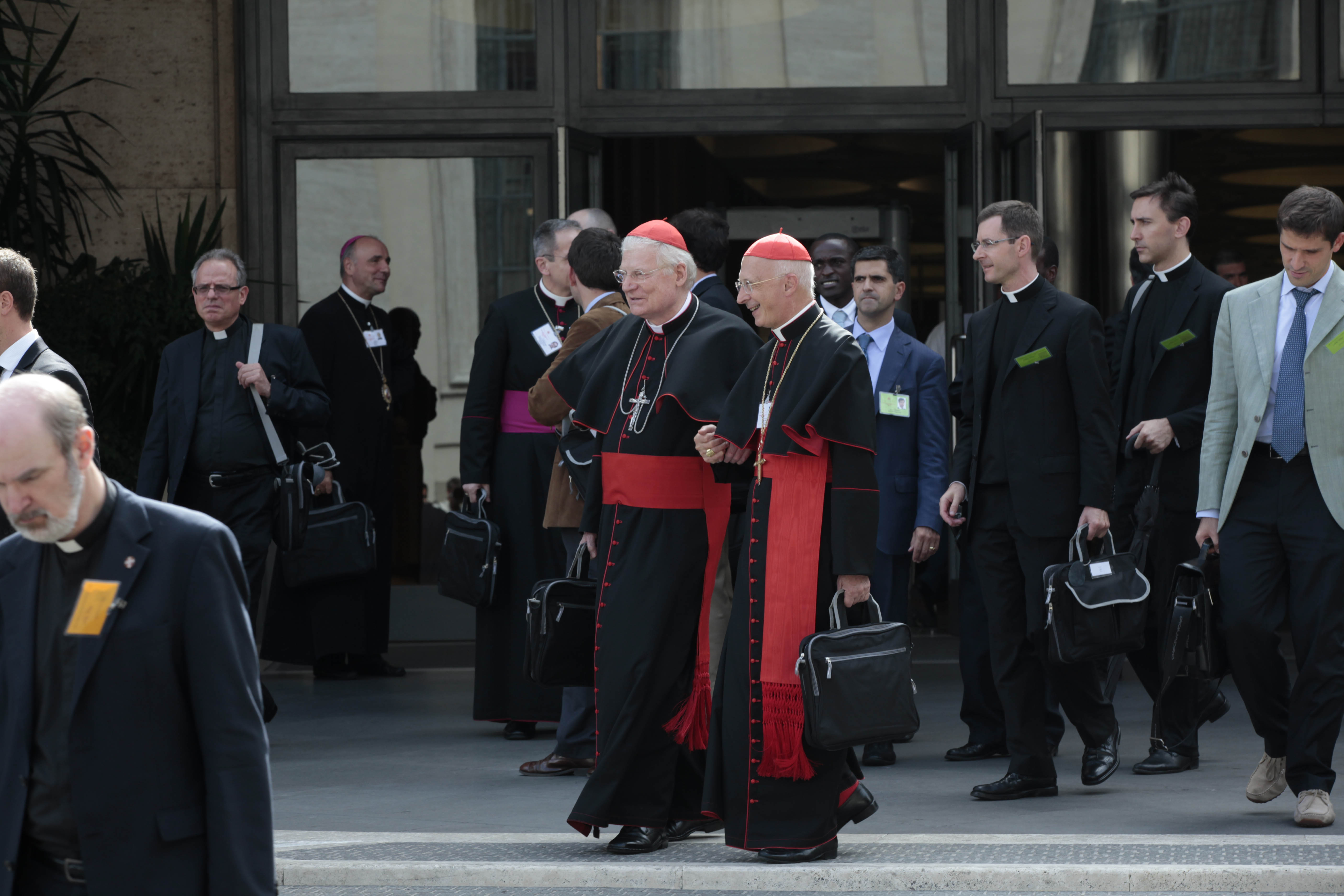
Faith, culture, languages; family, parish, laity; liturgy and sense of sin: these eare some of the themes addressed on October 16 by the European Synod fathers during the Synod on the new evangelization, ongoing until October 28 in the Vatican. Faith, science and culture. We are living "in a time of great opportunities to proclaim our faith also in the dialogue with natural sciences", said Cardinal Péter Erdö, archbishop of Esztergom and Budapest, president of the Council of the Bishops’ Conferences of Europe. According to the prelate, "the current scientific vision of the world offers a wide-ranging prospect. If we try to imagine the universe, our imagination opens towards God, towards his immense reality", and "natural sciences, physics, astronomy" raise "the question on the beginning and the end of the universe", while "there are researchers who are open to accept the existence of a transcendent God". Msgr. Ägidius Johann Zsifkovics, bishop of Eisenstadt (Austria), tackled "the problems between Christian reason and technological research". He added: "Only a deep, comprehensive, universal understanding of the person of Jesus, of how He carries onto Himself the soul of the modern man", will "prevent" "individualistic vision" thus creating "a new lifestyle", and a "new Christian culture, capable of permeating and modifying the temporal order". The Gospel, language and the human person. For cardinal Angelo Bagnasco, archbishop of Genova and president of the Italian Bishops’ Conference, "while it’s evident that certain cultural tendencies are contrary to the Gospel, it’s also true that on the side of the Gospel we find the human person". Contemporary culture, for instance, "demonizes the category of ‘limit’, understood as the denial of individual freedom and vital thrust". However, he cautioned, "the experience of limit – which is both ontological, moral, affective and psychological – is a great ally of the Gospel, as it states that man needs others, and above all, he needs the Other, that is God". Msgr. Diarmuid Martin, archbishop of Dublin (Ireland) guarded against the risks of the "manipulation of language", to which are most exposed the youth "who live in a culture of relativism and authentic trivialization of reality, often without being aware of it". A culture which "they have not created", but within which "they must find Christ" given their poor knowledge of faith". Family, parish, the laity. "The primary place of initiation should be the family, despite all the difficulties and the weaknesses it experiences today", remarked cardinal Kazimierz Nycz, archbishop of Warszawa (Poland), but it "necessitates the help of the parish, of movements and communities". "Adopting a more missionary style in its presence in the social fabric" is what is demanded of the parish by Msgr. Stanislav Lipovek, bishop of Celje (Slovenia), referring to the national pastoral document "Come and see", drawn up for the Year of the Faith. Parish and laity: Msgr. Felix Gmür, bishop of Basel (Switzerland), invites to "enhance the evangelizing action" and to "recognize the skills" of the latter. Perhaps through an "ecclesial mandate that may give them a mission" to be carried out as "baptized" persons. Msgr. Kieran O’Reilly, bishop of Killaloe (Ireland), highlighted "the significant role" of women, "central figures" for the spread of the Gospel in working environments, "in schools, in the families and in the health environment. Mgrs. Mario Grech, bishop of Gozo (Malta) underlined: "The Church will continue proclaiming the Gospel of marriage", but it’s necessary "to be present" in the life of "many de facto or divorced and remarried couples that wish to continue their journey of faith within the Church". For Msgr. Grech, these couples expect from the Synod "an enlightening word such as that pronounced by the Holy Father in Milan". Liturgy, martyrs and sense of sin. Msgr. Franz-Peter Tebatrz-Van Elst, bishop of Limburg (Germany), addressed the importance of liturgy, which far from being "a creative frenzy" is a "catechetical school" which brings "the community of the baptized to the second conversion, namely, to a new evangelization". Msgr. Cristoforo Palmieri, bishop of Rrëshen (Albania), said he hopes that "The teachings of Vatican II, which after 50 years since its celebration will be given to us in Albanian", may make us "more familiar also with the word of the Church". "Our society needs a long path of healing". "Our hope" is based "first of all in the participation of our martyrs", as recognized by Msgr. Joseph Wertz, bishop of Transfiguration in Novosibirsk (Russian Federation). For Msgr. Everardus Johannes de Jong, titular bishop of Cariana, auxiliary and general vicar of Roermond (The Netherlands), "our problem is not a visible enemy but the invisible spirits of evil". Hence it is important to "promote the prayer to angels and archangels" and to reawaken the sense of sin.
