ROBERT SCHUMAN
Interview with father Ardura, postulator of the beatification cause

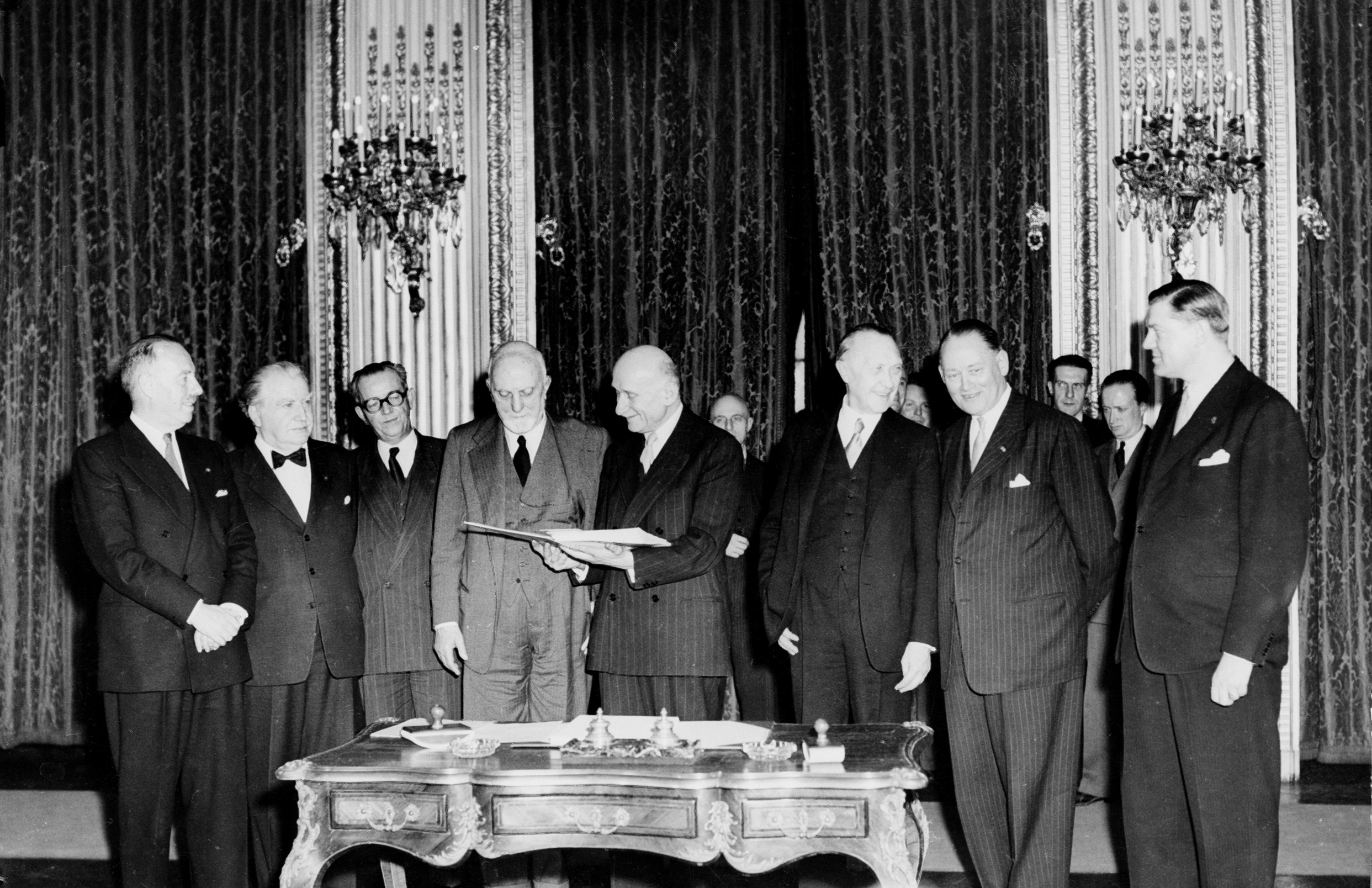
"His Christian inspiration, nourished by the Gospel, made him a coherent, capable and modern politician". Father Bernard Ardura described the figure of Robert Schuman (1886-1963), one of the "fathers of Europe" with passion and with historical rigor. SIR Europe interviewed him in his twofold role as president of the Pontifical Committee of historical Sciences and Postulator of the Beatification cause of Schuman, to whom we owe the famous Declaration of May 9 1950, considered the cornerstone of Community integration. In view of the commemorations for the 50th anniversary of his death, the Institut Saint-Benoît – set up in support of his beatification cause – proclaimed a "Schuman Year", ongoing until September 2013. Schuman’s life is marked by "europeanism". Which are its main features? "Robert Schuman was born in Luxembourg at the end of the nineteenth century. His father transmitted him his German nationality. Most of his professional and political engagement took place in France, where he lived until the last days of his life – in Scy-Chazelles, not far from Metz – in 1963. He spoke fluent French, German and Luxembourgish. He felt at ease within French and German culture alike. It can be said that he was destined to go beyond the borders. He was a true citizen of Europe, a faithful Catholic citizen. Since he was a child, his family raised him to the experience of faith, which he lived with special intensity. His faith wasn’t overstated, instead he lived it at a very profound leve. As an adolescent he read the Bible and studied Thomas d’Acquinas. He sought silence and prayer, and attended Mass every day, even in times of busy political activity". Thus this intense spirituality didn’t lead him to distance himself from his political commitment…"On the contrary, His faith guided him to devote his efforts for the common good. Probably as a young man Robert Schuman has considered the priesthood. But he later chose laicity, profession, service in the political field. He didn’t marry, in order to fully dedicate himself to this diakonia. In his biography figure also difficult moments: his parents’ early death, the imprisonment in Germany during World War II, the flight from the lager, his clandestinity. At the end of the war his political activity resumed, which he had begun at a young age, along with government assignments. In this passage a fundamental feature is enhanced, which is set to become a universal message; the coherence between his professed faith and his life". Schuman is best remembered, among other things, for the Declaration of 1950, which lay the grounds of the European Coal and Steel Community (ECSC, 1951), the first cornerstone of European integration. What is the significance of this moment in his life?"The Declaration is a culmination of a long reflection on Europe and on peace. Prepared with Jean Monnet – another father of Europe, with German statesman Adenauer, and De Gasperi -, it was conceived to stop the vicious cycle of wars, from 1870 until 1945, which opposed Germany and France, causing deaths and tragedy across the continent. Schuman – then French Foreign Minister – understood that we needed to go beyond the spirit of revenge and hatred passing through the French-German border and that it was necessary, after the World War, for Germany to get back into the European fold. The path chosen was the management of common concrete interests, just as coal and steel, the raw materials of the defense industry. Concrete interests eventually lead, in the vision of Schuman and Monnet, to a closer sharing of the economy and this would require real political integration. But the great aim of the Declaration, and therefore of Schuman, is peace". It is a very topical message. Is it not? "Indeed it is. European Community, in the eyes of Schuman, required renouncing certain aspects of national sovereignty for a greater good. I believe this is what is happening on the economic and monetary as well as on the political planes. Uniting the forces and the interests at the time was the only way to create a consortium of nations, which continue to share common historical, cultural elements, and notably, a set of moral values. A unity in diversity… For Schuman Europe was an inspiring idea, which is exemplified in his recurring appeal to ‘give a soul to Europe’, which is a message marked by specific topical relevance. The European Union must be realistic, concrete, but it needs moral and cultural common values: peace, solidarity, service for the common good, honesty…". How is Schuman’s beatification process proceeding? "The cause of beatification to some extent can be defined as ‘easy’ in the sense that Schuman was a man and a politician who did not have detractors and numerous testimonies on his clear and deep faith have been collected at diocesan level. But it can also be said that it is ‘difficult’, in the sense that he left no writings of spirituality or texts focused on some aspect of the life of faith. The only book that he authored, entitled ‘Pour l’Europe’, is a kind of political will. Moreover, we must always consider this ability of Robert Schuman to embody the Word and Christian virtues in everyday life. Therein lies his great Christian message".
