JEWS-CATHOLICS
Card. Kurt Koch on the validity of ”Nostra Aetate” and the Lefebvrian question

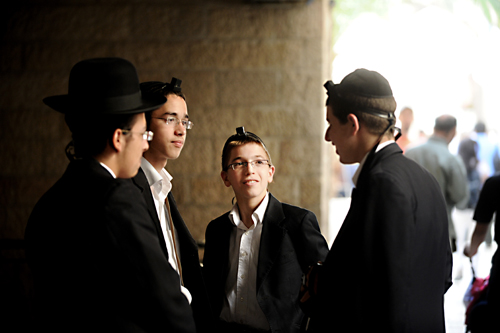
"The Holy Father has entrusted me with presenting the question in the most appropriate way to the Jews; "Nostra Aetate’ is in no way being called into question by Church Magisterium, as the Pope himself has reiterated many times in his speeches, his writings and has shown in his personal gestures towards Judaism. The rapprochement with the Fraternity of Saint Pius X doesn’t mean that the positions of the said Fraternity are in any way accepted or endorsed". The Lefebvrian question is the core issue addressed by cardinal Kurt Koch, president of the Pontifical Council for the promotion of Christian unity, speaking a few days ago at the Plenary of the Commission for Religious Relations with the Jews, held at the Vatican October 28-30. This is the first time (after the meetings of 1982 and 2005) that the Commission organizes a plenary bringing together in Rome the consultants and delegates of Bishops’ conferences, tasked with the relations with the Jews. Among the issues tackled during the meeting figure a balance of the dialogue processes under way, an overview of local initiatives, the possibilities of introducing a "Day of Judaism" at the level of the single Bishops’ Conferences and the celebration of the 50th anniversary of ‘Nostra Aetate’, due to take place October 28 2015. The possibility of the readmission of the Fraternity of Saint Pius X. In the prolusion -released November 6 – card. Kurt Koch, chair of the Vatican Commission for religious relations with Judaism, devotes the first paragraph to the "Lefebrvrian question" to clarify doubts and false interpretations triggered by the "possibility of the readmission of the priestly Fraternity Saint Pius X in the Roman Catholic Church". His Eminence reaffirms that the Council document Nostra Aetate is and remains "the founding document" and "the indispensable compass of all efforts aimed at the promotion of Jewish-Catholic dialogue". The Cardinal said: "the question of the importance and the validity of the Council Declaration "Nostra Aetate" has been raised, and not only by the Jews. The Jews feared that through a possible act of readmission of priests and faithful with anti-Judaic tendencies, who strongly reject ‘Nostra Aetate’, the Catholic Church would give a new direction to the dialogue with Judaism, or that the importance of the Council document for the entire Church would be relativized". Also "on the part of the Catholics – adds Cardinal Koch – sometimes there were those" for whom "Nostra Aetate" is part of the "Declarations" of minor importance, that could be considered less binding compared to other documents. But that is not the case, since "as relates to the content" no Council document can be separated or confronted". Instead, they should be "seen and considered seriously in their interrelationship". "Nostra Aetate" and the Jews. "Nostra Aetate" recalls "the deep bond that unites spiritually the people of the New Alliance to the descent of Abraham". "It decisively decries all forms of contempt, debasement and hatreds directed against the Jews, while it underlines the Jewish roots of Christianity. Notably, the Council document refutes the accusation of ‘deicide’ addressed against the Jewish people in various places in the course of the centuries". In the fight against all forms of anti-Semitism "the Jews continue being comforted by the hope that the Catholic Church is a reliable ally in combating all forms of anti-Semitism, which has not been uprooted in the present world".Benedict XVI and the Jews. Cardinal Koch expressed his gratitude for the efforts of dialogue undertaken by Benedict XVI "since the beginning of his pontificate" in order to "step up relations with the Jews. On this – reiterates the cardinal – there can be no doubt". Recalling the highlights in the "friendship" between the Pope and the Jews, the Cardinal states: "We can state with gratitude that no other Pope in history has visited so many synagogues as Benedict XVI". Also the dialogue undertaken with the "International Jewish Committee on Interreligious Consultations" (IJCIC) and the Great Rabbinate of Israel have contributed to the interweaving of relations in the course of the past 40 years, so that "the traditional clash has turned into fruitful cooperation, while bellicosity has been replaced by the ability to the positive handling of conflicts, and coexistence has turned into solid friendship. The ties of friendship established in this period have proved to be resistant, so that it has been possible to jointly address also controversial themes, thus preventing long-lasting difficulties to the dialogue process".
