COMECE
November’s issue of Europe Infos on the EU, research, education

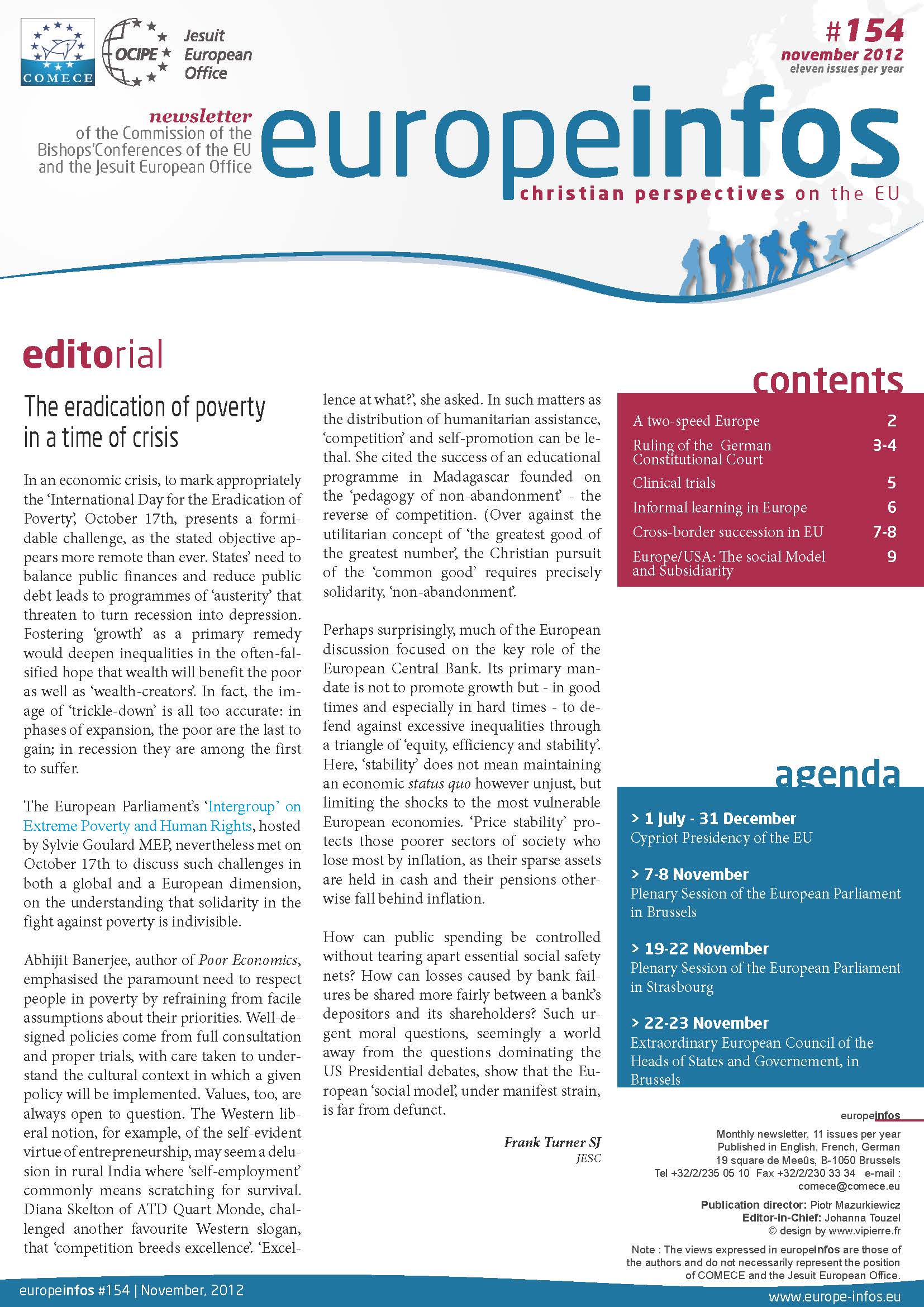
November’s issue of COMECE’s monthly magazine addresses a manifold issues ranging from an analysis of the institutional developments linked to the judgment in Karlsruhe and the October European Council, to regulations on pharmaceutical trials aimed at relaunching research, to formal and non-formal learning. An in-depth article addresses the complexities of cross-border succession, while the final contribution presents the electoral campaign of the US vice-presidential candidate that draws inspiration from the European social model and subsidiarity. The editorial by Jesuit Fr Frank Turner is titled "The eradication of poverty in a time of crisis".A two speed Europe. There is "an increasingly obvious split in the European Union between the 17 Eurozone countries and the 10 countries that are not (or not yet) participating in monetary union". "Maintaining a two-speed Europe in a common institutional framework", for Stefan Lunte, is the great challenge for the European Union in the next decade. The tensions causes by the crisis in Greece, and the difficulties experienced by the population in Spain and Portugal saw respite with June’s decisions – the measures for growth and the creation of a banking union, the announcement that the European Stability Mechanism (ESM) would intervene directly in bank bailouts and thus relieve national budgets – and with September’s ECB interventions. Conversely, October’s European Council "has shown that European investments for growth and employment, announced so resolutely last summer, are only being implemented very slowly". October’s debate regarded the creation of a European authority called to supervise 6000 European banks (elections in Germany condition the timing of this decision), while a special meeting to discuss a new EU multiannual financial framework 2014-2020 is scheduled for late November. But there is a risk of an ever-deeper divide. Here, writes Lunte, "by highlighting the common and unifying heritage of the vast majority of European citizens rooted in the Christian image of humanity and emphasising their similar lifestyles, the Church in Europe can help ensure that the centrifugal forces will not gain the upper hand".Clinical trials. On 17 July last, the European Commission published its Proposal for a Regulation of the European Parliament and of the Council on clinical trials on medicinal products for human use, set to replace the controversial 2001 Directive. According to the proposal, explains José Ramos-Ascensão these "investigations of medicines in humans where the medicines are applied outside normal clinical practice on the basis of a research protocol" must guarantee that they are conducted only if the rights, safety and well-being of the subjects of the trials are protected and if the data generated in the trial are going to be "reliable and robust". The Proposal, which is more binding than a directive, is designed to "limit differing transpositions and applications of the Directive (in the Member States)" which have "contributed to a decrease of 25% in clinical trials conducted in the EU in the period 2007 to 2011, while there has been a soaring devolving of clinical trials to the so-called BRIC countries (Brazil, Russia, India, China)". The model adopted is the one of a simplified authorization procedure for assessment of the application by all Member States concerned, facilitating multinational clinical trials in Europe, supported by the introduction of IT infrastructures (a portal and a data bank). This would enable to save 800 million euros per year. Positive aspects include the protection of subjects of clinical trials in less developed countries. The Secretariat of COMECE will continue to follow the process for the adoption of the Proposal, due to come into force in 2016. Formal and non-formal learning. "Youth on the move" is a flagship initiative of the European Commission in the framework of the "Europe 2020" strategy to meet the demands of the labour market for new key skills and as a way of improving career opportunities for young people. The Commission has announced a proposal for the validation of non-formal and informal learning, inviting Member States "to make it possible, by 2015, for all citizens to obtain validation of skills which they have acquired outside the formal education system" writes Christina Gerlach. The Proposal is addressed to the young and to the unemployed population. "National systems are to be set up to validate non-formal and informal learning", to avert the risk of annulling the specificities of informal learning. The competent Ministers will take a decision on the Commission’s proposal at their next meeting at the end of November, while Member States are tasked with implementing the initiative.
