SLOVAKIA
The heritage of Cyril and Methodius in the Country’s Constitution

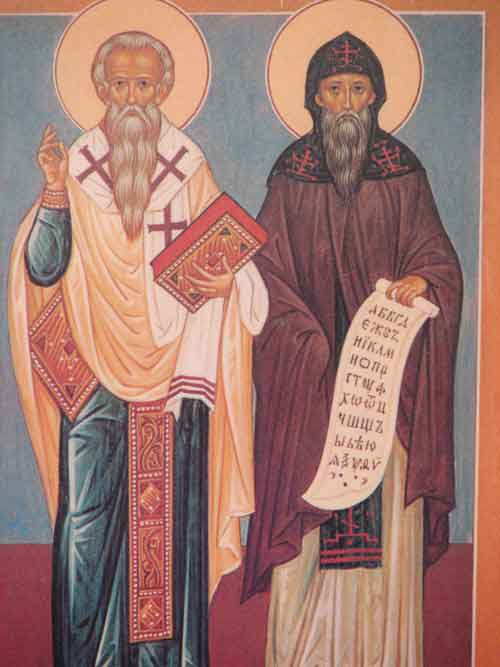
"Cyrilo-Methodian cultural heritage and its significance in regard to the Constitution of the Slovak republic" was the title of a lecture of cardinal Jozef Tomko, prefect emeritus of the Congregation for Evangelization of Peoples, delivered at the premises of the Ministry of Foreign Affairs and European Matters of Slovakia in Bratislava on 21 November. It was inspired by the Jubilee Year of Ss. Cyril and Methodius, commemorating the 1150th anniversary of their arrival to the region of Great Moravia.Heralds of the Gospel. "We are witnesses of their apotheosis", said cardinal Tomko, focusing on the fact that the Catholic Church has not only paid a great deal of attention to the "apostles to the Slavs" in the last two centuries but has also spread the veneration towards them all over the world. Even the Preamble of the Constitution of Slovakia speaks about "political and cultural heritage of the predecessors" and "Cyrilo-Methodian cultural heritage". During the last 40 years, three popes issued four documents about works of the Thessalonian brothers, with encyclical "Slavorum apostoli" by blessed John Paul II standing out among them. He introduces both saints as "heralds of the Gospel", "true predecessors of ecumenism", and emphasizes a "peaceful way in which they built up the Church, guided as they were by their vision of the Church as one, holy and universal". In their evangelizing mission in the regions inhabited by the Slavs we can see a model of "inculturation". As written by John Paul II, "all cultures of the Slav peoples owe for their beginning and development to the efforts of the Thessalonian brothers". The first Slavic pope pointed to their contribution to building of Europe, not only in regard to its Christian identity, but also to its "civil and cultural unity".Advancement of democracy. Cardinal Tomko also focused on the pastoral letter issued by Slovak bishops on the occasion of the beginning of the Jubilee Year of Ss. Cyril and Methodius in July this year. He pointed to the fact that Slovakia witnesses not only a "debate" about the significance of the Christian values within the society, but a real "battle" on this field. "Church wants to raise a healthy young generation", affims the Bishops’ conference. "That’s why it refuses any attempt of obtrusion in a form of unacceptable way of education, not leading to healthy and stable family and not building firm characters and personalities". Church points to real values, like protection of life from its conception until natural death, true sense of human life and its dignity. Religious freedom – including the freedom of conscience – has always been a criteria of the "advancement of democracy". The society must not force a man to act against his conscience. It’s a heavy damage to dignity of a man. "Let’s not allow that pseudo-values under the mask of freedom and democracy root in our life", appeals cardinal Tomko. Thus, the "Cyrilo-Methodian spiritual heritage" still remains actual. "Situation in the world, Europe and also in Slovakia forces us to realize real values of our life", continues cardinal Tomko.Spiritual heritage in the Constitution. The last chapter of the speech of the prefect emeritus of the Congregation for Evangelization of Peoples was dedicated to the Cyrilo-Methodian heritage in regard to the Constitution of the Slovak republic. He spoke about the significance of its Preamble and the sense of the words about the "Cyrilo-Methodian spiritual heritage" stated in it. In the cited statement, the Constitution acknowledges the existence of traditional religious and cultural values bound to the works of Ss. Cyril and Methodius. In fact, it indirectly accepts the truth that the mission of the Thessalonian brothers was of religious character. It was primarily inspired by the aim to convert our predecessors to Christian faith and after coming to the region of Great Moravia in 863 they achieved a great success thanks to implementation of an Old Slavic language to liturgy and education of native priests. "It’s agains historical reality to say that so-called byzantine mission was a political matter in its base", affirms cardinal Tomko. Cyril and Methodius prepared for their mission by translation of the Gospel, they found a school for education of priests. All those activities had religious and cultural character and that was the essence of their mission. Those who prepared the Constitution of the Slovak republic on behalf of the nation wanted it to be inspired by the "spiritual quality of the Cyrilo-Methodian heritage and high moral standards. That’s why the Preamble shouldn’t be understood only as a decorative expression. It has its importance and should become an orientation principle of implementation of the legislation in the life of the society", concludes cardinal Tomko.
