THE FAMILY IN EUROPE
Conference in Slovakia on the contribution to society

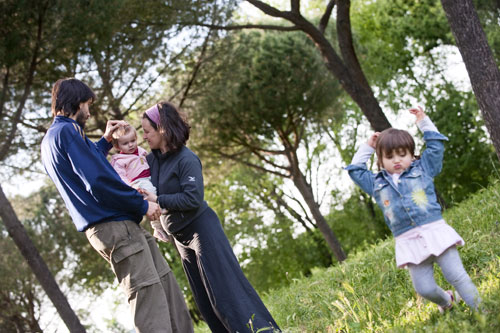
The representatives of nine European countries gathered at an international conference "Family to society, society to family" held on 30 November – 1 December in Castá Papiernicka, Slovakia. The event, organized by the Committee of the National Council of Slovakia and the Slovak Society for the Family, was the first of several regional conferences due to be held in the frame of preparation for the 20th anniversary of the International Year of Family.Solidarity between generations. Experts from Slovakia and abroad spoke about various topics concerning a relation between the family and the society, including demography, intergenerational solidarity, family policy, media in education, legislation and its impact on family and marriage, formation of children and youth, or unpaid work of mothers. Renáta Kaczmarska from the Division for Social Policy and Development, Department of Economic and Social Affairs of the United Nations, pointed to the results of Eurobarometer surveys indicating that only 27% of EU citizens overall believe that their national government is doing a good job in promoting a better relationship between the young and old. Eastern Europeans have been particularly strong in criticising the performance of their government in this respect. According to Kaczmarska, investing in intergenerational relations requires concrete actions. "For instance, national mechanisms could be created to review polities and practices through an intergenerational lens, making sure that they are designed so that all generations are viewed and engaged as resources to families, communities and each other. It is also important to improve or initiate supports and services for family care providers, strengthen maternity leave policies and financial supports. Grandparents should be recognized as both care providers and care recipients", explains Kaczmarska. External and internal order. Gregor Hochreiter from the Austrian Institute for Applied Economy and Western Christian Philosophy offered a lecture on how a modern economic life influences the family and the solidarity between generations. "The economy is subservient to concerns of health, and both are subservient to the salvation of the soul", affirms Hochreiter and explains that the current challenge is twofold: "First, our economic institutions have to be adapted to the needs of the families and the society as a whole, to the common good. This is the external order. But as much as it influences the inner order of man, it is also dependent on it". Finally, he reminds of the words of pope Benedict XVI who said that "without the healing of souls, without the healing of a man from within there can be no salvation for humanity".General welfare and personal happiness. "Without family there is no effective rearing of children, without proper rearing there is no personality, without personality there is no consciousness of freedom. That’s why the family belongs at the center of all socially oriented politics", affirmed Jürgen Liminski from the German Institute for Demography, Social Matters and Family who focused on element of happiness in his speech. According to his words, "the family, which naturally trains for love and virtues, with fostering of early emotions as the architects of our brains, this institution guarantees the common good, the general welfare and the personal happiness".Unpaid work of mothers at home. A major part of the meeting was filled with information on family policy, demographic situation and solidarity among generations in Hungary, Czech republic or Lithuania. President of the Slovak Society for the Family, Anna Záborská, mentioned concrete efforts aiming to the improvement of the social policy in Slovakia: "We ask the government and the Committee for Social Matters to elaborate a study on contribution of invisible unpaid work of mothers at home to the growth of GDP. Because this indicator – as it doesn’t show in any statistics – is not taken as something that is beneficial for the society. That’s why we suggest that a concrete study is prepared on contribution of mothers or fathers who take care of the family at home".Declaration of the Moscow Demographic Summit. The conference culminated by an official joining to the signatories of the declaration of the Moscow Demographic Summit 2011, which says that "natural family is an essential condition of survival and sustainable development for all nations and states, a basic and integral condition of demographic prosperity". The document appeals to governments of all nations and international institutions to elaborate a pro-family demographic policy, to approve special international pro-family strategy and action plan focused on "consolidation of family and marriage, protecting human life from conception until natural death, which would ensure a growth of birthrate and turn-off a threat of depopulation".
