CIPRUS
The history of the island in-between Eastern and the Western Europe

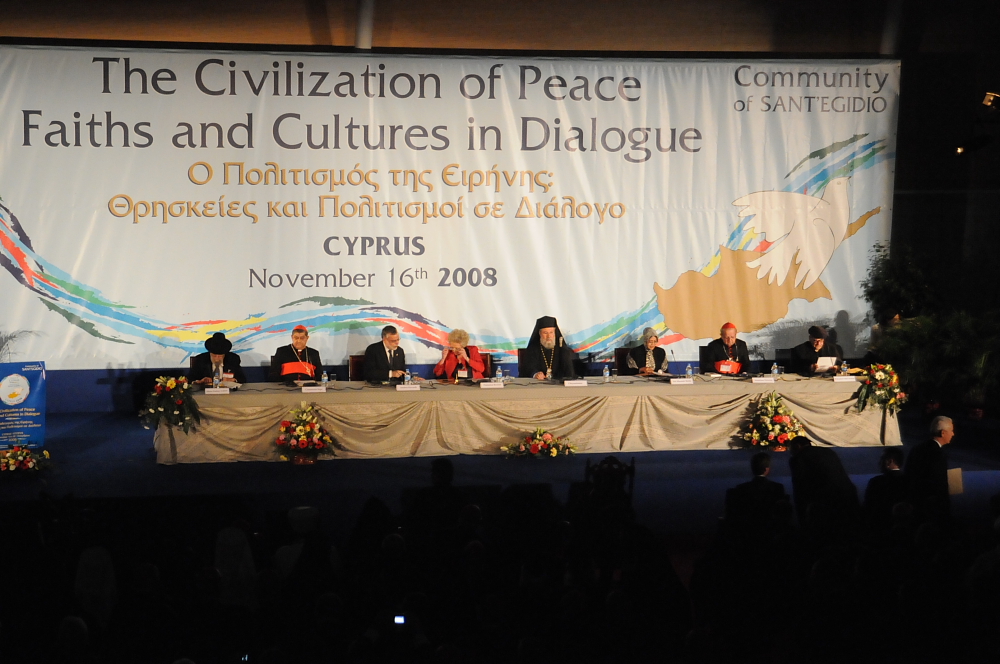
Is it a boundary island, the last wall of Europe, or is it a bridge that brings together different cultures, a model of coexistence of religions and ethnicities? The island of Cyprus, that joined the EU in 2004, and the monetary union in 2008, is viewed in multifaceted ways and interpretations. While Cyprus is nearing the termination of its first European Council presidential mandate, many of the problems hanging over the island remain unsolved. However, Cyprus "is not a problem, but a chance for Europe", underlined the founder of the Community of St. Egidio, Italian minister for international cooperation and integration Andrea Riccardi, on the occasion of the presentation of the volume "A Pope in Cyprus: a journey into the culture and the history of a country", by George Poulides, first resident ambassador of the Republic of Cyprus to the Holy See. The volume was presented in Rome on December 12 at the St. Egidio Community. The book, along with the visit by the Holy Father, the first visit by a Pope, have made it possible to retrace the history of Cyprus, understand its present situation along with its role within the EU, and envisage future developments. Its pages pave the way to various journeys – in time, between religions and cultures – against the background of an island that embodies the spirit of Mediterranean culture, based on the central role of encounter and mediation.The victory of non-violence. "Overcoming violence as a means of conflict resolution". With these words Msgr. Vincenzo Paglia, president of the Pontifical Council for the Family, described the visit of Benedict XVI to Cyprus, a place which has become the symbol "of the victory of non-violence over oppression, which gives force to the weak and helps us overcome divisions through hope and love". With this visit, occurred after years of contacts and exchanges, the Holy Father followed the "footsteps of Paul, who with Barnabas converted the Cypriots and founded the Church of Cyprus", a "pastoral and spiritual visit on the door of Christianity to Europe", underlined Msgr. Paglia, quoting from passages of the book. A historical moment, both for the island as for the pontificate of Ratzinger, which "could be compared to the event that brought Cyprus to join the EU". "A journey marked by spirituality, mindful of the historical dimension, which occurred in a climate of friendship" Msgr. Paglia pointed out. This very tie marks the relations between Benedict XVI and the Orthodox archbishop of Cyprus Chrisostomos II, which brought to renewed openness between the Church of the West and of the East. The Church of the West and of the East. In his address, Andrea Riccardi underlined the bond and the central figure of His Beatitude Chrisostomos II, praising "the determination with which the Archbishop of Cyprus interlaced and strengthened relations with the Holy See, going against the views of Orthodox fundamentalists". Thanks to his commitment it was possible not only to promote the pope’s visit in 2010, but also for the Community of St. Egidio to bring the prayer for peace in Nicosia in 2008. "For three days this divided city became the capital of ecumenical encounter". Although Cyprus is "a complex area of the Eastern world from the religious and cultural angles", it also is "an island that since 2000 has been engaged in promoting the openness to Europe, for the erection of strong and determined Europe". A message of peace and hope. Cyprus deserves to be more enhanced owing to its strategic position, a bridge connecting three continents. This geographical position has brought suffering and violence, but in the future it will represent a place for encounter, acting as the bearer of a message of hope and peace. The visit of Benedict XVI, signaled an important step towards openness, on the wake of "the experience in Lebanon, a journey that chancelleries had discouraged, but which the Pope undertook with great courage, simplicity and humbleness", Riccardi underlined. "Owing to the visit of the Holy Father, Cyprus has recovered dignity, consideration and international stature. This land, a model of coexistence, a place for the encounter also with Israel and the Arab world, deserves a key role in the future of Europe", Riccardi added. Beauty as bearer of hope. "A door bordering on three continents, which across the millennia has suffered and experienced the weight of its magic", said the author of the book, George Poulides. "A great number of civilizations that have settled down at on its territory in different historical periods have contributed to the creation of its artistic and cultural heritage: a patrimony of the Cypriot population and of humanity as a whole". Unfortunately, part of this patrimony was destroyed by hands of the Turkish occupation in 1974. "In mythology Cyprus is the island of Afrodite, the goddess of beauty, and as reminded to us by Benedict XVI, beauty is a major need of mankind. It’s the foundation of our peace and of our hope. Works of art are the expression of thought, they are born to survive to those who have conceived them so that they may transmit a universal message", Poulides concluded.
