COUNCIL AND ECUMENISM
Father Hervé Legrand on ”Unitatis Redintegratio”

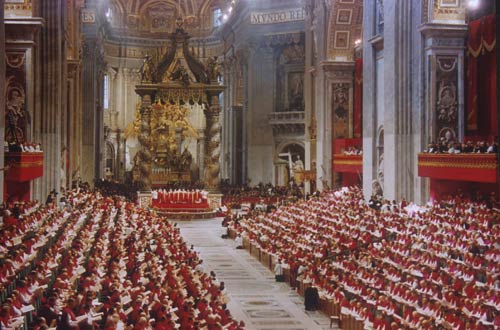
"Our Church is bound to remain an engine of unity on the condition that this commitment is placed on the same level of a ‘minister of interiors’ and not of a ‘foreign minister’". Namely, the distance separating what is "said" and what is "done" should be reduced. Father Hervé Legrand, French Dominican Father, Professor Emeritus of Ecclesiology at the Institut Catholique de Paris, concluded on December 13 in Rome the conference: "The directives of the decree on ecumenism were directed to Catholics only: what is the balance after 50 years?" The initiative, promoted by the Pro Union Centre, represents the fifteenth annual meeting celebrating the commitment of father Paul Wattson and Mother Lurana White, co-founders of the Society of the Atonement, devoted to the promotion of Christian unity. More progress in 50 years than in five centuries. At the centre of the reflection of Father Legrand lies the decree on ecumenism of the Second Vatican Council "Unitatis Redintegratio" (UR), promulgated on November 21 1964, at the end of the third session of the meeting. The document, said its rapporteur, is exclusively addressed to Catholics, while its correct interpretation "is strictly bound to that of Lumen Gentium". In fact, by jointly promoting the two documents, Paul VI, "had declared to the observers of the other Churches present" at the Council that "it was necessary to interpret the constitution starting with the decree". According to Father Legrand, despite "a few incidents, the balance of the ecumenical commitment taken by the Catholic Church in UR is already remarkable. Other Churches should no longer be described in terms of schism or heresy, but are acknowledged as "ways of salvation", and their members are viewed as "brothers in the same baptism". More progress has been made in fifty years – he assured – than in the previous five centuries". A question as "ministry of interiors". "It isn’t sufficiently underlined that Ur "fundamentally address us Catholics in particular to tell us how we can and must delve into our Christian lives, and amend what should be amended so as to abate all obstacles to Christian unity". It was thus emphasized that it is not the intention of the document to address "those Christians whom we are separated from to tell them what we expect from them". It would be a serious mistake, for the religious, to reduce "Catholic ecumenical commitment to the improvement of our relations with other Christians, as if it were the job of a ‘minister of foreign affairs’, while, according to Ur, "it is the responsibility of the minister of interiors". In other words, Ur demands that our commitments truly become "a dimension of our pastoral care and of our theology". Delving into some of the items of the decree and on some of the milestones of the developments of the following years, Father Legrand mentioned, with reference to the Eastern churches, the "theology of Sister Churches", due to become the "foundation" of the Balamand declaration (1993).A curb on openness. According to father Legrand, "the openness obtained thanks to the principles" of "Unitatis Redintegratio" have been, among others, "a governmental policy that distanced itself from Eastern sensitivity" and the Code of the canons of the Eastern Churches (1990) drawn up in Latin, which tends to bring together heterogeneous traditions "such as those of Bizantium and Ethiopia, of Armenia or Syrian India", promulgated solely by the Pope, without the heads of these Churches. Whilst pointing out that Ur, "just like Vatican II as a whole", presents a "gap in terms of canon law", father Legrand underlined the importance of a reflection on the "theological and epistemological statute of this law" which is "critical to the advancement of ecumenism" and without which progress will hardly be made. An irreversible commitment. As relates to the historical background, the statements contained in the Council document, have been, for the speaker, "very well received by the Catholic Church, bringing the requests of forgiveness expressed by John Paul II within the framework of the relations between the Churches". Moreover, he remarked, "the decision of the international Commission for dialogue between the Orthodox and the Catholic Churches to opt for a historical approach turned out to be almost fruitless". Father Legrand thus conveyed the hope that history "may be seriously honoured by our dialogue". "Experience has shown that whoever intervenes in a conflict situation is often compared to a public prosecutor or a lawyer". While a theologian is tasked with "proving to be a good investigating judge in search of the truth". For Father Legrand, "in agreement with Ur" we should "question ourselves rather than questioning others" in the light of the emphasis placed by the last two Popes on the irreversibility of ecumenical commitment for the Catholic Church. Although the "ecclesial atmosphere to this regard is no longer what is was in the years 1960s or 1990s", concluded father Legrand, the underlying work "will continue, also on difficult themes such as the primate of Rome".
