EDITORIAL
Signature collection across all of Europe in support of life from the conception

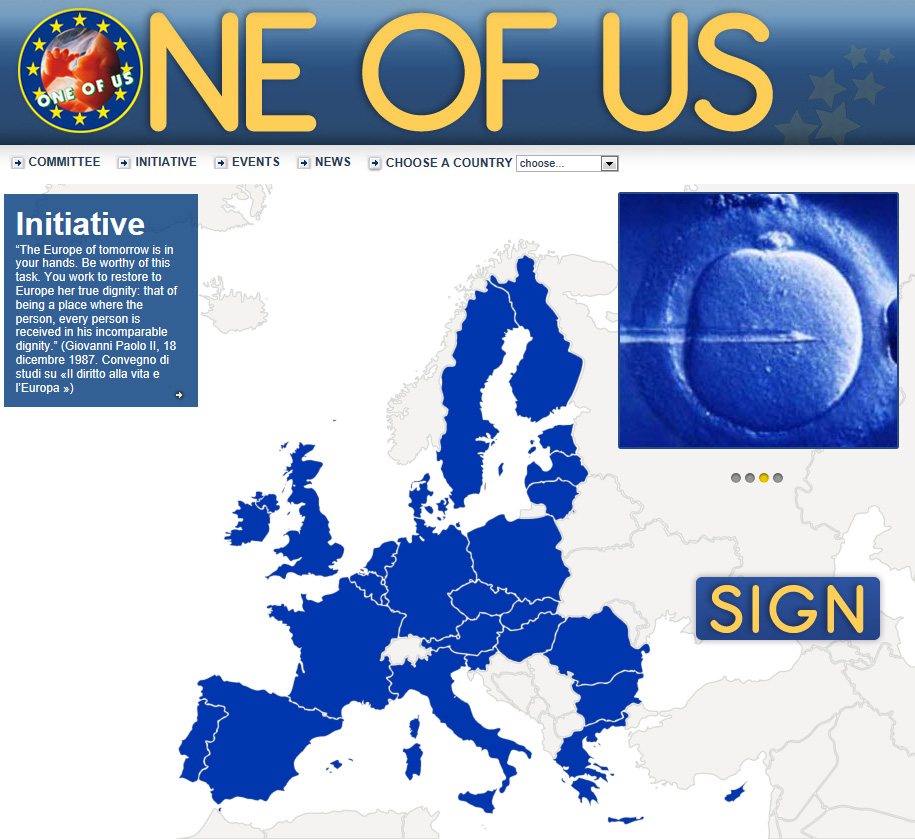
"The path to the attainment of the common good and to peace is above all that of respect for human life in all its many aspects, beginning with its conception, through its development and up to its natural end". These words by Benedict XVI are contained in the message for the World Day of Peace 2013. True peacemakers, then, for the Holy Father, are those who love, defend and promote human life in all its dimensions: personal, communitarian and transcendent. Life in its fullness is the height of peace. "Anyone who loves peace cannot tolerate attacks and crimes against life". There ensues that those who support the liberalization of abortion, or approve the destruction of the embryo in all its forms, pose a threat to peace.The words of the Church are not lonely voices. Recently some Europeans particularly sensitive to the issue of the protection of life have launched the initiative "One of us" in defence of the human embryo, in order to support the recognition of the dignity of man at the beginning of his biological development, or when he is nearing natural death. The initiative consists in the collection of at least one million signatures for the European legislator to intervene and ensure "legal protection of the dignity, the right to life and integrity of every human being from the moment of conception" (www.oneofus.org).Much of contemporary bioethical debate, especially in recent years, has focused mainly on the reality of the human embryo alone or as related to other human beings. "A fundamental question can be postponed no longer – stated the Pontifical Academy for Life many years ago -: who or what is the human embryo?" The appropriate response, at least in the first instance, comes from the realm of science, constantly updated, which allows us to know in great detail the different mechanisms whereby a new human being begins its existence. The moment that marks the beginning of the existence of a new human being is when the sperm penetrates the oocyte. Fertilization induces a series of events and transforms the egg cell into a zygote, a completely original reality compared to his mother. The embryo is intrinsically driven to develop according to cell differentiation and to the acquisition of complexity, and it cannot regress to a previous stage. This progress is continuous, gradual and coordinated by a specific internal project.To conclude, the most recent scientific findings show that the human embryo even in the period preceding the implant is "a human being, an individual being, a being that possesses in itself all the potential to develop into a human person and the inherent capacity to achieve such development".These scientific achievements are the object of overarching reflections, because science alone cannot tell the whole truth about man. Raising the question of integral truth means that not only addressing the question of experiment and verification. What is real, to be properly perceived, requires the commitment of other disciplines, such as philosophy. Far from being inherited from the past or a passion for the few it interprets the data of science by offering a liberating vision of man: he is not only cells, he is "something" more. He’s one of us! Scientific data enable the philosophy of science to claim that the embryo – that tiny dot – possesses personhood that belongs to every member of the human nature. Of course, personhood will manifest gradually and in different ways throughout life. In this sense, there seems to be no contradiction between the scientific findings and the ancient opinion linked to the immediate activity of a human being coming into existence. Fertilization is not only a biological fact and not merely a human fact either: it is a religious event, because it continues the creation of man in the image and likeness of God.The religious dimension of the human being, which slowly takes shape, cannot be overlooked. Speaking to the participants in the General Assembly of the Pontifical Academy for Life and the international conference "The Human Embryo before Implantation", February 27, 2006, Benedict XVI recalled a weakness, but also a potential of our time. Despite advanced knowledge, His Holiness said, "for our human intelligence it seems too daunting to realize that looking at creation, we meet with the imprint of the Creator. In fact, those who love the truth should perceive that research on such profound topics places us in a position to see and even almost to touch the hand of God".
