CHURCH AND EUROPE
Interview with the new COMECE Secretary Fr. Patrick Daly

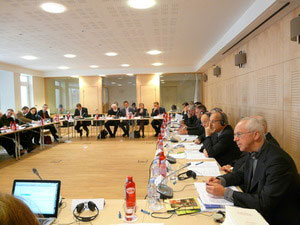
On February 1st Fr Patrick Daly took office at the Commission of the Bishops’ Conferences of the European Commission (COMECE) in Brussels. He was elected to the post of General Secretary in the plenary meeting past November. Fr Daly, 61, from Ireland, was to be seen in European institutions when working as translator and interpreter for the European Commission, before entering the priesthood in 1991. Fr Daly is a member of the Commission for International Affairs of the English Bishops’ Conference, and in the years 1992-2002 he accompanied English bishops delegates to COMECE acquiring familiarity with the body representing the bishops’ conferences of the European Community. The Irish priest succeeds Msgr. Piotr Mazurkiewicz, who served as Secretary from 2008 to 2012. The appointment of Fr Daly will be formally announced in a press conference scheduled to take place in Brussels on February 20. Sarah Numico has interviewed him for SIR Europe. Contemporary Europe is the object of widespread criticism. What are the highlights of the European process, if there are any? "I think that today we are neglecting an important feature, namely, that 27 nations entertain peaceful mutual relations. This absence of conflict, ongoing for the past 60 years, is a patrimony we tend to overlook. Some may argue, from a historical standpoint, whether it is the result of the European process or rather the achievement of NATO. We also tend to forget another feature engrained in the pillar of European institutions provided for by the Treaties, namely, the existence of institutionalised conflict-resolution mechanisms. We also forget that EU officers meet on a regular basis, that they thus get to know each other at personal level, which greatly contributes to the yearning to find common solutions. Indeed, major problems are yet unsolved, but criticism is ungrounded and is linked to the fact that the EU is unable to provide a clear self-picture to its citizens. It’s a multifarious reality and a lot of effort is still needed before strong bonds between European citizens are established so as to create a common sentiment, an identification that may resemble the bond uniting American citizens, that brings them together under their national flag". What could be the Catholic Church’s contribution to this regard? "The Church possesses a wealth of magisterial teachings on a set of hot issues for Europe. We should better understand how to transfer this message. The Church has relations with the political sphere at all levels, bringing her common voice on topical issues and also through her involvement in mutual dialogue. Our service could consist in offering to the architects of Europe the specific contribution of the Church on various aspects of the common problem". Could you describe the ecumenical dimension of Church-institutions relations? "Here in Brussels we cooperate with European Churches on a wide range of consequential topics. We seek to convey a common voice through ongoing dialogue with the representatives of Christian Churches, with the Church and Society Commission of the Conference of European Churches, along with Christian-based NGOs. Institutions need citizens’ help and they know that the majority of European citizens today still identify in Christian faith. It appears that they are also ready for dialogue with the Churches, even though Churches’ stands are often rejected".Your office begins in difficult times for Europe. Could you tell us with which spirit you are living this moment? "I begin my office with great openness, yearning to listen to the institutions and to the Church, starting with COMECE president, Cardinal Marx, and the other bishops, the Holy See, and all the collaborators that are part of my team. I carry with me my precious experience as European citizen. I have a deep curiosity and I wish to examine all the spectrum of opportunities that are there for us to seize, in the awareness of our limits. I yearn to work with all those who give a fruitful contribution to the European process". Which project do you plan to promote? "I would like to set up a ‘think tank’, a context for reflection on present issues, tasked with envisaging the developments and the major questions of the coming years that young generations will have to face, so that the Church may deliver the most appropriate response".
