COMECE
International press meets Father Daly, newly-elected COMECE General Secretary

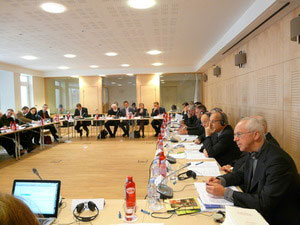
"The economic crisis would have arrived with or without the EU. But the crisis isn’t the failure of Europe. Moreover, without EU institutions we would have less tools to address" the ongoing recession. Father Patrick Daly, Irish, is new General Secretary of the Commission of the Bishops’ Conferences of the European Community (COMECE). He tool office at the beginning of January. In a press conference introducing him, on February 20, Fr Daly shared his personal and priestly path, and delved into Europe’s topical issues. A citizen from Europe. Born in Dublin in 1951, after high-school he attended the universities of Dublin, Leuven and Rome, specializing in historical and philosophical subjects. In the years 1981-1987 Patrick Daly worked as interpreter for European institutions in Brussels. In addition to English, he is fluent in French, Flemish, German and Italian. He then entered the seminary and was ordained priest in 1991 in the diocese of Birmingham, United Kingdom. "I served as parish priest in a city – he said – with a significant presence of foreigners, notably Indians and Pakistanis, marked by high levels of unemployment. I carried out intense ordinary pastoral activity that ranged from Catecheses to baptisms, marriages and funerals". For a decade, in the 1990s, he continued to attended European environments and accompanied – given the previously acquired experience – his own bishop, delegate of the English Bishops’ Conference, in COMECE meetings. Which is the Church’s "specific" contribution? "The specific contribution to Europe which the Catholic Church is called to provide, as Benedict XVI has said on several occasions is to proclaim the existence of God, of the Gospel, letting her prophetic voice be heard also when addressed to policymakers and EU institutions", the new COMECE General Secretary told journalists gathered in Brussels. "Church social doctrine – he added – provides detailed indications for dialogue with institutions, but its content must be conveyed in clear terms, thus stimulating reflections and decisions that prioritize the common good of Europe, that reposes on the rights and dignity of peoples and individuals alike". In a permanent dialogue with government institutions, Fr Daly went on, "the Catholic Church values the importance of ecumenical dialogue so that the joint stand of all Christian Churches may emerge stronger and with greater incisiveness when addressing the difficult challenges of our times". Promoting values. Always seeking this unity, underlined the COMECE Secretary, "the Catholic Church, mindful of the respect due to EU bodies and of their responsibilities, is nonetheless under the obligation to voice her thoughts on themes relating to life, the family and marriage". "At a particularly difficult time for Europe – he added – the Church highlights the inseparable bond linking the anthropological and social questions. Such questions demand the realization of a culture and of policies tasked with the promotion of those very values underlying the common foundations of the European home; both realms are called to be more aware of citizens’ needs, that are both spiritual and material, providing prompt responses". The Pope and Europe. "Benedict XVI has written many pages on Christianity in Europe, a theme he addressed on numerous occasions. The Pope firmly believes in the European project". Father Daly underlined the importance of the principles of subsidiarity and solidarity in the framework of the relationship between the Catholic Church and the Community project. He also recalled that the Vatican raised objections on the recent developments of the integration process. He added: "I cannot imagine that a future European Pope may oppose the process of integration. Similarly, if the next Pope weren’t European he would naturally be inclined to welcome" the path followed by the EU. Daly continued: within the COMECE Secretariat "we are reflecting on how Europe could best present itself to citizens in view of the upcoming EP elections", in 2014. From this perspective, "our primary task is to underline the importance of voting, an opportunity that democracy grants EU citizens to make their voices heard in political processes". For Fr Daly, the European Union "doesn’t know how to promote itself" meaning that it fails to publically share its achievements – that include "sixty years of economic growth, better standards of living and peace". "Our ecclesial community could promote the dissemination of the important role played by the EU in the pursuit of the common good in the global arena", highlighting that "we belong to the same European family".
