BELGIUM
The bishops’ letter-appeal to citizens and Parliament

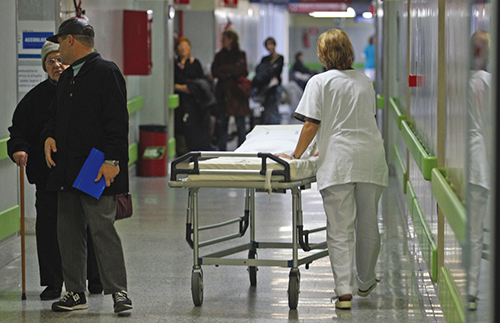
Belgium’s bishops voiced their opposition to the bill presented for debate in the Senate by the socialist party requesting to extend to children under-15 and to people affected by Alzheimer’s disease the possibility of resorting to euthanasia. On March 6, during a press conference, Monsignor André-Joseph Léonard, archbishop of Malines-Bruxelles, presented to the press the opinion of the Belgian episcopate contained in a letter-appeal to citizens and Parliament titled "Can social bonds be interrupted?" At the beginning of February the Federal Committee for the Control and Evaluation of Euthanasia registered 1.432 statements of euthanasia relating to 2012: a 25% increase compared to 2011. The statements of euthanasia registered last year represent 2% of all deaths in the Country. Maria Chiara Biagioni collected for SIR Europe the opinions expressed during the press conference. The letter. The bishops had already expressed their reservations in 2002 when the law on euthanasia was approved in Belgium. "This law – states the document published by the Belgian episcopate – could have seemed reasonable as it was meant as a tool against illegal forms of euthanasia. It had been presented as a very humane law which was written to ensure the encounter between the physician’s compassion and the patient’s concerns of a dignified death". The bishops perfectly understand that "a sick person may experience a period of ordeal, of uncertainties or of deep discouragement". It is precisely now – the prelates underlined – that the patient should feel the closeness of "people extending a hand to them, who make him realize that his/her human value is not annulled with the destruction of the body or of the mind; that his/her dignity exceeds the discomfort of no longer feeling in control of him/herself".The appeal. The bishops raised a series of questions related to an extension of the law on children and Alzheimer’s patients: "Isn’t a written attestation requesting euthanasia in case of loss of mental faculties, likely to become one day even superfluous to the extent of no longer considering it is necessary? And with respect to minors: is the extension of the law for children under 15 years likely to then pave the way to euthanasia "for small children, because their illness or their disability have become unbearable?" On these grounds the bishops submitted their appeal to Parliament where the bill is tabled to debate: "We call upon Parliament to consider that sick people, minors or people affected by dementia could benefit more from Public Healthcare in the framework of palliative treatments. Saying no to euthanasia doesn’t mean suffering, nor does it mean to prompt the suffering of others. The progress in palliative treatment has made great progress in providing relief to pain and helped prevent possible requests of euthanasia". The Belgian bishops want to be able to give their contribution and share their beliefs. The letter closes as follows: "We want to honour our democracy and human dignity".The opinion of a bishop. Msgr. André-Joseph Leonard told journalists that "the introduction of euthanasia isn’t confined to the consequences on the individual that claims it, but it changes the fundamental relationship with life and death in society, undermining the vital bond of solidarity of all citizens with those who suffer". The bishop raised the question of "the risk of delegating to others, in a long-term living will, the faculty of deciding for us, and even in the case of dementia, of resorting by proxy to euthanasia. Is this decision – which is the result of a free decision considered at a later stage – of entrusting to others the task of terminating our lives truly compatible with the Rule of the Law?" the bishop said. The opinion of the oncologist. Oncologist Catherine Dopchie, director of a palliative treatment division, underlined that euthanasia is becoming an increasingly ‘mainstream’ concept in Belgium whereby "conversely to the original spirit of the law, euthanasia is no longer considered an exception nor a violation of moral code, but rather a form of support to prevent useless suffering". The physician added: "I have often noted, in life-termination situations, and in moments of intense physical and mental activity, that people change their minds on what they want. Scientific surveys on the quality of life of oncological patients show that processes considered significant for the quality of life change as the situation worsens and with the loss of independence. Thus it is not reasonable, in my opinion, to consider oneself competent on the feelings stemming from a situation that is yet to occur. Thus if the request for an early declaration on euthanasia has an unlimited timeframe, it risks being practised on the basis of a document without knowing what the person is feeling that very moment".
