RUSSIAN FEDERATION
Over 100thousand people in Moscow live in dire conditions

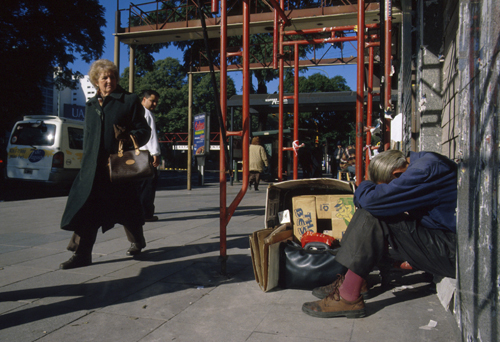
Along the streets of Moscow the homeless are the most evident sign of misery. According to recent estimates there are over 100thousand street people. They belong to various different nationalities and backgrounds. The "bums" are at the bottom of the scale, dirty, stinky and outcast. Conversely, most homeless are decorous, while at times they struggle with alcoholism: they are unemployed, and travel to Moscow from the suburbs in search of a job. When they don’t find a job they take to drinking and the situation grows worse and worse. After having lived on the street for a while they develop a form of "dependence" from this unusual form of freedom, and they no longer accept anyone’s help. These people are uprooted, alone and without points of reference. There are also large numbers of mentally disturbed and old people. Great solidarity. In the midst of this ocean of misery Catholic and Orthodox initiatives seek to provide some help, as is the case of Sister Paola and Sister Annamaria from the contemplative Missionary Movement of Cuneo (Italy). "For years we provided a shelter in a basement where we set up a soup kitchen. In September they sent us away, saying that the building was owned by the tax office and that it needed restructuring. But we later realized that they had enough of our homeless", they said. Also the building of the sisters of Mother Teresa that gave shelter to the homeless was torn down under the pretext that it didn’t comply with safety rules. Now the sisters host the homeless in their home in small groups at a time, so as not to cause the protests of the people living in the neighbourhood. Also the community of Cosma and Damiano, where Orthodox priest Aleksandr Men, killed in 1990, lived and worked, distributes meals to 300 people inside the church two times a week. In the squares of Moscow’s snow. There are 9 train stations in Moscow. Several religious and lay organizations distribute food at given hours and days during the week. Sometimes they arrive with vans full of warm tea, bread, and soup. Also the two Italian nuns, while waiting to find another place for their soup kitchen, in October decided to go to Kurskaja station: "We had 20 sandwiches in our backpacks. It was the first cold day, with zero degrees. We wandered one and a half hours in the streets looking for people". Another problem is that the poor can no longer seek shelter in the underground and in train stations. A large number of policemen and guards exert strict control. "We bought a cup of tea for two people shaking from the cold and accompanied them inside so they could drink in a sheltered place, but a guard immediately sent us away. ‘It’s a dog’s life, even worse than dogs’ – one of them told me". So for the whole winter, Sister Paola and Sister Annamaria stood on the square near the train station. On Thursdays in Kurskaja, on Fridays in Kievskaja. They distribute sandwiches, sheets, clothes with Andrej, from the evangelical church, who arrives by car with warm soup (some 50 litres) and coffee. As soon as the car appears, they all gather around him, no less than 100-120 homeless each time. Andrej recites a short blessing and thanksgiving prayer and then distributes the food with the volunteers. Sergej, Nikolaj, Natasha… Annamaria recalled: "I remember many faces of people I met on the streets, anonymous people who don’t show the world their best part, hidden by layers of misfortunes, limits or flaws they inherited, that lower living standards to the lowest degrees. But when we see each other, we talk and our humanities meet in simple ways, in the gesture of handing over a sandwich or a hard-boiled egg, asking how things they are, sharing for a moment the same street, the same cold air… that’s when something shines that is unseen outside but that you feel inside your heart". Sergej helps bring heavy bags outside, then he collects the papers and the containers that others have thrown to the floor. He is homeless and sleeps at the airport, where they know him and leave him alone. Nikolaj is older, he always wears a camouflage jacket and the Omon beret, perhaps because he feels nostalgia for the army. He’s been living on the streets for years, owing to a conflict with his children. Natasha died February 11, she used to sleep under a bus shelter, with a dog always near her, she was alcoholic. She too welcomed the nuns on Fridays with happiness and affection.
