ESTONIA " "
Renewed prospects for the Church of Estonia as CCEE member Country

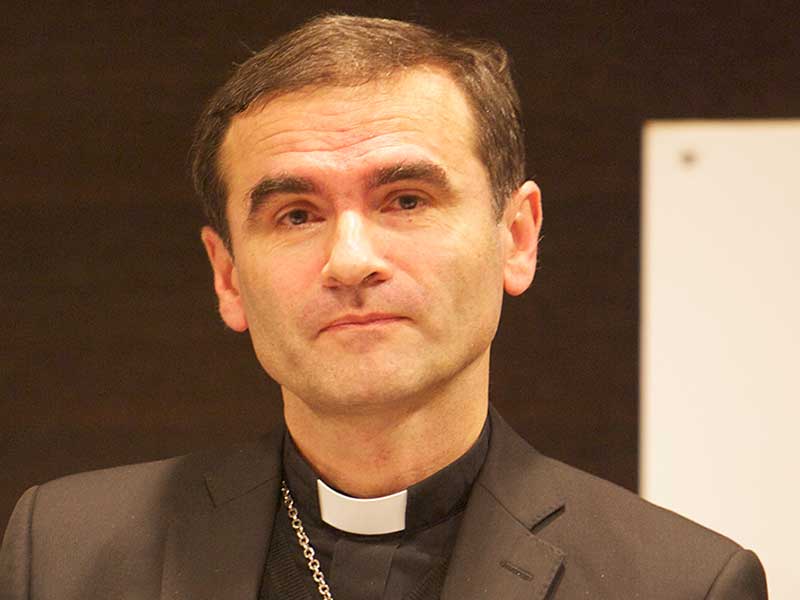
European Bishops’ Conferences (CCEE) welcomed Estonia as its new member. A small country with about 1.5 million inhabitants, 80% of which claim to be of no religious belief, has entered a road towards development of the position of the Catholic Church in the society. Challenges associated with this step were the main subject of an interview of Danka Jaceèková with apostolic administrator of Estonia, Mons. Philippe Jourdan. How would you describe the position of the Catholic Church in contemporary Estonian society?”The Catholic Church in Estonia is more-less like Churches in nordic countries, with Lutheran tradition. The Church in a situation of diaspora. At the same time, of course, it’s the Church which was for fifty years under the Soviet occupation, almost completely destroyed. Only thanks to the Catholics from Latvia and Lithuania it didn’t disappear completely, although now it is extremely secularized in general. Especially after the seventies and the eighties of the last century there was a movement with a big interest towards the Catholic Church, especially among the intellectuals. So I would say – of course that our Church is very small with only about 6,000 Catholics, just as our country, but it was very successful in its European integration. Estonian people are very hard workers, they are methodic and very able. Our Church is developing little by little, especially in the realm of Catholic education, which is very important for us because many people get to know the work of the Catholic Church through its schools. The situation in Estonia is that the majority of its inhabitants is not even baptised. So, it certainly isn’t an easy task for me as an apostolic administrator. But our efforts are very persistent. One of my predecessors – the first bishop after the Protestant Reformation Edward Profittlich – died in the soviet jails in 1942. His canonization process is still in progress and we hope that he will become the first saint of the Estonian Catholic Church. For 63 years, there have been no resident Catholic bishops in Estonia. Currently, there is only an ecclesiastical district that is not part of any bishops’ conference”. “God and the State. Europe between secularity and secularism” – how does this CCEE plenary assembly topic reflect in the official status of the Catholic Church in Estonia?”Even though the country is very secularized, I must say that the civil authorities and the government have been very open to collaboration with the Church. I hope I am not mistaken if I say it, but I think that Estonia is the only Lutheran country that has a Concordate with the Holy See, which means a solemn and official recognition of the Catholic Church in the country. It’s really a good thing”. What do you expect from your membership in the CCEE?”We are a small Church in comparison with Churches of Italy, France or Poland, it’s obvious, but this membership is important in many ways, including the life of the civil society in Estonia. I can say that the fact that we are now members of the CCEE is significant also for those who are not Catholics, as a recognition that Estonia is a part of Europe. This is the aspect that can’t be omitted. And – of course – it’s a way for me as an apostolic administrator to have personal contacts with bishops and cardinals of various countries, to share our problems, because althought the Catholic Church in Estonia has been developing, we still in certain sence depend on help from abroad for our work. So it’s important that the Church representatives from other countries know better who we are and what we are doing”. How could you describe the prospectives of new evangelization in Estonia?”We understand very well the role and the power of Catholic laity in this regard because during the Soviet times there was only one priest for the whole country. Therefore, our lay people were used to living without priests and also to evangelize without them. Currently we have I am very pleased that one of the two laymen in the Pontifical Council for Culture is Estonian, a well-known composer. We have been trying to strengthen the catechumenate, to form a community to receive new Christians, new Catholics, because many times they are individuals with very good will but without any support in their family, without community in which they could grow. We need to show them what it means to be Catholics in terms of ethics, to put emphasis on education, because that is the best way to explain what actually is the Catholic Church and what it means to be a part of it”.
