INTERRELIGIOUS DIALOGUE" "
EPP initiative in Nicosia. The situation in the Middle East and in the Mediterranean.

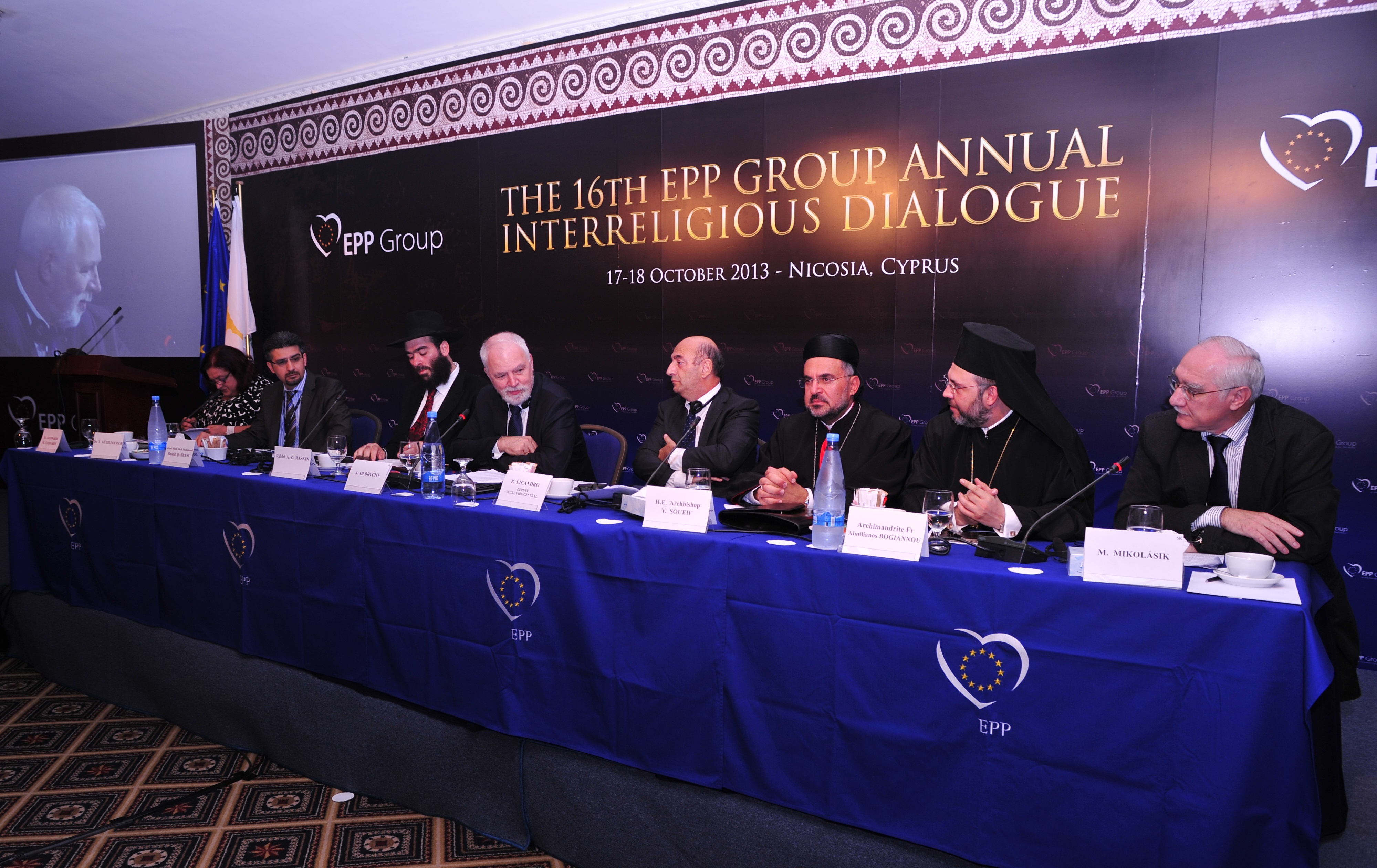
“There will be no such thing as political peace” in Europe and at global level alike “unless peace is acknowledged as a fully shared value”; “freedom of religion cannot be understood as freedom from religion”. Polish MEP Jan Olbrycht highlighted two key questions ahead of the 16th Annual Interreligious Dialogue promoted by the European People’s Party Group at the EU Parliament, held in Nicosia October 17-18. Politicians, leaders of monotheistic religions, representatives of international associations and experts in geopolitics convened on the island of Cyprus, viewed as a ‘bridge’ between Eastern and Western Europe, to discuss “The role of religions in peace-building and conflict resolution in the Mediterranean region”. Ecumenical dialogue; Muslims and Jews together for peace in the Mediterranean; political stability; fundamentalism as a factor of political destabilisation, the protection of religious heritage as a sign of civilisation and the coexistence of religions were the main themes of the meeting. The birthplace of religions. “The middle-eastern region is the birthplace of Christian faith and of monotheistic religions. Nonetheless, it is a region marked by tensions, with tumultuous developments. The reasons for these problems must be sought at all levels, jointly identifying feasible solutions. In this process religious leaders are called to give a positive testimony for the promotion of dialogue, peace, rights and solidarity”, said Chrysostomos II, Archbishop of Nova Justiniana and All Cyprus, speaking at the annual EPP meeting. The Archbishop underlined the “serious suffering” of Mediterranean peoples, who in fact are not distant from religion, or more precisely, they are exposed to a “wrong and distorted” understanding of religion, inscribed within fundamentalism. Chrysostomos II highlighted the need to ensure freedom of worship across the Middle East, mindful of the “discrimination suffered by Christians in many Countries”. “Every day Christians are the objects of acts of violence and discrimination”, said Chrysostomos II. He thus called upon the EU to “step up efforts aimed at ensuring freedom of faith and the protection of places of worship”. The case of Cyprus. The archbishop explained that Cyprus is a Country with a large majority of Orthodox Christians, with a large Muslim presence and a small minority (2%) of Maronites, Armenians and members of other religions. But since 1974, after Turkey’s occupation of the north of the Island, “the illegitimate regime therein installed”, which divided the nation in two, “is systematically destroying and ransacking all Christian presence, an ancient heritage is being wiped out”. Similarly, the Christian community has been repressed or led to move to the Greek-Cypriot side. “Churches, monasteries, abbeys and even cemeteries are being destroyed. Nonetheless we strive to ensure that all channels of dialogue between the faiths in Cyprus are open, since peace and human rights are possible only with availability to mutual encounter”. Purifying minds and hearts. “We all need to purify our minds and our hearts to build peace, the peace that God Himself shows us”: Youssef Soueif, Maronite archbishop of the eparchy of Cyprus, sjared his experience at the Inter-Religious Dialogue. Soueif pointed out that the word “peace” exists in the expressions of greeting of all the monotheistic faiths in the Middle East. “There is a theological foundation to peace – he declared -, because God’s peace is offered to all men, without distinctions”, and therefore all faiths and religious communities “must be against any form of abuse, oppression, and violence”, whether it is political, social or cultural. Quoting from the Bible and the Koran the Maronite archbishop recalled the commitment of the faithful of the main religions for peaceful coexistence. He said he is sure that “the majority of the populations in the Middle East”, who yearn for “fraternity, peace, reconciliation, rights and development”, wish that “the ongoing strife may end”. “Religions – recalled Soueif, who served as Secretary at the Special Synod for the Middle East – must be at the service of the common good”. In this peace-building effort, “religious minorities can play a creative role and bring their unique experience”. The lively debate in the two-day meeting was marked by various testimonies and voices of experts. These include that of the foreign minister of Cyprus Ioannis Kasoulides who after having provided an outline on the presence of religions and latent conflicts in the Middle East and in the Arab world, said: “In the European Union every citizen is free to profess his faith. For this reason Europe cannot remain silent before so many violations of religious freedom that are taking place worldwide”.