CCEE
The reflection of European Bishops on Christian witness in the Internet era

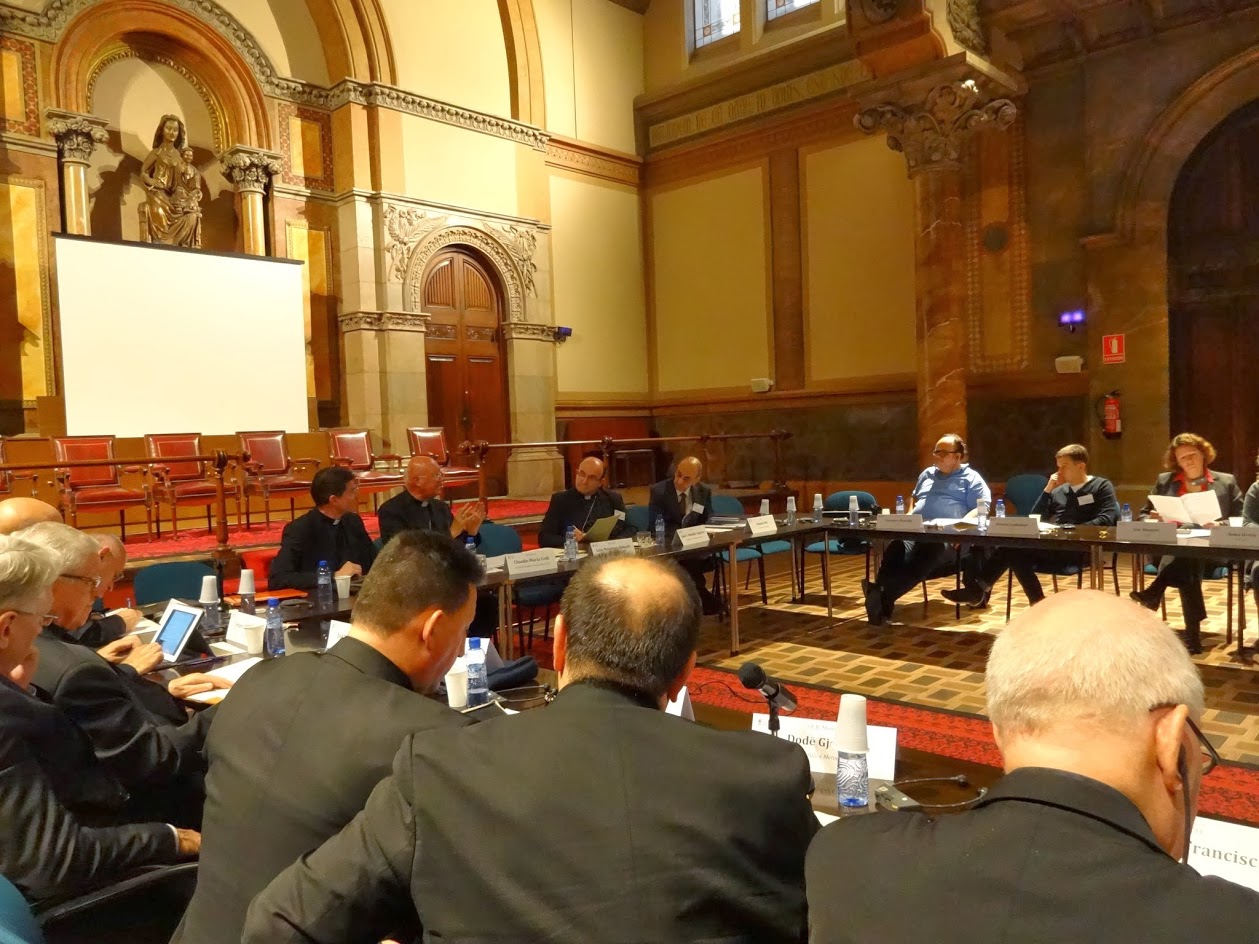
A European society in rapid transformation, marked by profound, secularized dynamics which despite increasingly modern and invasive technologies and communication languages brings to the fore new opportunities to “meet” and “prompt the encounter” “of humankind”. Within this framework, an increasing quest for meaning emerges, i.e., contemporary men and women feel the need – for authentic hope. “It is ever more urgent to communicate the Gospel in contemporary Europe and throughout the world. It is a reminder of the duty of Christian witness also through the tools and the ‘environment’ of social communication”. Father Michel Remery, Deputy Secretary General of CCEE (Council of European Bishops’ Conferences), spoke of the highlights of the meeting held in Barcelona from 8 to 10 November that brought together the bishops responsible for social communications.New frontiers. During three intense days focused on the theme “Evangelizing the soul of Europe”, about forty participants, including bishops and delegates of social communications of their respective Episcopal Conferences, analyzed the “frontiers” that challenge the Church’s missionary action today, the communication of Pope Francis, the use of new technologies. Thematic round tables addressed the following themes: the ongoing experience of communication in the diocese of Barcelona, presented by Cardinal Lluis Martinez Sistach, the role of media and interpersonal relations that developed over the past year in France around the movement “Manuf pour tous”; the figure of ‘architect Antonio Gaudi, who designed the Sagrada Familia, thereby identifying in architectural and artistic expression the ability to transmit the “beauty of God”.The Gospel and the Internet. The keynote address, delivered by Msgr. Claudio Maria Celli, president of the Pontifical Council for Social Communications, focused on the 50th anniversary of the Second Vatican Council document “Inter Mirifica”. “God speaks to us through daily events”, through “religious experience within current events”, said Msgr. Celli. Pope Francis thus “guides us towards a religious experiences that gives depth to current events, so that we may learn to feel and see that God tirelessly operates in every moment of our life and history”. The prelate outlined the challenges of the evangelizing mission in an era increasingly marked by new technologies. “The Church – he said – is not called to evangelize the Internet but to preach the Gospel on the Internet”, also because a significant and growing number of people “are present on social networks, and it is therefore our duty – as well as their right – to proclaim “the Gospel in these environments”.The “style” of the Pope. “Francis is a Pope who does not need interpreters “: Msgr. José Ignacio Munilla Aguirre, president of the Committee for Social Communications of CCEE, addressed the issue of the communicative profile of the Pope. According to the bishop of San Sebastián, there are some aspects which are particularly appreciated by the faithful and by the public at large which are found in Francis, such as “the consistency and authenticity of his figure”, the “courage and transparency” in dealing with “hot themes” that affect the life of the Church and of the whole of humanity. “It is important to always bear in mind that communication in Pope Francis does not originate from a personal charisma in his expression, nor is it the result of a technique. On the contrary, the source of his communication is to be found in two other factors”. In the first place, there is “an apostolic zeal that allows to overcome fears and venture into communication” itself. Secondly, the “Christ-centeredness” of the Pope, whereby “the identity of the Church is the servant of the Word of the Lord”, overcomes every forms of self-reference.Reaching out. Among the speakers in Barcelona figures theologian and journalist Miriam Diez Bosch, director of Blanquerna Observatory for Communication, Religion and Culture, who shared her contribution on “Marketing the Gospel”. Marketing is not a suitable word in the Gospel, but every believer lives in the surrounding world”, she explained. This is also why “digital communication is an unavoidable challenge” of the missionary journey. “People seek a meaning to their lives” – the scholar said “not always though, nor continuously or at least not explicitly. But it is important t that the Church is there when she is being sought”. There are countless ways, “starting with individual welcome to encounter… And communication technologies, including the Internet, can be of help”. Diez Bosch concluded: “A Church that is faithful to her origins, where mercy is the watchword and forgiveness its distinctive trait, has much to offer in a world in search of meaning. The Church must therefore be present on the borders, on the frontiers, including the digital ones, in order to be found”.
