POLAND
After a serious accident he had asked to die. He now explains how and why he changed his mind

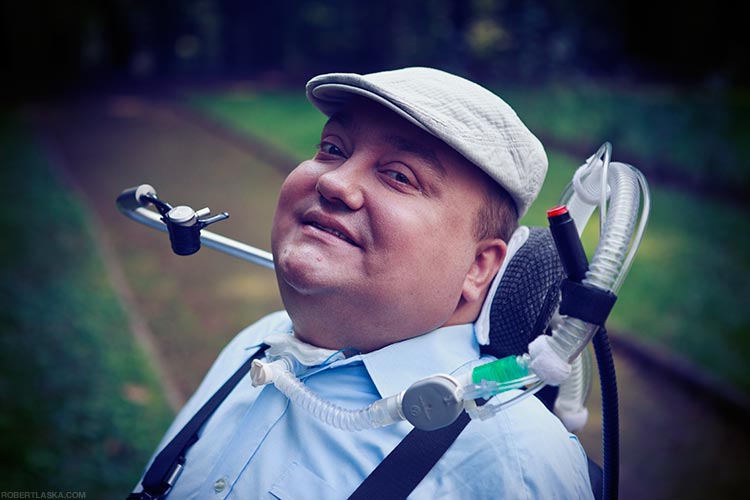
In 2013 Janusz Switaj began studying psychology at the University of Katowice, the capital of the Polish region of Upper Silesia. “I want to help others”, he said, smiling, in spite of the respirator always attached, which hampers his speech. In 1993, a few days after his eighteenth birthday, Switaj was the victim of a serious motorcycle accident. His cervical vertebrae were crushed and he remained paralyzed and forced to total immobility within the closed walls of his room in his parents’ home in Jastrzebie Zdroj. For 14 years he survived thanks to the loving care of his mother and father, but in the end, he thought he would make it no longer. At the beginning of 2007 he became the first citizen in Poland to file a court petition requesting euthanasia, expressly prohibited by law. “I was convinced that if my parents, whose presence I need 24 hours running, were to die, I would not be able to survive. So I asked the respirator to be removed”, he told SIR Europe. But fortunately, the story had other developments. Thousands of cases. The media hype triggered by the request of Janusz Switaj – who also endured painful cramps, today partially overcome thanks to a special machine – sparked off a hot public debate on the possible introduction in Poland of the “right to die”. It also led to a questionable verdict by the public opinion: 53% of those surveyed by CBOS Institute said they are in favor of euthanasia requested by the patient. Only 25% said they are against. Public attention also focused, shortly thereafter, on the case of a desperate mother who asked euthanasia for her seriously ill son. The latter however was not in a coma or in a vegetative state. Janusz received many letters requesting advice on how to demand euthanasia for oneself or for others. So the boy decided to organize a referendum on the legitimacy of dying and killing. During the debate on the “Janusz case” comparisons were drawn with Brook Ellison and Stephen Hawking, they too paralyzed and yet full of vitality. But while these are world renowned personalities, thousands more, unknown to the general public, are forced, due to accidents or disabling diseases, to total or partial immobility, without adequate support from the public institutions and by their relatives.Along the streets of the city. The debate in Poland continued, touching ethical and political issues, and it prompts emotional involvement. So Janusz had “time to recover his own life. “In March 2007, the “Fundacja Mimo wszystko” (Foundation “In spite of everything else”) of Krakow came in his support by offering him a job. He now works part-time. “My main occupation – he said – is to make phone calls to thank the donors who support us, but I am involved also in other social initiatives such as raising funds for children in orphanages during Christmas time”. The Foundation, established by Polish actress Anna Dymna, with the support of the Catholic Church, for the past ten years has been dealing with people affected by disabilities which have lost what they thought was a “safe job” and thus also the ability to integrate into society. Thanks to the clamour sparked off by the request for euthanasia, many anonymous donors helped Janusz to purchase of a wheelchair which, he said, allows him to go out of the house, walk along the streets of the city and even enables him to go, accompanied, to ‘university to take exams. Even Polish the publishing house of “Jesus of Nazareth” by Joseph Ratzinger decided to donate a part of the revenue generated from the sale of the book to Janusz, allowing him to overcome what previously seemed insurmountable economic limitations. “I would like to help others”. In 2008 Janusz published a book where he tells his experience. He started writing it in the hospital, pushing computer keys with a pencil held in his mouth. The first 10 thousand copies were sold out in a few days. “Maybe there will be a reprint”, he remarked. “So I could add a few chapters, since the book ends when for the first time I was able to take a trip to admire the beauty of Lake Morskie Oko and the peaks of the Tatra mountains. “From his bed Janusz obtained a high school diploma and now, he added, he wants to do “his best to help” other patients. The university has promised full support in the continuation of his studies. “I’ve found my way of living”, he said. “The important thing is to be optimistic. I think I still have many experiences to live, other challenges … I resigned myself to a damaged spine damaged but my head and my mind are fully functioning. I want to live”. Janusz has stopped considering euthanasia an option.
