ECONOMY " "
An international seminar on agriculture, solidarity and integration

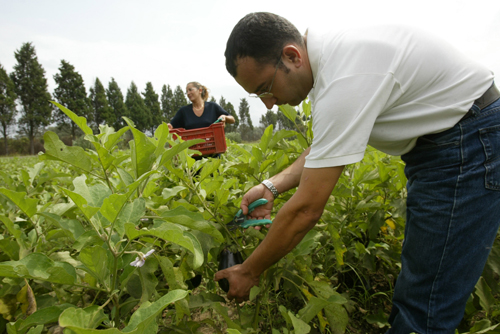
“More attention to man and the environment, less finance “: this will be the new European perspective according to Riccardo Milano, Professor of Economics and Ethics, director of the Ethical Bank, speaking at the international seminar “Europe 2020 economic and financial crisis, problems and prospects. “The event, held in Rome on 13 and 14 November, was sponsored by the International Catholic Rural association (ICRA), with support from the European Centre for workers’ question (EZA). “Humanity must cooperate more and recover competition’s original meaning, which is “to compete with'”, said Milano. “Courage and sobriety” are the values invoked from various quarters and requested to future legislators of the EU institutions. Starting anew from social dialogue. The tool with which we are called to address this economic and cultural change, according to the panel speakers, will have to be “social dialogue”, which, as pointed out by Albino Gorini, (Fisba-Fat Foundation), “promotes the formation of consensus and participation of all stakeholders, who thereby “become the tool” that helps shape the European social standards”. In this context, the recent decisions by European governments “have prompted situations of disappointment and conflict at national level”, said Gorini, and that is where “the potential of social dialogue” comes into play. Michel-Thierry Dupont, (Journées Paysannes, France) thus brought the experience of Breton citizens direly hit by the economic crisis, “who succeeded, regardless of political party affiliation, to ensure the suspension of the écotaxe” that the French Government intended to adopt on road transport. Fear and uncertainty. Positive results however are coupled by conditions of severe crisis, such as those in Romania where “the prices of services and commodities have increased, unemployment is rising, the exodus of young people is dreadful, and 1 January 2014 is eagerly expected in order to enter the British job market regularly,” notes father Gavril Buboi (Greek-Catholic Rural Association, Romania). His views are shared by Aimilios Dasyras (Federation of Greek Catholics) who calls for a “public and political debate” for his country. “In Greece – noted Dasyras – social dialogue concerning employment is making steps backwards, because constant changes generate fear and insecurity and there are many who resort to early retirement”. The role of agriculture. Can “social dialogue contribute to the growth of Europe based on labor and solve the problems of the rural world in a period of deep crisis?” According to Pietrangelo Giordano (UCI-Tecnici), the answer is “yes”, and “we believe that consultation and a new understanding of market solidarity can bring about an equitable redistribution of income while limiting speculative phenomena”. These concepts were reiterated also during an ICRA conference held in Avezzano, November 16, at the conclusion of the international seminar. The initiative, titled “Agriculture, Food and Environment: human ecology and sustainable development in Fucino,” was organized in collaboration with the municipality of Avezzano and with the support of the Regional Council of Abruzzo and the Province of L’Aquila. “Agriculture as a synonym of hospitality, solidarity and integration,” is the hope of Msgr. Pietro Santoro, Bishop of Avezzano. “The global crisis highlighted the extent to which our society needs agriculture”, but in this regard the bishop urged to fight against the “circumvention of contributions” and to invest in “qualified and ongoing training of labor workers”, most of whom are foreigners, and to ensure “a fair remuneration of agricultural work”. Which future. “Agriculture, food and the environment are three essential aspects, critical to sustainable development”, pointed out Vincenzo Conso, ICRA general secretary. To do this, “it is important to network and build bridges, to bring the human person at the centre of every action,” even with regard to “future economic and political decisions”. “Without a human ecology we will not be able to achieve sustainable development”, continued Msgr. Franco Appi, ICRA ecclesiastical assistant. “We must fight against an individualistic society that leads to fragmentation and replace it with a society based on solidarity and cooperation, which sees the family as its point of strength”.
