CHURCHES IN EUROPE
CCEE: the meeting of secretaries of Bishops’ Conferences in Strasbourg

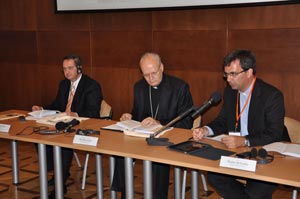
The fact that religion “is taking up an ever greater public relevance in the life and awareness of European citizens and that it is now a key element in view of social cohesion, is widely confirmed by the considerable increase in the number of appeals that are deposited at the European Court of Human Rights on issues related to the religious aspect”. The reflection emerged during the meeting of the Secretaries of the Catholic Bishops’ Conferences of Europe, held in Strasbourg June 19-22, promoted by CCEE (Council of European Bishops’s Conferences), in collaboration with the Permanent Mission of the Holy See to the Council of Europe. A just and peaceful society. The event, attended by some thirty Secretaries from across the continent, explored the role of the CoE, especially with respect to issues of democracy, peace-building, defense of fundamental rights; other sessions of the meeting have tackled some particularly delicate situations, such as those of Ukraine and Bosnia and Herzegovina. Participants talked about the promotion of human dignity and the family; of justice and legality; employment and repercussions of the crisis. The final statement underlines: “without getting into the strictly political sphere, and never forgetting that her mission is to bring the light of Christ and salvation to all -, the Church is convinced that only policies based on the principles of the human person, the common good, solidarity, and subsidiarity will be able to build a just, peaceful and fruitful society”. Integral development of the human person. “The role and significance of the Council of Europe for the European nations, not just in political terms, but above all at the social and cultural level, is such that it seems appropriate to come together in Strasbourg. In this way we aim to get a better understanding of how the Council of Europe works”, (supranational institution set up in 1949), “to deepen our mutual awareness and give voice to our church bodies”, said Mons. Duarte da Cunha, CCEE General Secretary, in the presentation of the the 42nd meeting of the General Secretaries of the Bishops’ Conferences of Europe Strasbourg, France, 19-22 June 2014Mons. Duarte da Cunha. “In fact we believe that the mission of the promotion and protection of human rights, the rule of law and democracy which are at the basis of the Council of Europe, takes on full meaning insofar as we promote peace, the integral development of the human person, the defence of freedom and life which are at the heart of the Church’s mission”, Msgr. Da Cunha pointed out. In this “joint task, it is urgent for Christians and the Churches to become evermore conscious of and expert in the issues which are tackled at a European level, that they be heard as representatives of civil society and become protagonists in the places where decisions are taken”. Roots and Christian values. With its 47 member Countries, the Council of Europe “corresponds to the idea of a continent from the Atlantic to the Ural Mountains, made up of nations and peoples who have shared much more than a history of suffering and wars, but a culture, traditions, aspirations and ideals at the basis of which have been the values and faith which Christianity has promoted, and continues to promote, for more than two thousand years”, CCEE underlined. The meeting – held in a rather informal environment, of listening, mutual understanding and friendship, including witticisms on the World Cup – was opened by the Archbishop of Strasbourg Msgr. Jean-Pierre Grallet, who also presided over the final Eucharistic Celebration during which were recited prayers for the European continent. Appointment in Madrid. In Strasbourg – where the prelates met with several officers from the CoE and the Court of Human Rights – were highlighted the “long-date initiatives that the Council of Europe has been promoting on the religious aspect of intercultural dialogue”. It was a way “to recognize not only the importance of religion but also its public dimension”. The participants, however, “expressed some reservations and concerns so that these meetings will be always respectful of the identity of religions, which are seen not only as a historical fact, but also as an experience determining the whole life of a person, from their conscience to their social life”. The participants were updated about the work of the CCEE and in particular about the 2nd edition of the European Social Days which will take place in Madrid from 18 to 21 September this year.
