PILGRIMS' ''WAY''
Increasing numbers of pilgrims on the Via Francigena, the Way of St. James, the sites of St. Francis

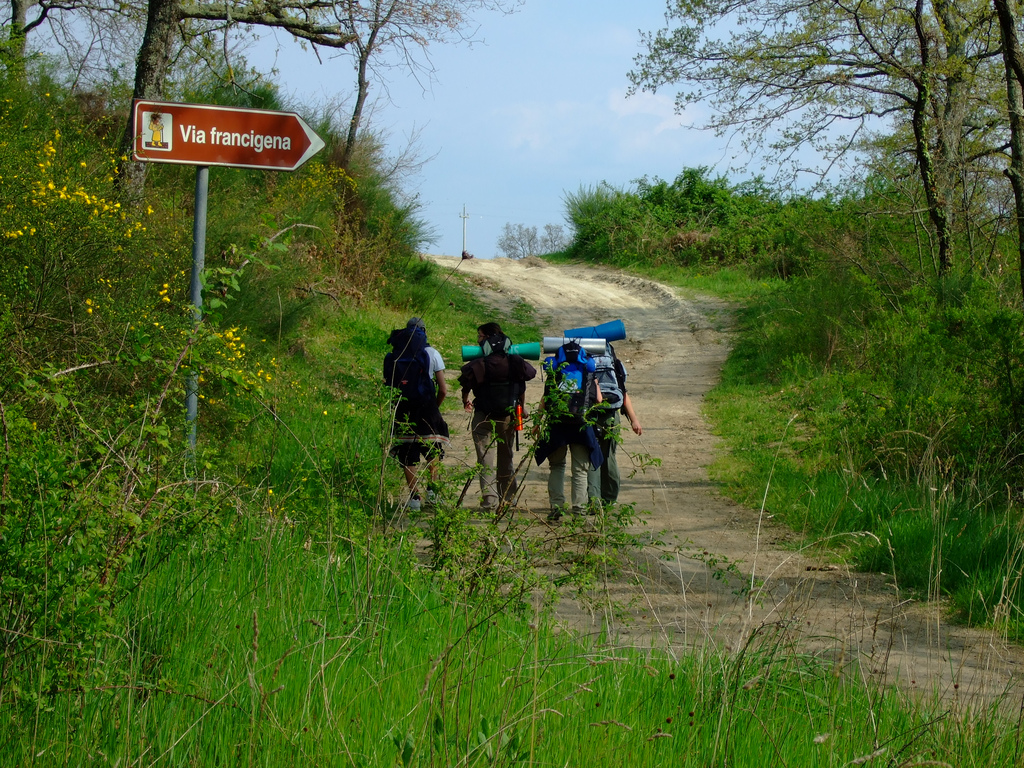
The Via Francigena, the Way of St. James, the Way of Francis are among the routes followed by thousands of pilgrims, especially during the summer. Their history is tied to that of Europe. They are the expression of Christianity journeying towards religious sites. These routes, awarded by international bodies, may serve as spiritual experiences, occasions for learning more about the Europe of the past and of today, highlighting significant and essential traits of European culture. Indeed, these routes (followed by increasing numbers of youths and peoples of all ages, many of them non-believers) help acknowledge the roots of modern Europe. Pilgrims towards Rome… The Via Francigena (info: www.viefrancigene.org), declared “Cultural itinerary of the Council of Europe” in 1994, comprises a set of routes (the so-called Vie Romee – Roman Pilgrimage routes) that connected central Europe, notably France, with Rome, which in the Middle Ages was considered one of the three “peregrinationes maiores” along with the Holy Land and Santiago de Compostela: the visit to the tomb of the apostle Peter. Currently, the pedestrian route of the Via Francigena in Italy is approximately one thousand kilometres long – from the Great St. Bernard to Rome – divided into 44 stops. Another route, not official yet, is that of the Via Francigena in the south, which unites the West to the East, Rome and the Holy Land. In Puglia, for example, there is a “Via Francesca”, which some claim to be the continuation of the Via Francigena to the south, trodden in ancient times by pilgrims who from Rome continued their journey to Jerusalem. Among the events planned this summer, the Abbey of Clairvaux in France, showcases until 20 October a didactic exhibition retracing the history of the paths to Rome. While the “Francigena International Arts Festival” with several stops along the Way, is ongoing until 21 August. …and at the tomb of St. James. The Way of Santiago de Compostela (www.peregrinossantiago.es/esp/), the long route that terminates at the Shrine where the tomb of James the Apostle is supposed to be, crosses France and Spain. Recognized a European Cultural Itinerary in 1987, the “Santiago Ways” have been declared “UNESCO Cultural Heritage sites” and with the passing of the years they have registered a remarkable increase in the number of pilgrims that follow the routes mainly by foot or on bicycles – 5 thousand pilgrims in 1990, 55thousand in 2000 and 215 thousand in 2013, half of whom are Spaniards. Among the foreigners, Germans, Italians and the French rank first. Such increases, – which reached a peak in the “Jacobean” Year 2010, considered a “Jubilee” year owing to the Bull issued by Pope Alexander III in 1179, which declared Jubilee Years those in which the annual feast of the Saint – July 25 – falls on a Sunday) show that Santiago is becoming, with the Marian shrines of Fatima and Lourdes, one of the favourite destinations of international religious tourism. On the route of Francis. In Italy, the “Way of Francis” is increasingly popular. Unlike the above-mentioned routes – i.e. the Way of Santiago and the Via Francigena, consecrated by a thousand-year-long tradition – the Way of Francis is not a true “road” traversed since ancient times but rather a route that links together several sites that testify to the preaching of the saint of Assisi. It is a Way that aims to revive the Franciscan experience in the land trodden by the Poor Man of Assisi. The destination is Assisi, while the starting points are the Shrine of La Verna in the north and the Sacred Valley of Rieti in the south. Both routes have major variations, veritable alternative routes, or rather suggestions for visiting important Franciscan sites, which would be otherwise overlooked. The spirit of the Way includes the “Path of Francis”, which connects the Umbrian sites of Franciscan spirituality and is inspired by the journey undertaken by Francis of Assisi in the winter of 1206 after having been stripped of earthly goods, to Gubbio, where his friend Federico Spadalonga lived, with whom Francis shared his captivity in Perugia and who had spoken to him of a Church reformed a few years earlier by the Saint Bishop Ubald.
