ALBANIA
The land that welcomes the Pope is a model of coexistence between different faiths. “It’s a part of our history”

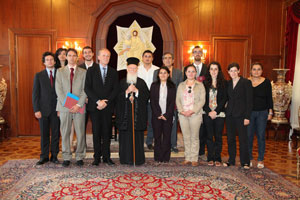
Albania, a land of dialogue and peaceful coexistence between religions: it’s not a mere acknowledgement drawn from cold statistics. It’s the history of a people whose century-long suffering – (from the Ottoman occupation until the proclamation by law of State atheism during the Communist regime (the only case in the world) – developed into a climate of mutual respect and cooperation between the various religions and Christian denominations, even despite difficulties. It is an aspect that will bring Pope Francis to visit, on Sunday September 21, the Country of the eagles. The Pontiff repeated it on several occasions since the announcement of his visit past June 15. In the general audience of September 17 His Holiness said: “I decided to visit this country because it has suffered greatly as a result of a terrible atheist regime and is now realizing the peaceful co-existence of its various religious components”. In fact, one of the most important moments of the visit of Francis will be the meeting with leaders of non-Christian religions and of other Christian denominations. In the anticipation of the event, Vincenzo Corrado for SIR Europe met a few experts to learn more on what could be best described as an “example” for Europe and for the entire world, as it was defined by John Paul II during his visit to the Country in April 1993. A strong bond. Albania is a Muslim-majority country. Reliable data is not yet available but 2014 estimates show that 56.4% of the overall population are Muslim, 15.9% Catholic, the Orthodox are 6.8%, the Bektashi (Islamic confraternity of Sufi derivation) 2.1%, other religions 5.7%, non specified 16.2%. Despite such diversified figures, said Gentiana Skura, who teaches intercultural and interreligious dialogue at the University of Tirana, “throughout history Albanians have not experienced inter-religious conflicts for any specific time, which shows that even in pre-communist time, religions in Albania have harmonically coexisted. This is a very important value of our nation. However, during the communist regime, there was an open conflict against religious authorities”. In fact, “in May 1967, 2169 religious institutions were destroyed and were transformed into state institutions”. Not to mention the fierce persecution against everything that was religiously inspired. “The open war against religion made most of the people respect religion in a hidden way. At that moment, different religious communities grew stronger and their mutual respect increased. The threats of the communist regime made them more united. There are several publications by Muslim and Christian authorities, which testify to this strong relationship between them, despite the risk of death”. Four models. Albania, said Genard Hajdini, Secretary General of the Inter-religious council of Albania (IRCA) is a veritable “model” of coexistence that reposes on four values “inscribed within the Country”. These are: “To keep one’s word, (besa), hospitality and/or generosity (mikëpritja e/o bujaria), courage (trima or trimëria), the family”. These values refer to our DNA, to our history”. “We respect everyone and we pray for peace in our Country and among our people”. But “not only among us…”. This is true also for our guest, for the stranger. “We call him miku (a friend of the family); we protect him/her from anyone, just as we protected the Jews during World War II, when none of them was killed or arrested in Albania to be handed over to the Nazis”. It is encapsulated in the slogan of IRCA: “To celebrate people”, according to the “commandment of love”, that teaches us “to love God as you love yourself”. Religious leaders, went on the Secretary General, “shake their hands, smile to each other, and visit each other’s homes during the mutual festivities, with true sincerity”. The fundamental message. The fact that there is dialogue and peaceful coexistence, remarks Altin Hysi, Secretary General of the Inter-confessional Biblical Society of Albania, “does not mean there are no differences among religions and confessional denominations”. However, “for various reasons”, these differences “have sparked off conflicts within the population. People find ways to live and work together regardless of their religion or religious denomination. Although they belong to different religions, Albanians have always felt the need to work and be together, as a people and as a nation”. For Hysi, “an important factor of this religious harmony is probably due to the fact that in Albanian families parents don’t raise their children educating them to differences of religious nature. This is a great merit of Albanian parents. The fundamental message is that it is possible to be different without mutually combating one another”. This is perhaps the secret of Albania, “a land of dialogue and peaceful coexistence”.
