FRANCE
The French Catholic Church chooses the web (www.findevie.catholique.fr) as a platform of thought and dialogue

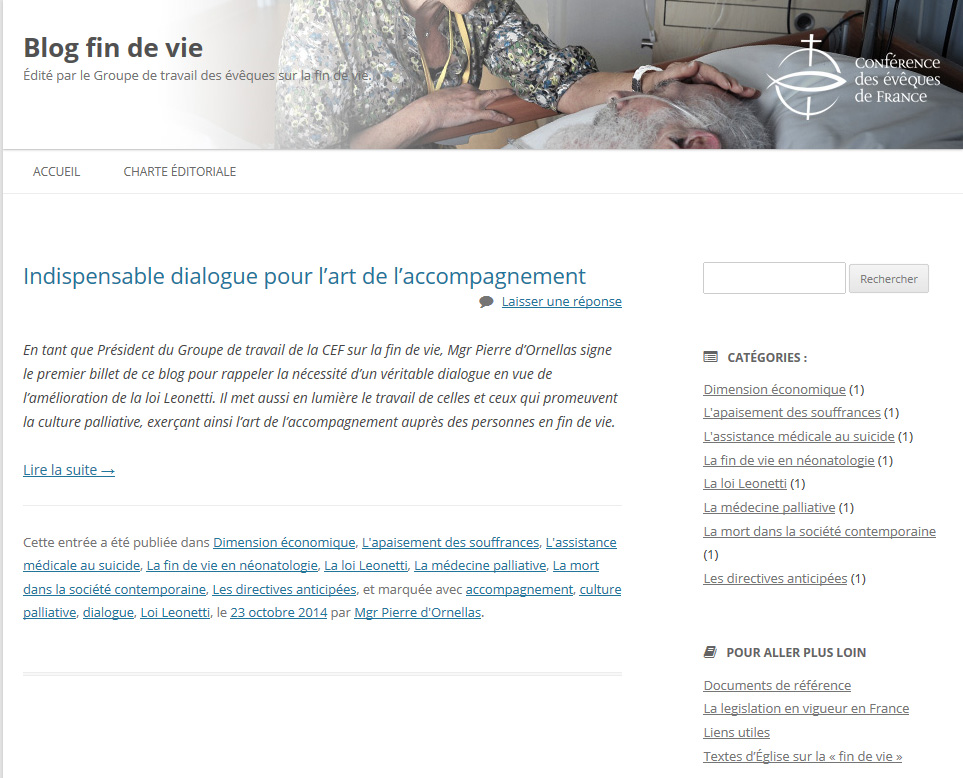
A blog to discuss a delicate and complex theme such as that of end-of-life: www.findevie.catholique.fr is the website that can be accessed by members of the virtual community. It is an area of open dialogue for all those who wish to address the theme of death, the limits of accompaniment to terminal patients, palliative treatments. The initiative is promoted by the French Bishops’ Conference, while the discussion is animated and run by Monsignor Pierre D’Ornellas, Archbishop of Rennes, whom the bishops appointed as responsible of bioethical issues. The Catholic Church thus chooses the Internet as a platform of thought and thinking. Everyone can participate and all opinions are welcome. The only recommendation is not to give in to emotional reactions and to be open to listening to someone else’s opinion and respect it. Previous experiences. It’s not the first time that the French Church promotes an initiative of this kind. It had already done so in 2009 when for the first time it promoted a blog on “Bioéthique”. Also on that occasion the doors of the web were wide open on issues related to embryo research, medically assisted procreation, prenatal and pre-implant diagnosis, surrogate motherhood. This gave rise to a lively discussion platform that involved experts in various disciplines and attracted thousands of users (as many as 96 thousand in 2009) from different Countries. It went on until 2013. Now the French Church has taken action and is proposing a similar area for debates on themes related to end-of-life. Mobilized Parliament. The choice of the theme is dictated by current events. Recent cases (in particular the tragic story of Vincent Lambert, a young man in a vegetative state after an accident) have led premier Manuel Valls to give a mandate to two MPs from opposing factions, Jean Leonetti (Ump) and Alain Claeys (Ps), to reopen the issue of end of life, agree on amendments to the 2005 law and present to Parliament on December 1st a written proposal to be discussed by the end of the year. The two MPs welcomed the “mission” and have scheduled hearings with religious leaders. On October 1st it was the turn of Mons. D’Ornellas. The themes. Why a blog? The archbishop of Rennes explained why: the Leonetti Law on euthanasia passed with unanimous vote in 2005. Ten years later an electoral promise made by the candidate Hollande re-opened the legislative debate. “Undoubtedly – the archbishop said – improvements to the text are needed. It would be illusory to hope that this process will take place without causing suffering in our society. For this to happen there must be a debate, since the absence of themes such as end of life, could be very painful”. These are the basic reasons for the French blog, which has adopted an “editorial charter” for its realization. In the meantime, the themes that are object of debate were defined in the letter that gives mandate to Premier Valls and to the two MPs. These are: the role of the law; death; end of life and suffering; freedom and dignity; the financial dimension of assistance to terminal patients. On these issues various experts will express their positions: doctors, nurses, healthcare workers, jurists, philosophers, theologians, members of associations. Dialogue and respect. Each contribution – states the “editorial charter” – represents an opinion expressed at personal level that does not involve in any way the Bishops’ Conference. A contribution, called “billet”, will be published every 15 days. Users will have the possibility of commenting or they may ask questions to the author of the contribution in the following 15 days, after which a new “billet” will be published, while it will still be possible to post comments on the previous one, which however will no longer receive an answers by its author. Finally, the “charter” states that the “moderator” of the blog retains the right not to publish the comments that are “incompatible with the spirit of dialogue and respect of other contributors, characterizing the blog”.
