EU COMMISSION " "
The hand-over from Barroso to Juncker prompts reflections on the role of the Executive and the challenges that lie ahead ” “

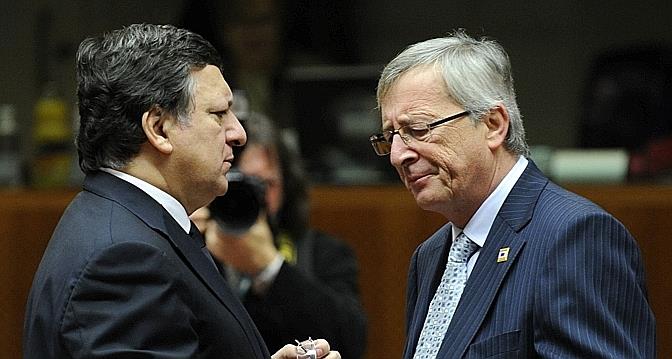
Parallel yet converging lives: it is an interpretation of the handover at the helm of the European Commission. In fact, on November 1° outgoing Portuguese President José Manuel Barroso, has retired after ten months of service (between lights and shadows) in Brussels. Luxembourg statesman Jean-Claude Juncker, who began an equally uphill mandate, takes his post. Experienced politicians. Barroso, born in 1956, married, three children, with a tentative academic career behind him, was an activist of Maoist university rights in Portugal under Salazar’s dictatorship. He had a change of heart in the recovered democracy that came about after the Carnation Revolution, when he became an affiliate of the Social-Democrats, namely, Portugal’s centre-right. He was then elected MP, Foreign Minister and finally premier, hitting world news for having hosted the 2003 summit between George W. Bush and Tony Blair aimed at planning Iraq’s invasion. On his part, Juncker, born in 1954, comes from a working-class family. He is married with two children and started his professional career as a lawyer. As a young man he joined the Christian-Democratic party of the Grand Duchy and was soon after elected MP, and then Prime Minister. In his curriculum figures also the governance of the International Monetary Fund and the presidency of the Eurogroup. That same Eurogroup in 2008 faced the crisis of the sovereign debt that initiated the feared and rigorist “Troika”. The same “moderate” line. Both leaders therefore belong to the same post-war generation. They share political activism in the European People’s Party, the same moderate-conservative policy, and a sound adherence to national identity, while cultivating, with coherence, a solid Community vision. They have both occupied primary posts in the EU, which went through a set of radical changes over the past 15 years, namely: the adoption of the euro currency, the failure of the constituent process, the “great enlargement” towards the East, the adoption of the Lisbon Treaty… Both statesmen have witnessed the outbreak of recession, realizing that neither national economies of member Countries nor the EU as a whole, had the required tools or the reaction capacities to face the global challenges and the ensuing disaster. Hence they began a difficult path aimed at the creation of authentic economic governance that is still underway. “Mission possible”. Numerous political commentators have signaled that the passage from Barroso to Juncker has marked an imminent change of pace in Community economic policies. The time of rigour has come to an end, they said, now it’s time for support to growth. But the biographies of the two Commission presidents, their distant and recent decisions, their public speeches, seem to prove otherwise: namely, exiting the crisis under the banner of the development of real economy and employment is a shared goal, but so is the awareness that without sound public budgets and national structural reforms investments for growth are practically impossible. This is where José Manuel stopped, and this is whence Jean-Claude is starting off. And while Barroso had to act from a defensive position, fending off the assaults of speculation, along with banking and corporation failures coupled by surging unemployment, Juncker now has no other choice that to play an offensive role to carry out a “mission impossible”, reorganization, and allocation of the promised 300 million investment package, to get enterprises, consumption and – most importantly – employment, back on their feet. Europe of results. Jean-Claude Juncker himself, in his first speech at the helm of the Commission (the EU’s executive organism), engine of common policies in Brussels and “guardian of the Treaties” and of their enforcement, spoke of a “last chance” for Europe and for Europeans alike. Perhaps with minor emphasis but with equal determination, Barroso often said: “common problems need common solutions”.The words change but the concept is the same. What is needed – quoting from Barroso – is a “Europe of results”, provided that Member States governments don’t draw boundaries, as it often happens. This is the path that will bridge the EU’s democratic gap and ensure that citizens regain confidence in the “common home”, in order to overcome nationalisms and populisms lingering across all corners of Europe. Barroso is well aware of it. Juncker has been warned.
