EDITORIAL
John Paul II delivered a historical – topical – speech at the European Parliament in 1988, while the visit of Francis draws near” “

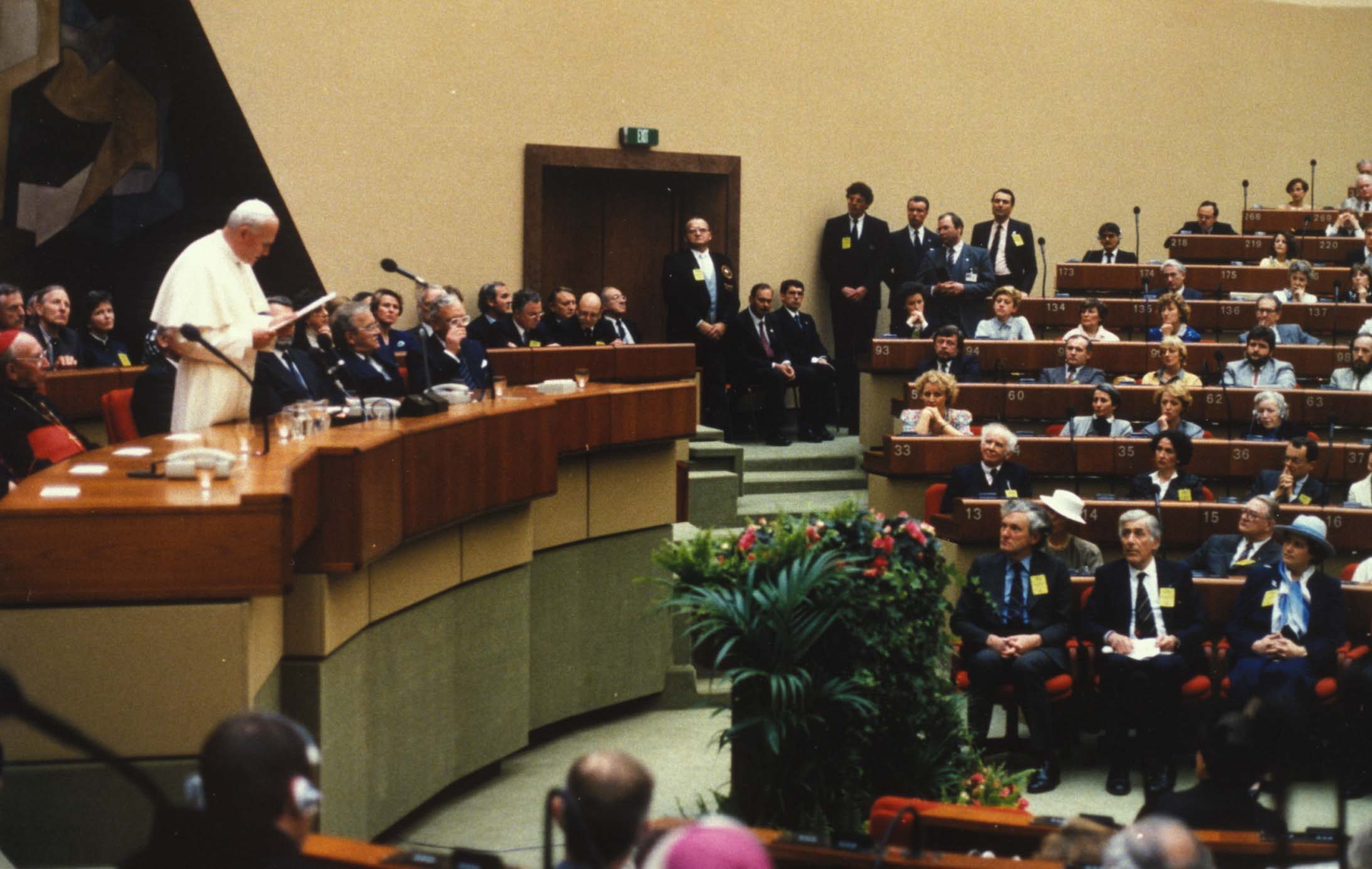
“The Church cannot ignore the construction of Europe. Her century-long roots lie amidst the peoples that make it up, and one day she led to the baptismal font peoples for whom the Christian faith is and remains one of the elements of their cultural identity”. It was October 11, 1988. Twenty-six years since the visit of John Paul II to the European Parliament in Strasbourg seat it is worthwhile rereading his words against the backdrop of the upcoming meeting of Pope Francis with the EU Assembly and the Council of Europe. It will happen November 25, in a city that is at the same time the symbol of a dream and a commitment for peace, justice and solidarity. Many faces and many scenarios have changed since then, but there are words that passed without being consumed by time and space, and that represent a key to understanding the present and the future. Thus the words of John Paul II, “Your Europe will be that of the free association of all peoples and of the sharing of the manifold richness of its diversity”, come from the heart of the Christian faith, and for their origin they extend to the field of the life and thought of the peoples of Europe. The post-synodal apostolic exhortation “Ecclesia in Europa” of June 28, 2003 speaks from this perspective. What should we expect from Francis, who in a few days will be speaking in Strasbourg? What will Europe say to a Pope who comes from a land that is on the other side of the world? We will have an answer on November 25, but already after the Angelus on November 9, remembering the fall of the Berlin Wall, “the symbol of the ideological division of Europe”, the Pope sent a signal: “We need bridges, not walls!” On the eve of the meeting of Bergoglio with European organizations, the “European thought” of Wojtyla can enrich the period of waiting even when it becomes a warning, like the one contained in the passage of the speech of 11 October 1988: “No one could imagine that a united Europe would be trapped by its own selfishness”. In their self-confidence the people of Europe have disregarded the risk that the Polish Pope pronounced with clear words: “Whenever man no longer relies on a greatness that transcends him, he is likely to indulge in the unbridled power of arbitrariness and of pseudo-absolutisms that destroy him”. The warning in no way decreased Pope Woityila’s faith in Europe, in fact, it reiterated an invitation to Christians to place their sensitivities and their skills to the service of European institutions in order to strengthen and expand a common home whose doors are open to the rest of the world. Europe’s vocation to the world lies is this passage from the speech of 1988: “Other continents today experience a more or less profound symbiosis between the Christian faith and culture, which is full of promises. But after nearly two millennia, Europe offers a very significant example of Christianity’s contributions to culture, that, by its nature, must not be limited to the private sphere. Christianity, in fact, has a vocation for public profession and active presence in all areas of life”. Does this example still apply today? This is one point on which we can expect a further reflection by Francis, we can expect a message to Europe with the warmth and the hope that come from “the other side of the world”. Of course, there will be words that will question and spur on a Europe that to most of us appears tired, aged, and resigned. Looking forward to November 25 it’s good to remember the three areas in which Pope John Paul II twenty-six years ago called for Europe to “act as a beacon for world civilizations”. Those words continue to bear topical relevance: “to reconcile man with the creation”, “to reconcile man with his fellow others”, “to reconcile man with himself”. These are the tasks of all European citizens and of European institutions in particular, for which John Paul II called for, even demanded, honest and competent Christians. It is a question which should encourage thoughts and commitments to preserve a light of humanity: Europe inside and outside its own borders.
