GERMANY" "
Catholic and evangelical Churches’ joint call to guard against increasing weapon export and production

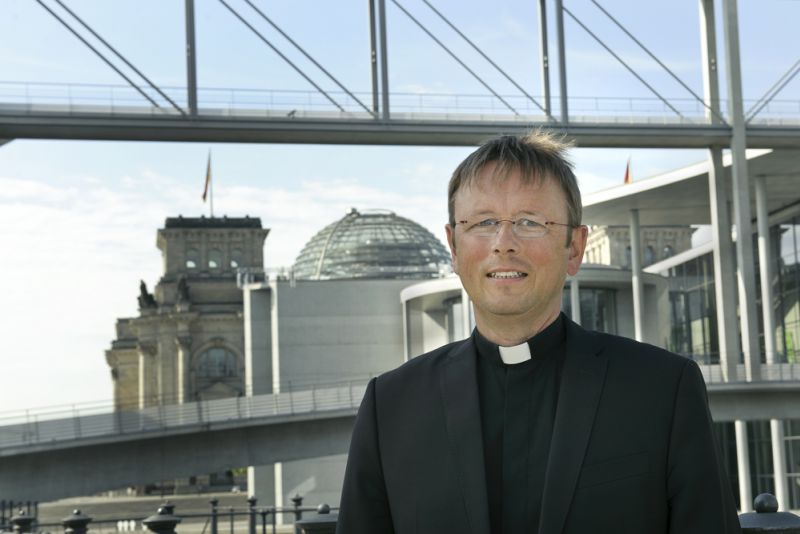
The Joint Church and Development Conference (GKKE, Gemeinsame Konferenz Kirche und Entwicklung) is an ecumenical organization of the Catholic and evangelical Churches in Germany, whose tasks include compared analysis of socio-cultural phenomena in the North and the South of the globe. Since 1997 GKKE releases a joint report in which, with the help of experts in the sector and with the support of a specialized institution, the BICC, Bonn International Center for reconversion, are collected and analyzed publicly accessible data on arms exports (big and small) from Germany. The 2014 Report, the 18th published so far, strongly criticizes significant growth rates recorded in the offer and sale of arms to third countries. Massimo Lavena for Sir Europe asked Msgr. Karl Jüsten, Catholic president of GKKE, Chairman of Katholisches Büro Berlin, to explore the themes of the current Report. How could the ecumenical activity of the Catholic and evangelical Churches contribute to the effective reduction of arms trade? “Thanks to our pressures, the federal government publishes an annual report similar to ours. The German population is very critical of arms exports. This year, the report on the authorization of exports of armaments in 2014 was published for the first time in the summer of 2014, and in October was presented an interim report with additional figures for the first half of 2014. This is a big step forward in terms of transparency. But speaking openly and freely of arms exports, it should be assessed whether the criteria of exports from Germany and Europe are respected. As for the formulation of these criteria, the Churches have expressed their ethical criteria and their guidelines relating to the ethics of peace. Much of this has been taken into account. The growing criticism by the Churches and civil society, also due to increasing transparency, has contributed to the federal government’s decision to decrease authorizations of exports of small arms from Germany to third countries outside the EU and NATO, weapons that can have devastating effects. We also fought bitterly to ensure a ban on landmines”. Increasing arms exports in crisis areas is accompanied by increased transparency of information on sale flows. What do non-official, non-controlled sales amount to? “We can only analyze the legal exports of weapons. We ignore data on illegal exports. For years, we have been highlighting the problem of dual-use goods: these are technologies produced by the civil industries, which however could also be used for military purposes, for the production of weapons. We also criticize the fact that weapons could be resold and end up in countries that, according to our criteria, should not receive weapons. Control over the final destination is lacking, although the German Federal Minister for the Economy announced more intensive monitoring”. Other urgent problems…? “The Country contributes to the setting up of arms factories in countries with not guarantee that the manufactured weapons will end up in safe hands. This is a serious problem. This is why we criticized the authorization granted to a site for the production of amphibious armoured transport vehicles in Algeria. As for small arms, which are the weapons of mass destruction of our times, their illegal proliferation usually begins in the form of legal exports of weapons from one State to another, meant to equip the army or the police forces. Failing security, a weak State, poor security sectors, are among the causes of widespread illegal armaments trade. The Arms Trade Treaty, determined in 2013 by the UN General Assembly, offers new opportunities for controlling the arms trade worldwide. To ensure the efficacy of the Treaty, vulnerable States in particular must be given greater support in terms of surveillance and for the creation of efficient state-control systems”. Germany is a major weapon manufacturer and exporter. Is the issue of market reconversion a feasible path? “Arm production in Germany is decreasing. Many companies in this sector have increased their production for civil use. Large companies manufacturing only weapons have a difficult future ahead of them. In fact, in the year 2000 the federal government decided that job retention is not a good reason to export weapons. In general, too many weapons are still produced throughout the world, even by our friend Countries in the EU and NATO”.
