EDITORIAL/1
The Old Continent, threatened by crises and nationalisms, strives to reach peace and unity of intentions. Is there a need for a new “Schuman Declaration”?

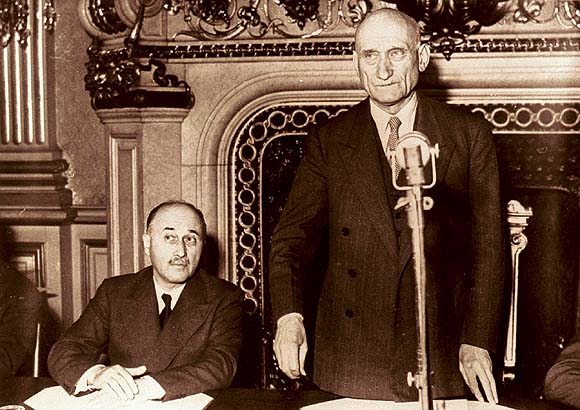
Some anniversaries are worth celebrating. The Old Continent will celebrate two anniversaries in the coming days. May 8 marks the 70th anniversary since the end of World War II, the “great darkness” in the history of humanity, symbolically represented by the crematory ovens of Auschwitz, by battlefields and by military cemeteries disseminated across Europe and by the atomic bomb on Hiroshima and Nagasaki. May 9 is the 65th anniversary of the Schuman Declaration, with which the community integration process that led to today’s European Union was formally launched. These dates reveal the topical relevance and highlight evident bonds. In fact, the conclusion of the second world conflict recalls the supreme value of peace, which has constantly been under threat. Peace is still lacking in many areas of Europe (our first thought goes to Ukraine, as well as to other areas that are far from being pacified, like the Balkans) and in too many regions of the planet. The Schuman Declaration, a milestone of the “common home”, that opens with a call to peace, became the real “mission” of European economic and political integration. “”World peace cannot be safeguarded without the making of creative efforts proportionate to the dangers which threaten it”. The words of the then French Foreign Minister, concerted with Jean Monnet, Konrad Adenauer and Alcide De Gasperi, today take on a prophetic value. So much so that at the “The State of the Union” event in Florence, promoted by the EU’s European University Institute, was presented the draft of a “New Schuman Declaration”, as if to interpret the need for a European renaissance, although over the decades the situation has changed completely. Indeed, 21st Century Europe, and the Europe of the second post-war period, is once again in need of peace among its States, of mutual understanding between its peoples, solid institutions that will guarantee democracy and rights as well as shared values, social and economic development, employment, strong and constructive relations with neighbours, notably in the Mediterranean and in the Middle East, which are the source of constant demographic pressures that upset the consciences (not all of them, to say the truth, and never enough) of European citizens. It’s Third Millennium Europe, that witnessed with concern, and with a certain degree of disbelief, the elections in the United Kingdom, the most ancient parliamentary democracy, marked by the protagonism of secessionist, regionalist and anti-European political parties. Until today, the island had kept a foot in and a foot outside the Community, until it confined itself in a corner of Europe, and later wondered how it could recover a central role – both at cultural and political level – in a Union marked by weaknesses and delays, crises and nationalisms, but still among the protagonists of the global scenario. At the same time – Europe is faced with the unsolved question of Greece. A country in a stalemate, and on the brim of default, determined to speak out against a “selfish” and sullen Europe, unable to carry out urgent – albeit painful – internal reforms which appear to be the only way to bring back Athens – the ancient cradle of democracy – into the league of modern and developed European democracies. “Europe will not be made all at once, or according to a single plan. It will be built through concrete achievements which first create a de facto solidarity”: it’s another passage of the Schuman Declaration, which prospects the path of progressive results to be obtained by applying the solidarity principle. Patience and unity of intentions, for a united, modern Europe: the long path of integration can continue also from here.
