TO ITALIAN BISHOPS
Francis opened the CEI Assembly. Reflections on co-responsibility, collegiality, communion. Message with universal bearing

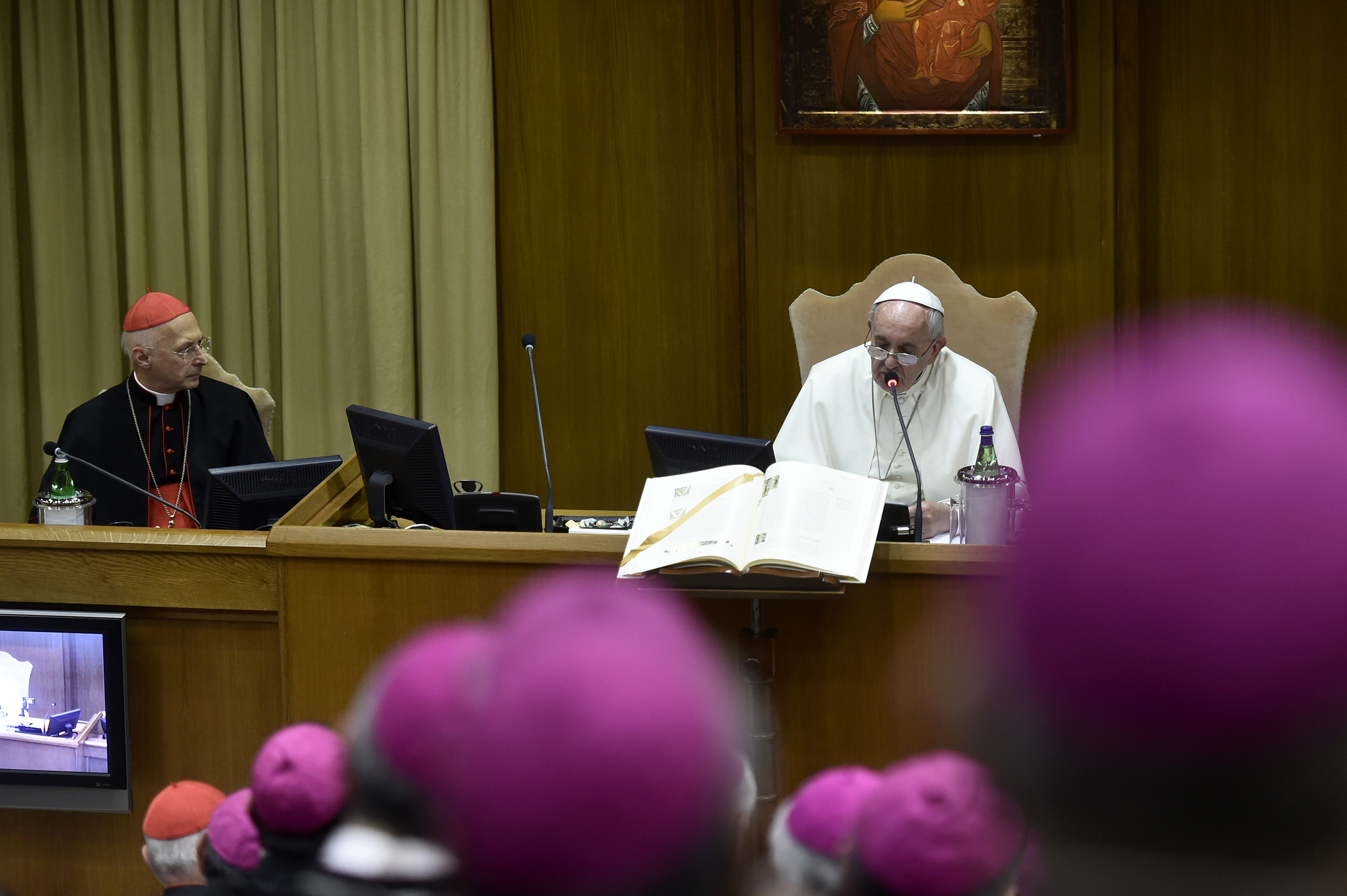
“Ecclesial sensibility” means “to appropriate for oneself the same sentiments of Christ, of humility, of compassion, of mercy, of concreteness – Christ’s charity is concrete – and of wisdom”. Pope Francis traced this full-fledged portrait in his third speech to Italian bishops delivered May 18 in the opening session of the 68th CEI general Assembly. In ten intense minutes the Pope explained that “ecclesial sensibility” has “grown weaker because of the continuous confrontation with enormous world problems and the crisis that does not even spare the Christian and ecclesial identity itself”. That’s why it is necessary to address this problem condemning “private and public corruption” and reacting to various forms of “ideological colonization”. To win this challenge the pastoral realm is decisive. The laity should not be in need “of a Bishop-pilot”; they should be able to assume their “responsibilities” in all areas. There is no need for conferences that “narcotize the communities”, with abstruse and incomprehensible documents, there is a need for “collegiality and communion”, between “the rich Dioceses – materially and vocationally – and those in difficulty”. Also ageing monasteries and congregations can become “an example of lack of ecclesial sensibility” unless they are “consolidated before it’s too late”. “It’s a global problem”, was the Pope’s impromptu remark. Going against the tide. “In this realistically poorly comforting picture”, according to the Pope’s analysis, “our Christian and Episcopal vocation is to go against the current: that is, to be joyful witnesses of the Risen Christ to transmit joy and hope to others”. “Our vocation is to listen to what the Lord is asking us” – the Pope added quoting Isaiah – ‘Comfort, comfort my people, says your God'”. “We are asked to console, to help, to encourage, without any distinction, all our brothers oppressed under the weight of their crosses, accompanying them, without ever tiring of working to raise them up again with the strength that comes only from God”. “It is very unpleasant to meet a consecrated person who is dejected, unmotivated and spent: he is as a dry well where people do not find water to quench their thirst”, Bergoglio cautioned. It is therefore necessary to recover “the joy of the Gospel, in this historic moment when we are often surrounded by disturbing news, local and international situations that make us experience affliction and tribulation”. No to “corruption” and “ideological colonization”. For Francis “ecclesial sensibility” “entails also not to be timid or irrelevant in renouncing and overcoming a widespread mentality of public and private corruption that has succeeded in impoverishing, without shame, families, pensioners, honest workers, Christian communities, discarding young people, systematically deprived of all hopes for their future, and especially marginalizing the weak and the needy”. It is ecclesial sensibility that, as good pastors, makes us go forth to the People of God to defend it from ideological colonisations that take away human identity and dignity”. Invitation to emancipation. “Lay people that have authentic Christian formation should not be in need of a Bishop-pilot, or of the Monsignor-pilot or of clerical input to assume their own responsibilities at all levels, from the political to the social, from the economic to the legislative! Instead, they are all in need of the Bishop Pastor!!” That of the Pope is a true invitation to emancipation, which extends beyond the border of the Italian Church, with a European and global scope. “Ecclesial and pastoral sensibility”, for Francis “is concretised also in strengthening the indispensable role of the laity willing to assume the responsibilities they correspond to”. Also in pastoral choices and in the elaboration of Documents “the abstract theoretical-doctrinal aspect should not prevail, as if our guidelines were not destined to our People and to our Country – but only to some scholars and specialists – instead, we should pursue the effort of translating them into concrete and comprehensible proposals”. “Collegiality” and “narcotising” conferences. Ecclesial sensibility “is revealed concretely in the collegiality and communion between the Bishops and their Priests; in the communion between the Bishops themselves, between the rich Dioceses – materially and vocationally – and those in difficulty, between the peripheries and the center, between the Episcopal Conferences and the Bishops with the Successor of Peter”. The Pope drew an accurate, detailed list, and denounced, “a widespread weakening of collegiality”, “in the determination of pastoral plans, as well as in the sharing of economic-financial programmatic commitments. The custom is lacking of verifying the reception of programs”. For instance, a congress or an event “is organized that, putting in evidence the usual voices, narcotizes the communities, homologizing choices, opinions and persons”.
