COUNCIL OF EUROPE
Interview with vice-secretary general Battaini Dragoni. Dialogue between faith communities, institutions and culture promoted in Strasbourg

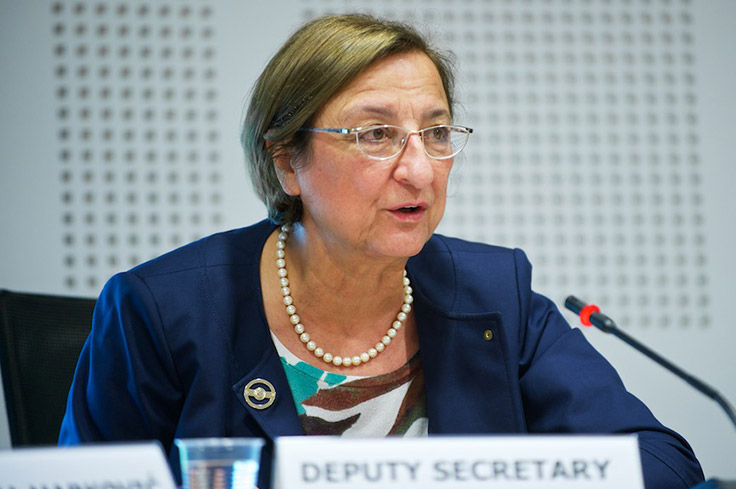
The promotion of the role of religions in intercultural dialogue, in the fight on radicalization and violent extremism, cooperation with Mediterranean Countries and those in the Middle East, the stabilization of Libya. These are some of the themes on the agenda at the Council of Europe. Giovanna Pasqualin Traversa interviewed for Sir Europe the vice Secretary General Gabriella Battaini Dragoni, who on June 8, at the Palais de l’Europe in Strasbourg, presided over a seminar promoted by the Permanent Mission of the Holy See at the CoE in preparation for the 2015 edition of the meetings on “the religious dimension of intercultural dialogue” (Sarajevo 8-9 September). What value does the Council of Europe ascribe to religions? “Several years ago we realized the importance of involving religious leaders as well as representatives of organizations of atheists and agnostics to facilitate mutual dialogue on rights and on the respect of the different decisions in order to contribute, starting from the fundamental values contained in the European Convention on human rights, to the creation of an ‘inclusive’ society also by adopting the tools of education and intercultural dialogue. The CoE has just launched a plan for the fight on radicalization and the meeting in Sarajevo will be particularly significant because it falls within this framework”. What does this plan envisage? “Legal and social measures, starting with the Convention on the Prevention of Terrorism and the Additional Protocol adopted by the Committee of Ministers on May 19 against the phenomenon of foreign fighters. The plan envisages controls to prevent their departure towards the countries in the Middle East, increased exchange of information between security services and the national intelligence, ensuring surveillance once back in their countries of departure. Our task is to ensure that safety is not at the expense of democracy or human rights; we need to find a balance between the two. It is increasingly important to prevent the escalation of fundamentalism in prison. In fact, in several countries, in France in particular, some of the convicts sentenced for minor crimes come out of prison as fundamentalists”. What can the school environment do in terms of prevention? “It can do a lot. To this regard, we developed a three-year program. It is necessary to create, through teaching, a way of speaking about our history, culture and society, that is respectful of other cultures, in order to avoid condemnations and feelings of exclusion that could expose to the risk of fundamentalist manipulation, but we should also ask ourselves how we can integrate the various communities within our societies. Our conventions are open to neighbouring countries. If they agree to ratify the Protocol we will be able to make a step forward, creating a legal area for the fight on terrorism and on the phenomenon of foreign fighters. In this commitment based on prevention, the role of the various religious denominations and of their leaders – acting as filters and as mediators of messages -plays a fundamental role. A new session of negotiations on Libya opened in Morocco under the aegis of the UN… “For years the Council of Europe has been promoting neighbourhood policy on the southern shore of the Mediterranean and with the Middle East. After the ‘Arab Springs’ we offered support and assistance to Morocco, Tunisia and Jordan. As regards Libya, divided between the government of Tobruk, recognized by the international communities and the pro-Islamic factions in Tripoli, we tried to contact the legitimate authorities to discuss their constitutional reforms, since the constitution is the backbone of a Country. However, we sadly had to admit that while on the one side huge international efforts aimed at helping the Libyan party to sit around the negotiating table to reach a much-needed compromise solution – since the situation cannot be solved through military action but through negotiations – we realised that inside Libya there are parties that support the military struggle in order to prevail over the other factions. Let us hope that we shall see the glimpse of a solution before the end of the month”.
