CHURCHES IN BRIEF" "

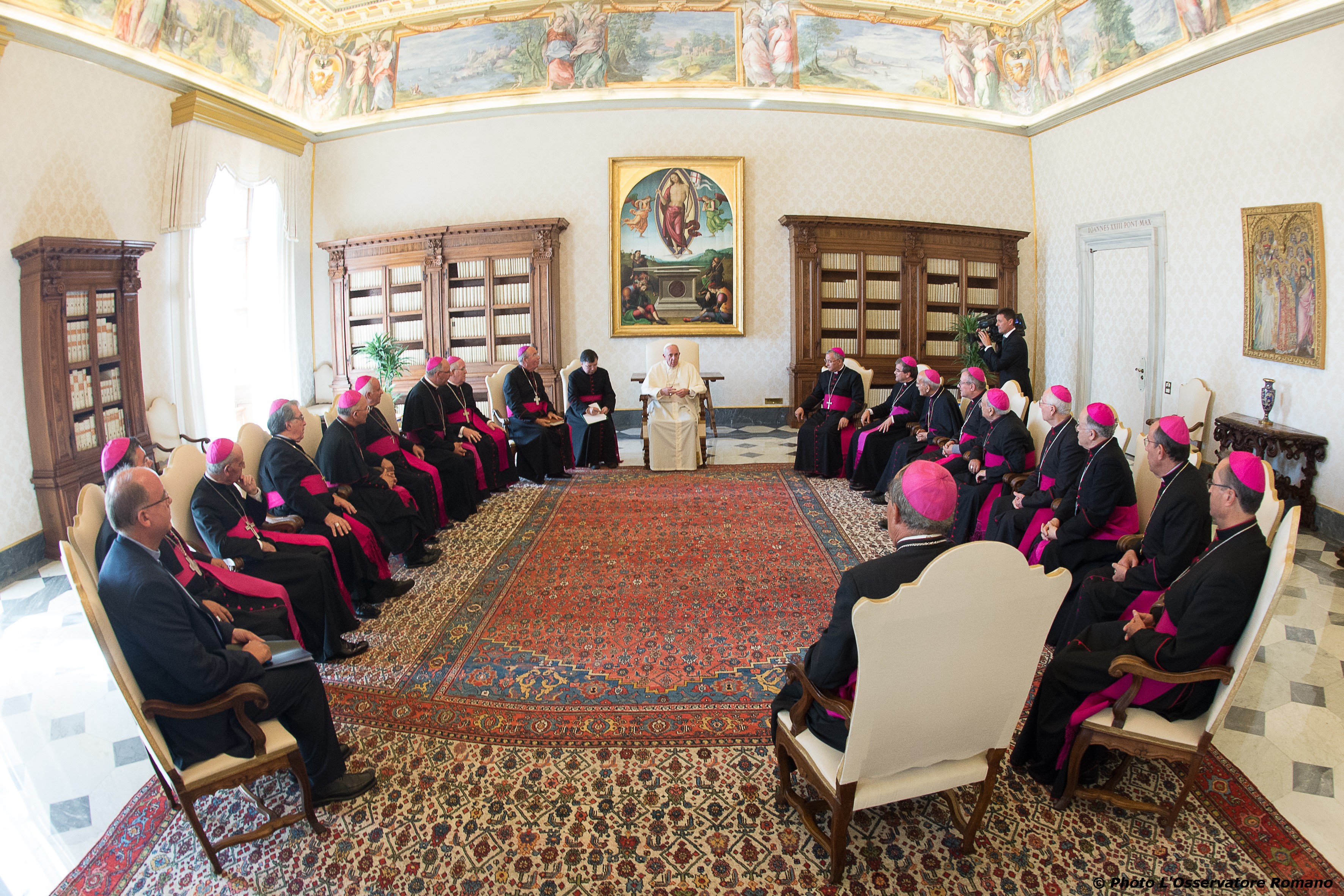
Portugal: the bishops’ “Ad limina” visit to the PopeThe Ad Limina apostolorum visit of Portuguese bishops began on September 7, when the prelates presented to Pope Francis an “overview of the life of the dioceses in the Country.” At the first meeting in the Vatican the Pope received first the bishops of the ecclesiastic provinces of Lisbon and Evora, followed by the prelates of the archbishopric of Braga. Finally, “Pope Francis welcomed the entire group consisting of 38 bishops, with great friendship, with a dedicated address meant to guide the future life of the Portuguese Catholic Church”, made known the Secretary of the Bishops’ Conference, Fr Manuel Barbosa. “The Portuguese episcopate has undertaken this journey as a special moment of grace and as an opportunity to reflect upon the pastoral guidelines for the coming years”, the spokesperson added. Since his first speech the Pope called upon the Portuguese Church to undertake a reflection on its situation, where, he said: “Today our proposal of Jesus is not convincing.” “Jesus walks with the youths… Unfortunately, the currently mainstream thought, whereby the human being is viewed as an apprentice-creator, completely inebriated with freedom, finds it hard to accept the concept of vocation in its highest sense of a calling that the human person receives from the Creation of his own being and life.” Thus the Pope invited the catechists, and the Christian community as a whole, “to pass from the educational to the catechumenal model, namely, to focus not only intellectual knowledge but also on the personal encounter with Jesus Christ, lived in a vocational dynamics whereby God calls and the human person responds.” “The Portuguese Church needs young people that are able to respond to God’s calling, to create stable and fruitful human Christian families, and to have consecrated men and women who leave everything to follow the treasures of the Kingdom of God.” Nordic countries: Msgr. Kozon at the head of the bishops The Bishops’ Conference of Nordic Countries, gathered in its autumn Assembly from September 4 to 8 in Copenhagen, re-elected its members to the various positions. The bishop of Copenhagen Mons. Czeslaw Kozon was elected President for the next four-year term. The post was held for the past ten years by the bishop of Stockholm, Msgr. Anders Arborelius. Inter alia, Msg. Teemy Sippo, bishop of Helsinki, was elected at the permanent Council, in addition to Kozon and Arborelius. The seven bishops of five Countries members of the Bishops’ Conference (Sweden, Denmark, Norway, Finland) have renewed a four-year mandate to Sister Anna Mirijam Kaschner, Secretary General of the Conference, in office since 2009.Croatia: Stepinac and the rescuing of the Jews The latest issue of the scientific journal “The Catholic Historical Review” features an article by the American historian of Jewish origin, Esther Gitman, to “contribute to the debate about the role of Archbishop Alojzije Stepinac of Zagreb during the difficult years of World War II.” The news was given by the Croatian Catholic University. The title is “Archbishop Alojzije Stepinac of Zagreb and the rescuing of the Jews, 1941-1945.” In the article, the author “shows how the archbishop of Zagreb took action to rescue hundreds of members of the Jewish community in Croatia”, and endeavoured to save “over a thousand Jews in mixed marriages as well as many others threatened by the Nazi regime.” Having researched various archives, testimonies of the survivors and of family members as well as other documents, the author shows how Stepinac “responded to the policy of the Ustasha regime that followed the orders of the Nazis and fascists, and how he used his position in the Church to promote the rescuing of Jews.” Spain: a survey on Church social doctrine The 22nd training course in Church Social Doctrine, which focuses on “The economic logics and the fight against inequalities”, will end on September 9 in Madrid. The initiative is promoted by the Bishops’ Commission for Social Pastoral Care of the Spanish Bishops’ Conference (CEE). Over the past days participants delved into various themes, such as “Inequalities in Europe and Spain: economic and social consequences”, “The common good in the fight against poverty”, “Samaritan ethics today: benchmark values and practical requirements for the Church.” Panel speakers included, inter alia, Jorge Nuño Mayer, Secretary General of Caritas Europe, Pedro José Gómez Serrano, economist, Francisco Lorenzo Gilsanz from the Foessa Foundation, Fernando Fuentes Alcántara, Director of the CEE Secretariat of the Commission for Social Pastoral Care.
