editorial" "
40 years since the start of Vatican Council II, ” “ecumenism is growing despite difficulties and is uniting European Churches and cultures ” “” “

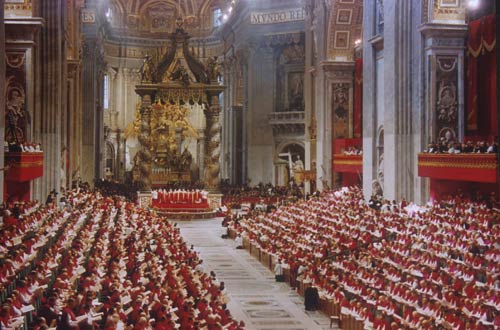
Forty years since the opening of the Council we need to pose some questions: “Has Vatican II succeeded in conferring an innovative spirit on dialogue between the Churches? Have the Churches succeeded in drawing closer to each other? What point has been reached by the ecumenical dialogue promoted by the Council?” A fundamental presupposition for understanding the “why” of the Council was the willingness to enter into dialogue that characterized, in the 1960s, a world that had only recently emerged from the catastrophe of the second world war. This was the context in which the first concrete step of dialogue between the “sister Churches” found its natural collocation: the reciprocal annulment of excommunication by Paul VI and patriarch Athenagorus. Vatican II ensured that the two “sisters” or the two lungs should once again breathe in unison. The words addressed by Athenagoras to John XXIII deserve to be recalled in this regard: “We are brothers to each other. Peter and Andrew were brothers and as brothers cooperated fraternally together. We Catholics and Orthodox should do likewise. The door has been opened by Christ and no one can close it; we must only enter”. We need to enter, but where and how? Each human confrontation is composed of dialogue and opinions which are often different but converging on the unique and immutable values of truth and of life. Nonetheless, to be authentic and effective, dialogue requires a capacity to renounce, forgive, listen, and strip oneself of all personal pride. Today a certain “crisis” in the ecumenical process is undeniable, but it’s not the Council that is to blame for this; the blame lies elsewhere, perhaps in our way of understanding and acting. A “crisis” does exist in dialogue between the parties but this term should not be considered in its possible negative aspect, i.e. in terms of “collapse” or “one way street”, but in terms of its positive potential, which is that of indicating a time which may indeed be one of instability but also of choice and decision. Just as happens in a family where it’s said that “the marriage is in crisis”, but where the personal commitment of each of its members does not slacken and becomes on the contrary more fervent, more focused on the true values that have generated it. And so people discover that the marriage overcomes its crisis stronger and firmer than before. What a mystery and, at the same time, what a great truth! But how can the signs of the overcoming of the crisis be glimpsed? We need to acquire the eyes of Christ and the consciousness that no sacrifice is lost, that each tear has its value and that the secret of the world is contained in St. John’s maxim “God is love”. Just as the young man who was only intent of accumulating gold, and who only on the day when his last remaining friend presented him with a pair of glasses through which he could see nothing because the lenses were of gold grasped that the time had come to reflect on what is really important, so we too must ascertain what we have in our heart and claim to safeguard as faith. It would be enough, in other words, simply to take off the glasses of bad faith to see the small but decisive steps taken in the ecumenical field in the long journey towards the full unity so deeply desired and professed by Vatican II: a unity that is not juridical, but conciliar, liturgical, a unity in diversity. Of just such a step, extraordinarily moving, we are witnesses just as I write these lines: the visit that the patriarch Teoctist of the Romanian Orthodox Church is now making to the Holy Father and, through him, to Italy and to the whole Catholic world.
