COMECE
Europe Infos December issue

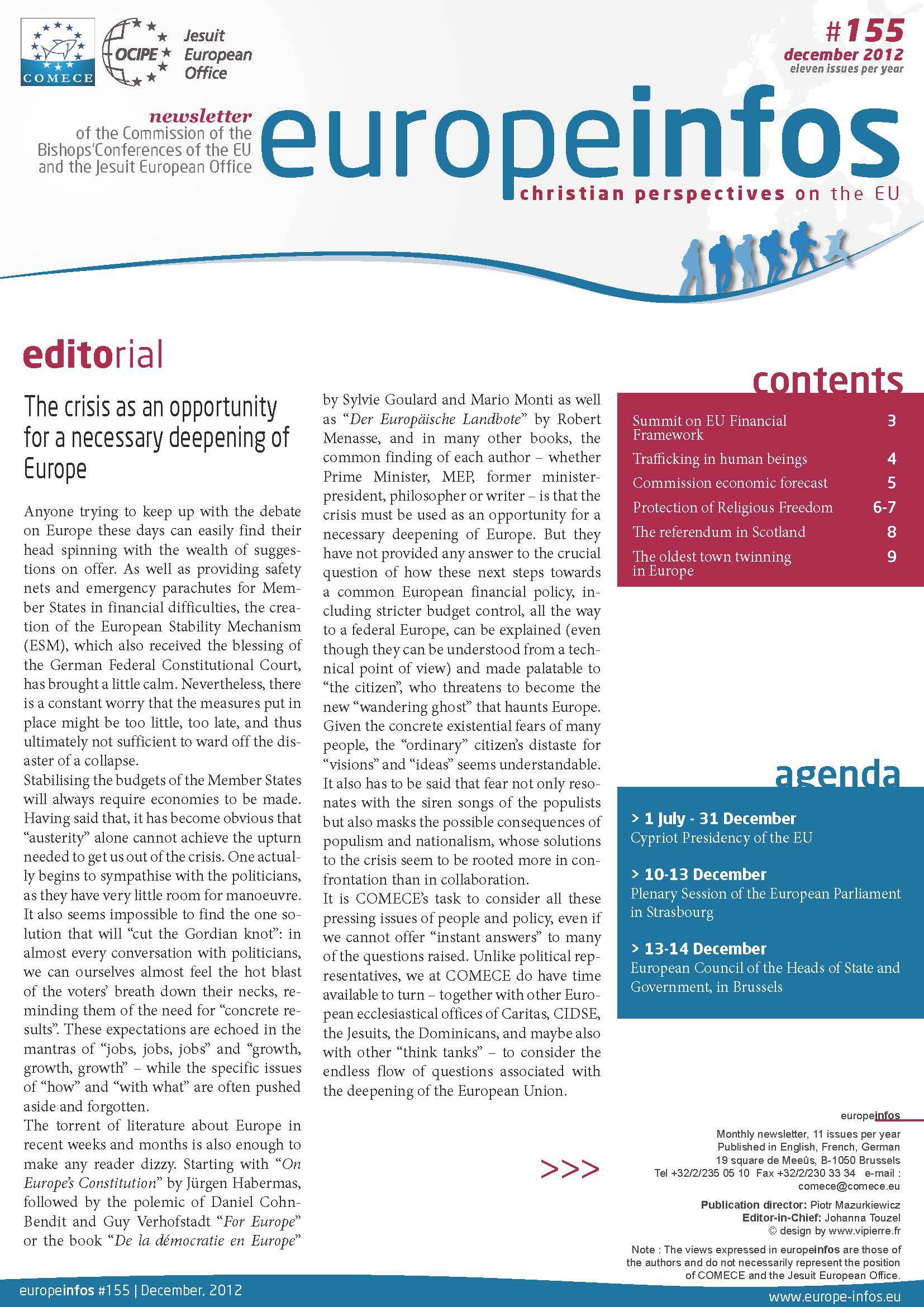
In its latest 2012 monthly newsletter Comece has dedicated various articles to the economic crisis, with comments from Stefan Lunte, Frank Turner, and the editorial by Michal Kuhn, Comece secretary general pro tem. The newsletter also addresses policies to fight human being trafficking, foster human rights related to Religious Freedom, Scotland’s search for independence and the oldest twinning experience in Europe which dates back to the IX th century.Human being trafficking in the EU. "It is estimated that almost 880,000 human beings are victims of trafficking for commercial reasons in the EU every year (out of almost 21 million in the world for profits of about 25 billion euro) mostly children and women – sexual exploitation being the most common form of trafficking and an increase in men labour exploitation. Countries of EU origin: Romania, Bulgaria, Poland and Hungary: follow Nigeria, China, Vietnam, Ukraine and Russia". Are some of the features highlighted by José Luis Bazán, Comece secretary, in the analysis that the Eu started producing since the ’90s to stop this aberrant trade. "However, through the 2000s the outcomes have been weak and disappointing even due to the complexity of the phenomenon and the ease of change in the criminals’ patterns of behaviours and organization". Three Eu directives of 2011, and the appointment of an EU Anti-Trafficking Coordinator and the launching in June 2012 of a specific EU Strategy will improve the results "even if the main responsibility for addressing trafficking lies in the Member States and their obligations to transpose and implement EU Directives: severe sanctions, early identification of, assistance to and support for victims, training of law enforcement officials and prosecutors. The most important thing however is prevention, through an understanding of the root causes of trafficking – both in the demand and supply sides- which are not only social and economic and cultural but also of moral nature".Grim economic forecast from the European. "The 200-page document on the European Commission’s new economic forecasts, covering the two years to the end of 2014 is enlightening" said Frank Turner, of the Jesuit European Social Centre, " its primary purpose is to support rational policies rather than guesswork", while "the second function of such official documents is distinctly unscientific and entails communicating confidence, since loss of it can be fatal to an economy". Here lies a genuine dilemma. "Forecasting a crisis will make it even more likely: but if the clarity is not permitted, what is the point? The Commission’s forecast bears the signs of this dilemma". "The tacit obligation to avoid stirring up fear", therefore this document employs a dehumanised language: its constant euphemisms deny actual experience. For example "difficult post-crisis correction" as if the crisis were now overcome and the words adjustment and confidence each occur more than 100 times: "poverty" not even once. We neither expect nor desire moral outrage in a technical report. But a little more plain speaking would be helpful". The oldest town twinning. The cites of Le Mans and Paderborn have been linked in twinship for twelve centuries. It all started, at the turn of the IX th century , with various and complex agreements and manoeuvres between the two city’s bishops, sealed by the transfer of St. Liborius from Le Mans to Paderborn and the signing of a treaty of eternal friendship between the two dioceses and their cathedral chapters. "What is remarkable about this twinning is the constancy of contacts between these two towns, even during times of great trial and hardship, including wars", commented Hervé-Marie Cotten, priest in Le Mans diocese and chairman of the St. Liborious Brotherhood, while he was summarizing the events of this twinning since its birth. "The cathedral chapters corresponded on a regular bases and the tone of the letters goes far beyond common courtesy, expressing concern about each other’s fortunes". After the signing of the Treaty of Westphalia, during the French Revolution, until the period immediately after World War II; and today, with the exchange of priests, students, seminarians, until the twinning between the town municipalities was finally made official in 1967. "At the heart of this European Community, this friendship extending over many centuries may serve to encourage other types of exchange, apart from trading links- Cotten concludes, " centred on spiritual values of respect for the person, mutual trust, spirit of sharing and brotherly communion".
