ROMANIA
Father Roca (diocese of Iasi) on the Catholics’ presence in his Country

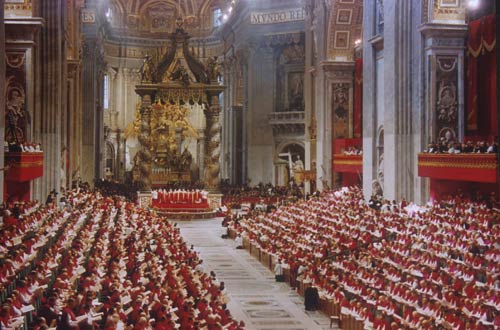
Even the Catholic Church of Romania is looking forward with great expectations to the opening of the Year of Faith and to the Synod on the New Evangelization. There have been also few, sober initiatives to commemorate the fiftieth anniversary of the opening of the Council. "In our country the Council texts were published only after the fall of communism in 1990, a quarter of a century after the end of the ecumenical assembly". Father Felix Roca, from the diocese of Iasi, drew a balance on the presence of the Latin Catholic Church and of the Greek Catholic Church for SIR Europe within a national Orthodox majority, marked by increasing secularization. Father Roca, 35, in charge of Youth Pastoral Care in Iasi, national advisor of Catholic Action, also serves as educator and teacher.The anniversary of the Council reverberated across dioceses in Romania, but at the time of Vatican II (1962-1965) the regime in Bucharest wasn’t very tolerant of religious faiths. When was it possible to "draw near" the Council? "Very little news on Council activity in St. Peter’s filtered all the way here. All of our priests and bishops were prevented from the public arena under the regime. While there was Mass celebration and prayer, public and cultural gatherings by the Catholic Church were prohibited. There was a hovering threat of persecutions… Nonetheless, a certain amount of news information was filtered from Rome through personal contacts at international level. Very few foreign newspapers or magazines circulated. I was told that some pages of council documents were copied with typewriter and carbon paper in seminaries for limited circulation. After the Iron Curtain was lifted things gradually started to change. The Constitution and the other Vatican texts were printed, and were later studied and diffused". Can it be said that the Council is a patrimony of the Romanian Church? "There is a great commitment to share with the people of God the teachings that emerged from the Council, as well as the subsequent Magisterium of the Popes. There is a special emphasis on the reading of the Word, participation in the liturgy. Moreover, the task of educating lay Christians for a positive and responsible presence in the Christian community and in civil society has gained topical relevance. I think this is an important fruit of the Council. I personally wish to highlight the beauty of ‘being a community’, of being together, which is finally truly appreciated". Could you tell us more about this aspect?"There is a strong yearning to share faith and everyday life. We talk, engage in mutual dialogue, make plans and support each other. It’s a Church that is growing day after day. We have comforting elements, such as a high number of religious vocations. Lay Catholics are more present in various areas, i.e. in Caritas, through various associations. I notice increased attention on the problems of the family, struggling with the consequences of the economic crisis which undermines the social fabric and leads an increasing number of people to emigrate".Can one talk of a visible and organized presence of Catholics in Romania?"The Greek-Catholic Church and the Latin Catholic Church are a minority in the Country, amounting to about 6% of the overall population. I wouldn’t say that we could identify an organized presence in society, although a sense of public responsibility by the faithful is growing. It should also be said that Romanian public opinion doesn’t think highly of politicians, who always emerge as the least popular in all surveys – while the Church and the army respectively rank first and second-. And the recent institutional clash between the president of the Republic and the head of the government didn’t make it any better". You spoke of the burden of the crisis on families."It’s a difficult situation. People complain. As a Christian community we are committed in acts of solidarity, for the help to the needy. Notably, under the guidance of bishops, we seek to pass the message that immigration can’t be a lasting solution, not to mention related problems, such as abandoned children or foster care, to people who love them, but who aren’t their mothers and fathers". Council, Year of Faith, new evangelization bring to mind also the term "ecumenism". What is the situation in Romania? "The relationship between Catholics and Orthodox is a very delicate subject. There is mutual esteem and at personal level many differences have been overcome. However, it should be recognized that in the last period mutual relations have gotten colder. Even a joint celebration for Christian unity is lacking… There is a long way to go in the direction of ecumenism".
