EUROPE AND SYNOD
European bishops’ addresses (5)

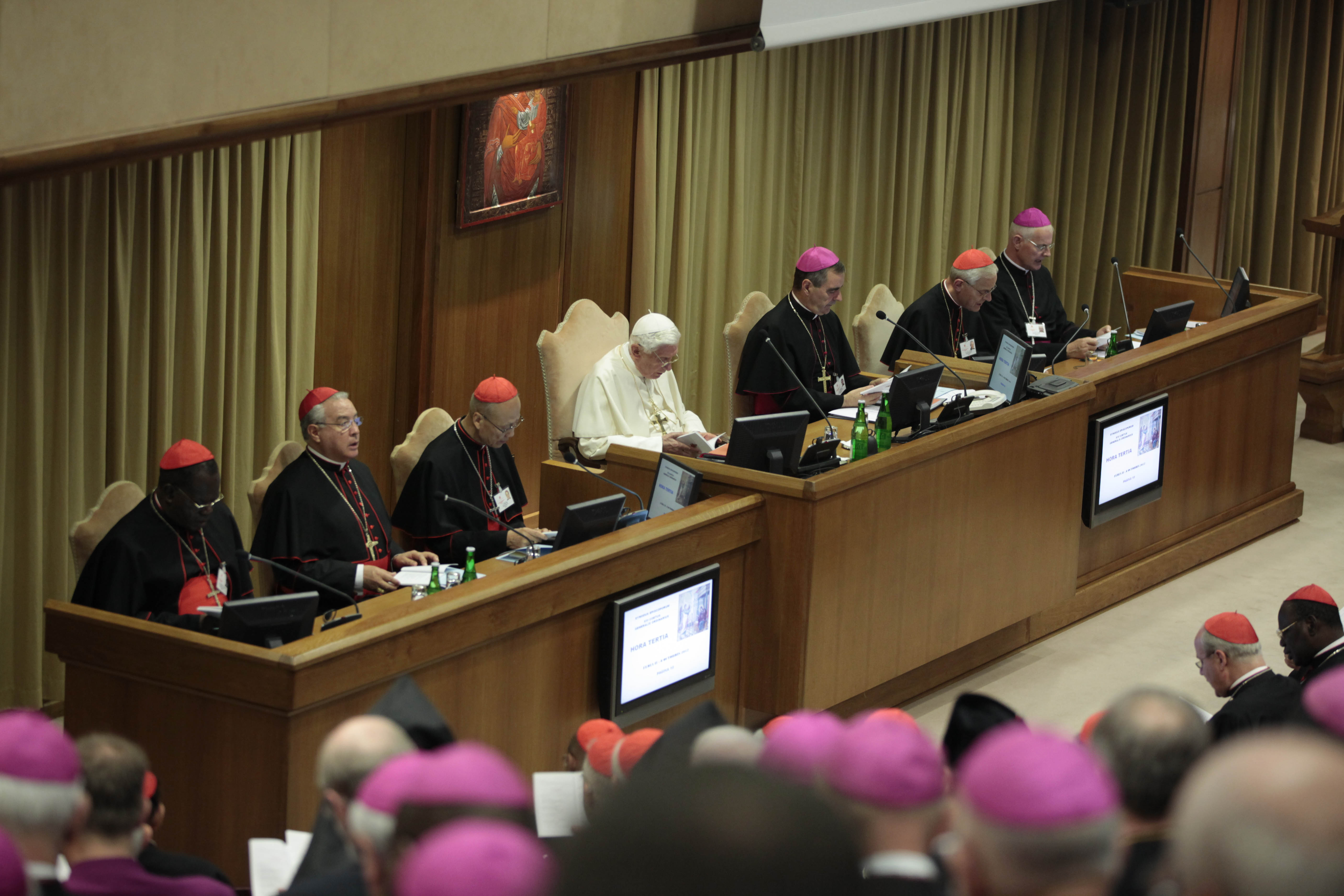
"The new evangelization isn’t only a temporary program. It’s a way of looking at the Church’s future". The statement, contained in the Relatio post disceptationem, has been the leitmotif of the reflections in the workshops collected by the speakers in the reports presented on October 19. Follow some of the reflections emerged in the documents by the European synod fathers, and in some "in scriptis" lectures , that were written but not presented orally. The youth’s "hunger" for truth. The parish "is the first place of evangelization", but today the new evangelization "should inaugurate roads and streets of dialogue" where "contact with the parish or the Christian community are still lacking". Msgr. Ladislav Nemet, bishop of Zrenjanin (Serbia), reiterated the role of the family and the importance of "cultivating ecumenical contacts". Msgr. György Udvardy, bishop of Pécs (Hungary) highlighted "our strong responsibility towards the young", the "hungry crowd". The prelate referred of the encounters with the young on the square in front of the cathedral, notably, "their sincere questions on the meaning of life, on reason, and truth", along with their need to know "what is good". A lesson and a stimulus, for Msgr. Udvardy, to "seek new forms" of interpersonal relations, to "listen to questions" and "learn how to formulate in convincing and personal ways the teaching of the Church, so it may not be a mere opinion but a true certainty". Gospel and cultures. For Msgr. Bruno Forte, archbishop of Chieti-Vasto (Italy), the Gospel proposal "in the various contexts – all marked by globalization processes – is met by various difficulties". Its "incisive" proclamation requires "to address the interlocutor with sympathy and friendship". "It is also necessary to bear in mind the cultural contexts", notably, "the relationship between the family, the social bond and the Catholic tradition" and to "transmit the Gospel given its capacity to enhance the positive elements present in all cultures, purifying them from those elements" that go against "the integral realization of the human person". Muslims, Christians and religious freedom. "Relations with Muslims ought to be closely followed", said Msgr. Claude Dagens, archbishop of Angoulême (France). "Also in those countries where it’s not always possible to evangelize explicitly – he warned – the Gospel of Christ can be lived by bearing Christian witness. We should not forget that there is a crisis in Islam which at times is compensated with attitudes of conquest". The "opportunities and challenges deriving from a growing presence of Muslims in the first world" was delved into by Msgr. Kieran O’Reilly, bishop of Killaloe (Ireland), who highlighted "the concern of Christians in countries with a Muslim majority population and Christians’ right to practice their religious creed". The "consequences of sexual revolution for the family and the redefinition of marriage" along with the "passage from atheism – to self-questioning – to conversion – to "mission" are for the Irish prelate further "hot issues". No to the dichotomy of spirituality and religion. Msgr. Bernard Longley, archbishop of Birmingham (Great Britain) guarded against the risk of "fuelling a false dichotomy between spirituality and religion". "Catechesis for the young and the old, presented in an attractive manner" that can respond to their authentic questions, "will promote the new evangelization". The prelate invited to promote practical initiatives, such as the Lectio Divina, to "present the sacraments under a new light" and ensure the appropriate preparation to the "evangelizing" laity and the permanent formation to priests and religious. Man’s restlessness. We can grasp in "historical events the signs of God and his appeals" remarked Msgr. Ricardo Blazquez Pérez, archbishop of Valladolid (Spain), for whom evangelization entails also "closeness and dialogue with men to listen to them and establish with them a dialogue on their disquiet and misery". For the archbishop, "it is reason of concern that many are drawing away from the Church, sometimes in a very loud way, other times in silence", with the consequence that what "was sufficient in the pastoral action of many years ago, now no longer is". He pointed out: "The entire Church must experience a new missionary thrust".
