CHURCH AND EUROPE
Church in Europe: building hope in adverse, troubling times

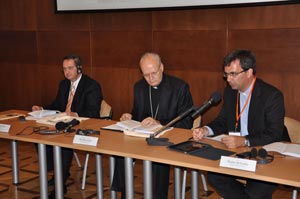
A "paschal glance" over Europe: it is the invitation that the Church addresses to European Christians in the difficult times of transition that the continent is experiencing. This image conveyed by Cardinal Angelo Bagnasco enshrines one of the messages of the plenary assembly of the Council of European Bishops’ Conferences held September 27-30 in St. Gallen, Switzerland. Europe’s fatigue, anguish, and hopes lie in the heart and prayers, in the analyses, reflections and decisions of our continent’s bishops. Such "paschal glance", precisely because it is preceded by Holy Friday, does not neglect the feelings of suffering or loss. Rather, it grasps, especially in the current long-lasting times of hardship, the signs of a new birth, a new season. It is also the glance of those who accept the risks linked to personal and communitarian commitment in order to avoid giving in to scepticism and pessimism, often caused by missed or wrong answers provided by the cultural, political and the economical realms. On the other hand, there is an evident want of great thinkers, the bearers of far-sighted projects and decisions. But merely outlining a weakness is not enough. Europe certainly needs rigorous analyses and targeted therapies to endure and face internal and external challenges. However, full healing will occur only when the spiritual and moral motivations that guided and supported Europe across the centuries will be fully recovered as an integrating part of its journey.Along this path Benedict XVI placed three signs for Christians. These are: the Year of the Faith, the Bishops’ Synod for the New Evangelization and the 50th anniversary of the opening of the Ecumenical Council Vatican II. These three occasions, with the respective public celebrations, interrogate believers’ consciences on the urgent need for a testimony of service to Europe, which, according to cardinal Marc Ouellet, "is overcome by a crisis in hope". The first question deserving an answer, underlines the cardinal, regards the "image of Christ that we are transmitting to mankind, to women and to European youth". It isn’t a question of transmitting a media image. The task of each Christian is to communicate a Face by renewing ancient idioms and experimenting new ones in faithfulness to the Gospel and to the inalienable values that belong to the whole of humanity. It isn’t an easy task in a cultural and social context whereby the sign of freedom is understood as a distancing from God. On these grounds Christian faithful are challenged, and supported, by a lived and pondered faith. But the sole forces of the Christian believer, even when they are united with those of the community to which he belongs, are not enough. It was recalled by Péter Erdõ who asked "the Master of history" to "accompany His Church giving us good ideas for our concrete work, along with a perseverance in the faith and instilling us the psychological force to live our epoch, which is so complex and marked by burdensome phenomena of crisis, cherishing hopes and a relentless commitment for the salvation of the whole world". And may that very "paschal glance" illuminate the ways in which others see Europe too. It isn’t a distant or a detached glance, since, points out the final message of the CCEE assembly, "the Church, by bearing testimony of the truth of the faith participates in the cultural and social debate with its own patrimony of wisdom and culture, presenting the reflections of the righteous mind".Major questions, which in Europe involve life, family, work, education, freedom and the coexistence of different historical and religious traditions, are at the centre of the "different" glance that Benedict XVI places in a harmonious relationship with the glance of God on the whole of mankind.
