CHURCH IN EUROPE
CCEE Assembly: the relationship between faith, culture and reason in the final message

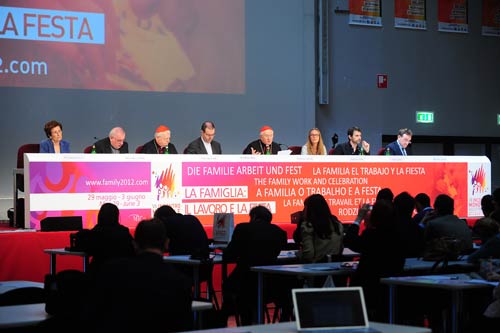
"In the European context in which we live, we call for full respect and openness to dialogue, without any prejudice and arrogance". Christians "feel their responsibility as citizens, and are endowed with a heritage of truth that has been proven by two thousand years of service, goodness and civilization". The Council of the European Bishops’ Conferences Europe’s Bishop’s Conferences, (CCEE), who gathered for their Plenary Assembly in St. Gallen (Switzerland) from September 27 to 30, on the eve of the opening of the Year of the Faith focused on the "challenge of evangelization".The ultimate "yes" of God. The meeting, held in the city that hosts the CCEE headquarters, considered a fruit of the Second Vatican Council, addressed with the contribution of experts various themes that include the presence of Christians on the international public arena, also in the light of the Council and the Year of the Faith; the new evangelization and the Synod that will begin on October 7; the legislative and political progress of institutions such as the EU and the Council of Europe; the discrimination of Christians in the world. In their final statement, the bishops presidents of the European Bishops’ Conferences, wrote: "We are aware that Jesus Christ’s good news was God’s ultimate "yes" to the life of Man, freedom and love. As a matter of fact, the Gospel reveals to us the truth of God-Love and Man’s true face, which save Man from moral evil, leading him the to the fullness of his humanity". CCEE thus acknowledges "the serious drifts of economic laissez-faire and ethical libertarianism", and highlights "Christianity’s topical relevance, since it offers all human beings its unending topical legacy, by advocating a personalistic and communal humanism". Faith and reason. "Secular cultures, fighting over their different anthropological visions, should not look at the Christian message with suspicion, while it spreads its wings of faith and reason. Both wings belong to European history and are the foundation of our civilization", continues the final declaration. The Church in Europe "engages in the cultural and social debate with Her heritage of wisdom and culture, showing what righteous reason can bring. The intention to redefine society’s natural foundations, like the family or the coexistence between different historical and religious traditions, is not considered to be incidental". The message by CCEE, presided over by Cardinal Peter Erdö, Archbishop of Budapest, stresses also the signs of intolerance, and even the "instigation of hatred of Christian doctrine and faith, as well as of Christian faithful". Their voice is considered "bothersome by some, who accuse this voice of intolerance and obscurantism: but it is actually perceived as being dangerous, because it is a free voice that is unbending in front of particular interests and unwilling to give in to blackmail". The bishops said: "Destabilizing individuals and societies is not for the good of Man, but just a way to pursue partisan interests". Persecuted Churches. The assembly focused on the problem of the persecution of Christians in Europe and in the rest of the world: "Attendants renewed their closeness to persecuted Churches with a request to the international community to raise its voice loud and clear calling for the respect of the right of religious freedom always and in all places". In the meeting, the bishops commented on the findings of the Observatory on discrimination and intolerance against Christians in Europe. They thus conveyed their firm condemnation of such painful episodes which express and involution of culture and civilization as a whole". Several Commission. At the end of the assembly it was decided that the next CCEE assembly will be held on October 3-6 2013 in Bratislava. Msgr. Stanislav Zvolenský, president of the Slovakian Bishops’ Conference, commented for SIR Europe: "I see it as a great opportunity to allow our European brothers to know the community of our faithful and the life of the Catholic Church in Slovakia, as well as our culture". Statutory provisions regarding CCEE internal administration include the appointment of the presidents of several commissions. Msgr. Giampaolo Crepaldi, Trieste (Italy) was confirmed at the head of the Commission Caritas in Veritate. The Commission for Catechesis, schools and university will be chaired by Msgr. Marek Jedraszewski, archbishop of Lódz (Poland) who was reconfirmed at the lead of the University section; for the Catechesis section was appointed Msgr. Duro Hranic, auxiliary of Dakovo and Osijek (Croatia), and for the school section Msgr. Eric Aumonier, bishop of Versailles (France). The Social Communications commission will be chaired by Msgr. José Ignacio Munilla Aguirre, bishop of San Sebastian (Spain), while the European Services for Vocations is chaired by Msgr. Oscar Cantoni, bishop of Crema (Italy).
