
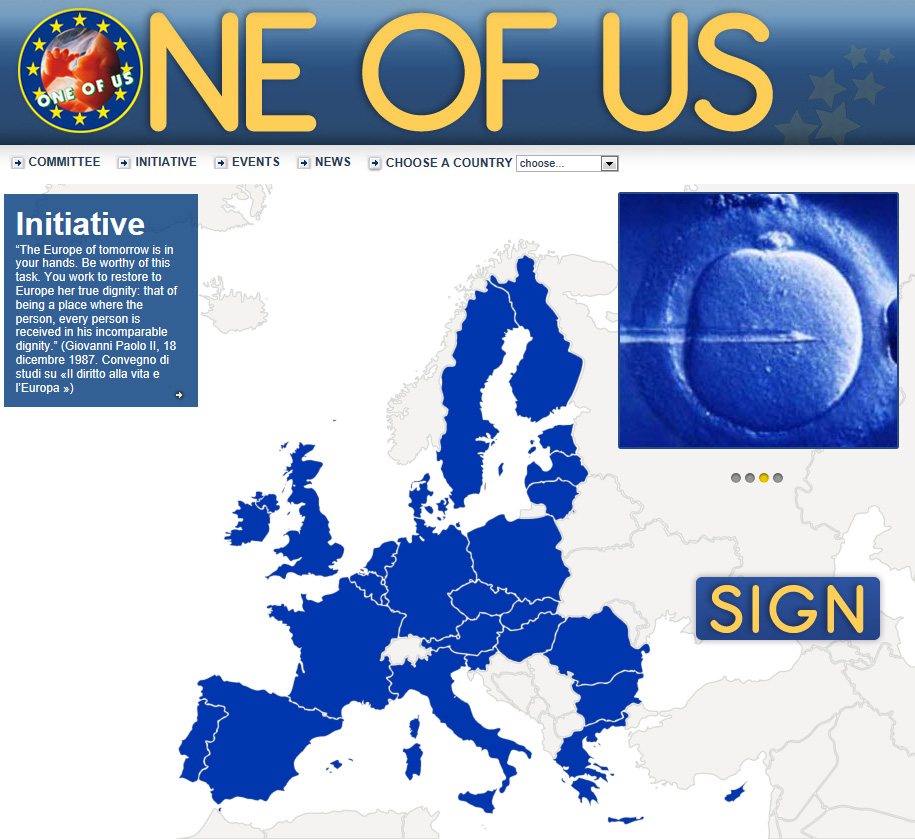
Citizens’ initiative "One of us": online information The website www.oneofus.eu is coordinated by the promoters of the citizens’ initiative ‘One of us’, aimed at extending "juridical protection of the dignity, the right to life and of the integrity of every human being from conception in the areas of EU competence in which such protection is of particular importance". A new procedure enabling citizens’ participation to the EU legislative process, as provided for by the Treaty of Lisbon, was launched on May 10. It is supported by a wide range of pro-life movements in EU countries. A citizens’ initiative has to be backed by at least one million EU citizens, (with signatures collected on paper or online). The EU Commission is then invited to propose legislation on matters of interest within a year. The purpose of the initiative, the promoters explained, "is that each human being is recognized as ‘one of us’ from the moment of conception in every measure carried out by the European Union". In particular, the initiative is asking EU27 "to put an end to the funding of activities that imply the destruction of human embryos in the areas of research, in the programs for reducing birth rates and in public health practices that imply the violation of the right to life". All the information regarding this and other initiatives are available by logging on: http://ec.europa.eu/citizens-initiative.Presentation of the candidates for the 2012 Sacharov Prize Pakistan, Russia, Belarus, Iran, Rwanda: countries where democracy and the rule of the law continue being "fragile", where fundamental freedoms are seriously strained. On September 25 the European Parliament’s seat in Brussels presented this year’s nominees for the Sakharov Prize for Freedom of Thought. The candidates, the EP stated in a release, are: an imprisoned civil society activist fighting for freedom of thought and expression in Belarus, the founder and director of a centre for legal assistance to victims of Pakistan’s blasphemy laws, a Russian feminist punk rock band, an Iranian lawyer and director, democratic opposition activists from Rwanda. The nominations are proposed by the political groups represented in the EP. After having valued the various proposals, the winner will be proclaimed and awarded on December 12, during the plenary in Strasbourg. Joseph Francis, from Pakistan, founded the Center for Legal Aid, Assistance and Settlement (CLAAS) for victims of blasphemy laws. Ales Bialiatski is an activist fighting for freedom of thought in Belarus. He founded the Viasna Human Rights Centre. Victoire Ingabire Umuhoza, Déogratias Mushayidi, Bernard Ntaganda, are imprisoned Rwandan opposition politicians; Pussy Riot is a band from Russia. Three of its members were imprisoned after protesting the violation of civil rights in the Country; Nasrin Sotoudeh, lawyer, and Jafar Panahi, director, are both human rights advocates in Iran. EU Aid Volunteers: the Commission’s proposal The EU Commission set out its plans for a European voluntary corps providing humanitarian aid in disaster areas inside and outside the EU. The purpose of the initiative was reiterated a few days ago by Kristalina Georgieva, Commissioner for International Cooperation Humanitarian Aid and Crisis Response, illustrating the initiative involving 10,000 volunteers trained in European humanitarian organizations. The proposal includes a budget of 239 for the period 2014-2020, that will be used for professional training and experience on the field. According to the Commission humanitarian organizations need "more well-prepared people to support them helping communities struck by disasters". The Executive proposes "to develop European standards for managing volunteers in humanitarian projects and a European training programme".Foreign languages in school: early learning English is by far the most taught foreign language in nearly all European countries, with French, Spanish, German and Russian following far behind, according to the report "Key Data on Teaching Languages at School in Europe 2012", presented by the EU Commission. The research also shows that children are starting to learn foreign languages at an increasingly early age in Europe, 6-9 years old on average. the German speaking community in Belgium, for instance, provides foreign language learning for children as young as 3. "A majority of countries or regions have lowered the starting age for compulsory language learning in the past 15 years and some even offer it in pre-school", highlights a passage from the report, which highlights that an increasing amount of time is devoted to the study of foreign languages in Europe. The report also confirms a rather surprising finding: "few countries require their trainee language teachers to spend an immersion period abroad".
