ITALY
”Interview on God”: faith and reason in the thought of Cardinal Ruini

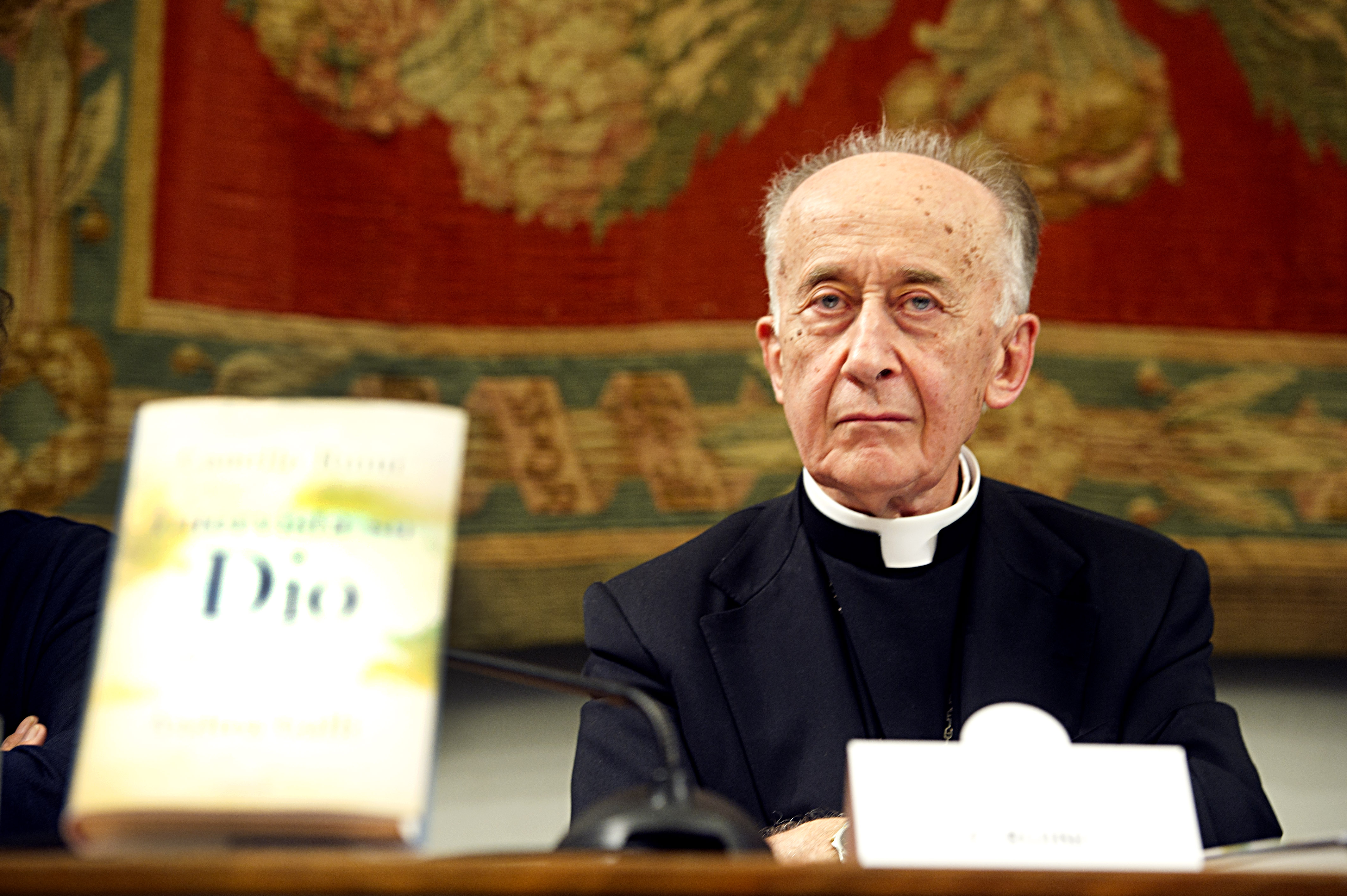
Faith and reason are marked by "a deep continuity" but also by "a rupture, since faith requires belief and welcome to something unexpected by reason" just as "Christ’s cross", the most "manifest" of all aspects for which "faith breaks the scheme of reason". Cardinal Camillo Ruini, former CEI president, president-in-office of the CEI Cultural project Committee, author of the volume "Interview on God. The words of faith, the path of reason ("Intervista su Dio. Le parole della fede, il cammino della ragione" – Mondadori 2012), spoke on the evening of September 13 during the first of a series of three TV programs dedicated to the book, broadcast by the Italian Catholics’ network Tv2000 (www.tv2000.it). During the debate His Eminence addressed the questions of twenty seminarians from the Fraternity of Saint Charles Borromeo.Why it’s impossible to understand God. "Because God is Absolute and Infinite", replied Cardinal Ruini. "The human mind is open but it’s also limited. As Saint Augustine said: if you understand, that isn’t God". "When we seriously approach God – the prelate said – human reason is forced to be humble". This humbleness is "difficult", since reason "is intrinsically bound to possess". But it’s also "sound": when "reason is aware of its limits, those limits are harder to cross". Conversely, when "it is unaware of them" reason is "no longer able to take a distance nor can it open up to reality". Why we should seek God whithin our hearts. "Many people – Cardinal Ruini explained – raise this question", and even those who don’t, "carry it unconsciously within themselves, since human persons possesses an openness to the Infinite. It is a structural part of intelligence and freedom". On the other hand, man’s openness to the Infinite "is empirically shown also without speaking of God, examining that micro-phenomenon that distinguishes man from all the rest", namely, "culture and its development". It is an "endless process, which always extends beyond acquired data". It consists in "making man aware of his openness to the Infinite", without "forceful actions" and also without renouncing the question because "in words, many appear uninterested". How to look at the future. "With confidence and commitment", replied card. Ruini. "It also depends on our choices, on our freedom", and on our "determination to its creation". In the mid-1980s, he recalled, John Paul II said that "we had finally left the wave of secularization behind". Today’s theologians and sociologists don’t consider religion as "an outdated phenomenon", nor do they see "signs of tiredness". This reflection springs from a " deep root, embodied in the human person". New evangelization. For the prelate, "just like its most classical form", it consists in "Jesus’ proposal as our one and only Savior", notably, it is a question of "bearing Christian witness in all those spheres where faith in God is not to be taken for granted and where it isn’t commonly accepted". Moreover, this "central truth of faith, the eternal truth", ought to be proclaimed in a way that is "capable of interpreting and responding to contemporary culture. It is not enough to propose it. It should always be witnessed with life". Thus "there isn’t a great difference between old and new evangelization". Today, the Cardinal recognized, "witness is largely requested", since we’re living "in the so-called epoch of the quest for authenticity" whereby "there is no yearning to speak of the truth, but authenticity is largely debated. And if "somebody’s word is proved unauthentic because it doesn’t correspond to his/her life", that person "is not credible". Which language. For Cardinal Ruini "the language of Jesus remains the prototype of the language to speak of God. This, of course, doesn’t require special studies". Instead it is born of the "abundance of the heart and of the deep conformity lived with Jesus, as Jesus is the point of reference of our life". "A rational infrastructure" is equally important, without which "faith becomes a purely subjective fact, that cannot be communicated". Indeed, it’s not enough to be convinced to propose "a similar path" to others. Faith needs to be testified "as much as possible, with reasons that can be seen as plausible to all". Heart and reason. "If we want to speak of a primacy" when reaching and proclaiming God, the Cardinal pointed out, "it should be the primacy of the heart", understood in Biblical terms, namely "individual profoundness". His Eminence said he is "unwilling to compare primacies. Heart and reason should go hand in hand. This is the great problem of our era. To separate what is distinct, but which is united in the human person". The human person "is one: he/she loves and thinks in a profound unity" that is both physical and interior. "If a part doesn’t follow" a "schizophrenia" is triggered, which questions also our "abidance to faith". Hence the final warning of the Cardinal is to "refrain from superiority, opting for unity and synergy".
