ASSISTED FERTILIZATION
The bishops on the new ”inhuman and immoral” law

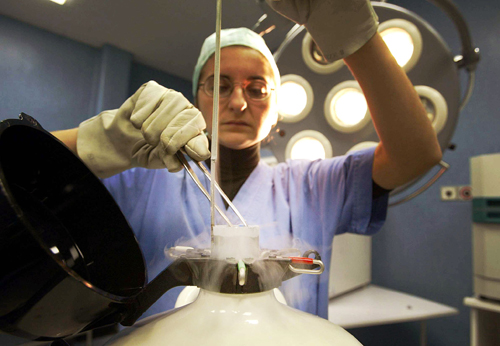
Croatia has passed a new law on medically assisted fertilization. From now on not only the male and female gametes can be legally frozen – as stipulated in the previous law – but also the embryos. The right to access assisted fertilization is guaranteed to all couples who cannot have children, including those de facto – i.e. unmarried – couples, and even to single women. The donation of sperm or egg donors is provided for in those cases whereby those of the parents cannot be used, or to avoid transmission of serious genetic diseases, along with the donation of embryos.The Croatian Bishops’ Conference (HBK) immediately spoke out against the law which is described as "deeply immoral and inhuman" because it opens the door "to the dissolution of the fundamental values of marriage and the family". According to the Croatian bishops, the legalization of embryo cryopreservation "to human persons conceived in this way does not guarantee the right to life but, in most cases, it sentences them to death".For its part, the government defended the law because "all those who considers non-ethical one or all of the procedures envisaged by the law are free to choose not to follow it. However, couples who cannot have children should be given the possibility to choose and be assisted by public health in their decision". On this statement it is necessary to make some reflections, as it signals a distorted appearance of state and democracy.We are faced with a pendulum that swings between two extremes: on the one side, the State’s position as the founder of morality, establishing what are the good or bad deeds of its citizens, limiting the personal freedom of individuals. There has been experience of this during dictatorships in the course of history – present also in the twentieth century – and in not yet waned forms aimed at the control of the life of individuals. It is enough to think of the pressures exerted by certain states or international organizations to accommodate the number of children.On the other side, there is the position of the State, viewed as the guarantor of each individual choice. Especially in bioethical choices it is said that one should not impose anything and that everyone should be free to act according to their human and religious values. So, nobody can force a Catholic to choose euthanasia, but not even a Catholic could prevent anyone else from asking it for themselves or for a loved one.Thus was born – certainly not by the Catholics! – the confrontation between believers and secular people, between the supporters of the sanctity of life and the supporters of the quality of life. We note that – if one renounces all ideologies – there is no real opposition. The quality of life depends on many factors, both physical and also spiritual. The quality of life depends on the dignity of life that has a transcendent origin.But back to the swings of the pendulum. What is wrong in these two positions? They are both lacking a true vision of reality. The first believes to be the source of values: the state determines what is good or bad in relation to the community, the second renounces the quest for what is good or evil and merely deals with individual rights. Both positions fail to understand that there is something that precedes the state and individual choices and this is the dignity of human life. Robert Spaemann, the most influential contemporary German Catholic philosopher, says that human dignity is not a property of the person among many, but, rather, is "the metaphysical reason why humans have rights and obligations" ("Three lectures on dignity of human life", Lindau 2011).Dignity is so inviolable, that no one can strip it from someone else. If anything, it can prevent that person from presenting himself with dignity. Embryos treated like things will never lose their dignity even when smothered in the cold of a refrigerator, just like the Crucifix has not lost it amid the indifference and the fury surrounding it.The problem is another: can a modern, democratic state wait and see and allow such barbarity? Can it afford not to see that individual rights, more than once, humiliate the weak? If that were the case, a future with hovering dark clouds lies ahead, because, having tolerated one exception, countless others should be permitted.Freedom is elsewhere. It is the ability to choose according to human nature, which belongs to everyone alike. "Possessing a dignity – Spaemann says – is a biological consequence of belonging to the family of free beings". If the State should not judge desires and punish the culprits of misdeeds, then it also has the duty to intervene when individual actions violate human dignity, because it does not renounce the foundations of human nature.These are considerations of rational order, even though they were consolidated in the Western world thanks to the Christian faith.
