CHURCHES IN BRIEF

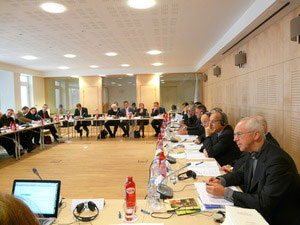
Citizenship: dialogue EU Commission-ChurchesEU citizenship "is a central theme for our European identity" and it is a topic of great interest in view of the elections for the European Parliament in May 2014. The subject was discussed on June 20 during a seminar sponsored by the EU Commission, in relation to the European Year of Citizens 2013, with the contribution of several members of the Churches in Europe and experts from different countries. For the European Commission, Chiara Adamo and Sophie Beernaerts exposed the essential elements of EU citizenship, as established by the Treaties, and the actions taken by the Commission in this area. Among the many speakers, the British bishop Msgr. William Kenney (citizenship and Christian social teaching) and Polish Orthodox Archbishop Jeremiasz (elements for citizenship in the Christian sense). The Secretary-General of COMECE (Commission of the Bishops’ Conferences of the European Community), Fr. Patrick Daly, maintained that citizenship has three dimensions: "Belonging, being, and the future". "The future refers to a common destiny"; on the other hand, Europeans "belong to a recent political construction that is still in the making", to which Christians want to give an effective contribution, supported by the teaching authority of the Church. In the seminar more issues concerning citizenship have been touched, all within the framework of the economic and social crisis affecting the continent.Belarus: message of archbishop KondrusiewiczArchbishop metropolitan of Minsk-Mogilev, mons. Tadeusz Kondrusiewicz, wrote a pastoral letter on the occasion of the 400th anniversary of preservation of the miraculous icon of Mother of God in the national sanctuary of Budslau. The main celebratory events will take place on 5-6 July, the message was read in Catholic churches of Bielorussia last Sunday. Mons. Kondrusiewicz writes that faith in God is subject to trials and testing in every epoch of human existence and we should do our utmost not to make it a "light faith". He mentions a danger of modern subculture that invites people to "flow with stream" and ignore spirituality instead of realizing the real values of life. Another challenge can be seen in a "dictature of moral relativism" denying an absolute truth. Archbishop calls this attitude a "heresy" of our times that is closely associated with another, maybe the most dangerous threat of unsufficient respect for the greatest gift of God – human life – that can only be fought by our firm support of civilization of life and love. Kondrusiewicz writes about the crisis of family: "This leads to the systematic crisis of the society, because the family represents its irreplaceable fundament", continues the prelate, inviting the faithful to understand the Jubilee Year of the sanctuary in Budslau, celebrated in the Year of Faith, as a chance to "review" our faith and testify about it in our everyday life. "The Mother of God is a shining example in this process. She didn’t abandon us during times of persecution and she stays with is also in this new epoch".Poland, a church dedicated to John Paul IIAt the end of the 362th plenary assembly of the Polish Catholic Bishops’ Conference, on June 23 the bishops took part in the blessing of the Shrine of John Paul II in Borek Falecki, near Cracow, and the Shrine of Divine Mercy in Lagiewniki. The Shrine, whose area exceeds 2,000 square meters, decorated by Father Marko Ivan Rupnik (whose mosaics adorn the Redemptoris Mater Chapel in the Vatican and the shrine of Father Pio in San Giovanni Rotondo, Italy) is part of the "Nie lekajcie sie" ("Don’t be afraid") Centre dedicated to Pope John Paul II, built on the initiative of Cardinal Stanislaw Dziwisz, former personal secretary of the Pope and now archbishop of the Polish city. Since 2011, the relics of Pope John Paul II are on the altar of the lower church of the shrine, and a chapel displays the marble slab that covered his tomb in the Vatican Grottoes. The structure has been built upon 300 concrete pillars which are necessary to stabilize the ground below, says Msgr. Jan Kabzinski, the director of the Centre, who hopes that the consecration of the shrine can be celebrated by Pope Francis.