EDITORIAL" "
An image representing the CCEE spokesperson’s meeting in Romania

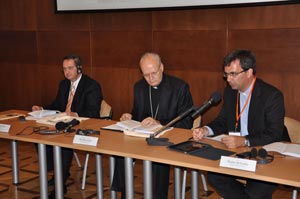
The spokespersons of the European Bishops’ Conferences gathered with the archbishop of Bucharest in the convent of the Discalced Carmelites, is already enjoying remarkable attendance even though building works are yet to be completed. It happened on the late afternoon of June 14, after the closing session of the annual meeting promoted by the Council of European Bishop’s Conferences with national pastoral communication officers in Europe.That evening gathering has various meanings, starting with the image of the convent, which values and livens the memory of many martyrs the beatification of Fr Vladmir Ghika, tortured and killed in Communist prisons, is scheduled to take place at the end of August while also transmitting a message of hope and rebirth. The gathering of the spokespersons is an embrace that unites European Churches and extends to encompass all peoples of Europe, jointly sharing the difficulties deriving from a crisis that seems to be everlasting. Archbishop Ioan Robu answered questions with serene yet somber words, marked by the smile of the Gospel, namely, that very Christian realism that is knowledgeable of contemporary challenges, addressing them and seeking solutions with a competent approach, and that in this commitment trusts the Lord of our History. Church communication in Europe can also be represented also by the picture of the entrance to a convent of discalced Carmelites on the outskirts of Budapest. The atmosphere was marked by a thriving yearning to share reflections, experiences, projects, successes and failures. That was the case also in the days that preceded the meeting. Participants share the belief that Europe, striving to breathe and with uncertain pace, needs neither tired, pessimistic, sceptic nor resigned people in order to recover and revitalize its soul. The spokespersons, guests of an East European Church which Archbishop Robu, president of the Romanian Bishops’ Conference, justly described as “a young Church”, reiterated that also for communication this is not the time to survive but a time for regeneration. Momentous issues of our present times, ranging from religious freedom to human rights, from the environment to the family, from privacy and copyright to the peripheries of the world and of the soul, accompanied by the vibrating echo of the campaign “One of Us”, that must be stepped up with concrete gestures and reflections expressed also with a signature of endorsement in all European Countries, are at the centre of the brave venture. In the background, Pope Francis’ words to representatives of the communications media is a guiding principle: “Your work calls for careful preparation, sensitivity and experience, like so many other professions, but it also demands a particular concern for what is true, good and beautiful. This is something which we have in common, since the Church exists to communicate precisely this: Truth, Goodness and Beauty “in person”. It should be apparent that all of us are called not to communicate ourselves, but this existential triad made up of truth, beauty and goodness”.The warning of Cardinal Roger Etchegaray, historical CCEE president, follow in his wake: “Europe can be a discouraging place when considering the technocratic drift of its institutions, cut off from citizens’ lives. A pedagogy of Europe is missing. That much needed effort will be accepted only when it will be deemed just and useful”. And mother Church, mentor of humanity also in Europe, feels that it is her specific educational responsibility to focus on communication, both ancient and modern, understood as a service to human conscience. The spokespersons of European Churches, with the humbleness of those who acknowledge the wounds, with the responsibility of those who want to heal and with the expertise of those who don’t mistake creativity with improvisation, returned to their Churches feeling they were a step ahead, well knowing that European history “is not a calm river”, as Jacques Delors has often said. Delors, a politician of high moral, cultural and political standing, often reiterated that “Europe’s future is to put to sea!” Thus that evening, on the doors of the convent, where the world met the Church, under the skies of Bucharest, resounded the words “duc in altum” pronounced by John Paul II, who always had Europe at heart to the point of asking that skilled and trained Christians be appointed to serve in European institutions, as the distance, which isn’t only political in nature, separating European institutions from European citizens should be bridged or at least reduced. It’s an act of love and trust by the Church, conveyed also through the intelligence of her media communications officers, as a realistic and credible alternative to euroscepticism and europessimism.
