EUROPE" "
Revitalizing Christian roots: a reflection by cardinal Kurt Koch

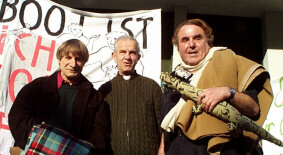
Cardinal Kurt Koch, President of the Pontifical Council for Christian Unity, spoke in a conference in Seggau, Austria, a few days ago, on the themes of Europe and its roots. Follows an abstract of his speech. Europe today. “Full reception of life e and of all created things” are needed for a Europe that risks focusing only on profitability. In the ongoing situation of this disproportionate crisis, the question gains new topical relevance: “Can a Europe with the euro as its only currency be vital? May it also need a spiritual and religious form of currency?” The question could also be: “Does the European integration project manage to address ongoing tensions?” In fact, if Europe is understood only as an economic union, the outcomes of the present crisis will be ruinous for its very identity. “Without a spiritual identity Europe will be at the mercy of the powerful”, said Card. König, and this is the “burning challenge we are called to address today”. Europe is not characterized by geography, languages and populations, rather it’s a “cultural and historical concept”. As Benedict XVI said in 2011, the meeting between Jerusalem, Athens and Rome (the faith in God of the people of Israel, the philosophic rationality of the Greeks and Roman law) is at the origins of European culture. These elements have grown together in Christianity and thus “European history and Christian history are inextricably bound”. Thus “in what do Christian roots consists in and where can they be seen today?” And also, “how can they be revitalized?” Three principles. “The main heritage of Christianity in European history can be summarized in three principles: the principle of divinity, of humanity, and of sociality, that must be circumscribed, with the risk of dangerous developments”. “People and society can’t fully develop without a transcendent foundation” is the meaning of the principle of divinity. However, “the ongoing situation in Europe is infected by a pantheism impregnated with money, which became ever more an earthly god”. The 20th century has shown that “a humanity that is not grounded on the divine element is very quickly transformed in bestiality”. Conversely, the principle of divinity “does not contradict human values. Rather, it reminds us that important values such as the nation or national legal systems remain human values provided they are not absolutized or divinized”. The “principle of humanity” stems from the belief in God creator, i.e. the inviolability of human dignity, equality and human rights. There derives that “when God is distanced from social life or dismissed with tolerance, there is the danger that also human dignity may be trampled upon”. This is evident especially “in the unbalance between the legal and the moral defense of things and the defense of human life”.Belief in the Trinitarian God, foundation of the human person and of his characterization through human relations in Christian faith, inspires the third principles of “social personality” at the two poles of individualistic egotism and socialist collectivism. The reconciliation between individual freedom and sociality is the “anthropological foundation regulating the balance between autonomy and community in the project of the United State of Europe”. A positive laicity. “How can these Christian roots have an effect in a society that views itself as secularised and whose understanding of life emancipated itself from religion and notably from Christianity?” The solution is not to run after the model of Christianity, but rather to live “a free and loyal relationship in full cooperation between Church and the State”, reconsidering “the meaning of laicity”, as stated by Benedict XVI during his trip to France, in the framework of “positive laicity”, whose political and religious realms are mutually recognized, respected and protected notwithstanding their specific differences, indispensable in the private and public life of the citizens. Ecumenism for a new evangelization. The Cardinal retraced the history of divisions between Christians as one of the causes of the “privatization” of the religious sphere. “This analysis implies that the recovery of the public mission of Christianity takes for granted the overcoming of divisions passed down in a recovered unity among Christians”. The celebration of the 500th anniversary of the Reform must also be an opportunity for repentance, on both sides, on the tragic consequences of such division. A historical reconsideration of this kind will be a service to the ecumenical movement, for the mission of Christians, and for society as a whole. “Christianity will be a sign and a tool for the unity of humanity not only as relates to the recovery of its unity”. In this perspective lies the “political value” of the ecumenical dialogue. For Cardinal Koch the project of the new evangelization of Europe will work provided that it is not cacophonous but harmonious, i.e. ecumenical, leading Christians to be increasingly “i perceived as a diaspora” within a plural framework.